Nudibranch
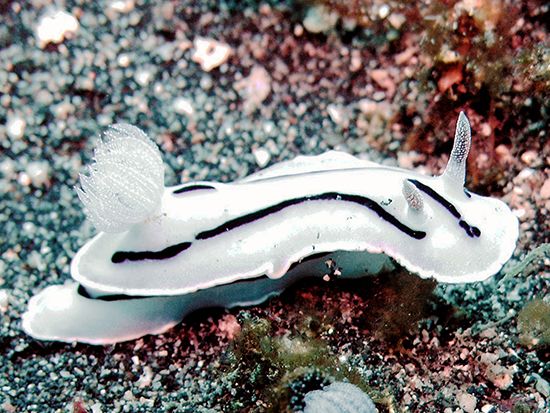
Nudibranchs employ several sophisticated strategies to defend themselves against predators, primarily relying on chemical defenses and specialized coloration.
How do nudibranchs defend themselves from predators?
Nudibranchs employ several sophisticated strategies to defend themselves against predators, primarily relying on chemical defenses and specialized coloration.
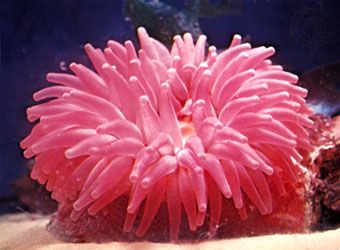
- Stolen Defenses: Many nudibranchs feed on cnidarians (such as sea anemones) and ingest their stinging capsules, known as nematocysts. They store these capsules within specialized dorsal outgrowths called cerata, which they can then discharge to sting and deter potential attackers.123
- Camouflage: Nudibranchs often utilize camouflage to blend into their surroundings. Some species, such as Phestilla melanobrachia, ingest the pigments of the coral they consume, depositing these colors into their gut or epidermis to achieve a near-perfect match with their host background.4
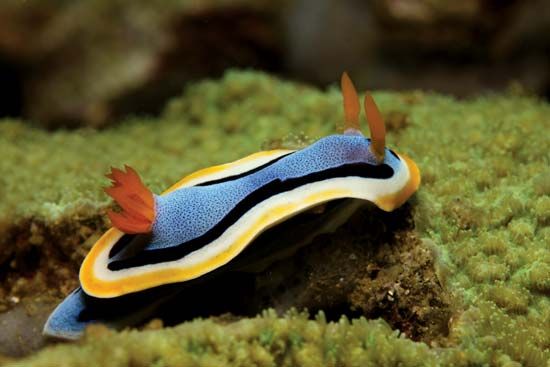
- Aposematism: Many nudibranchs exhibit bright, contrasting coloration, a form of aposematism. This serves as a warning to predators that the animal is noxious or distasteful, helping the nudibranch avoid attacks entirely by advertising its defensive capabilities.56
What are nudibranchs and how do they differ from other gastropods?
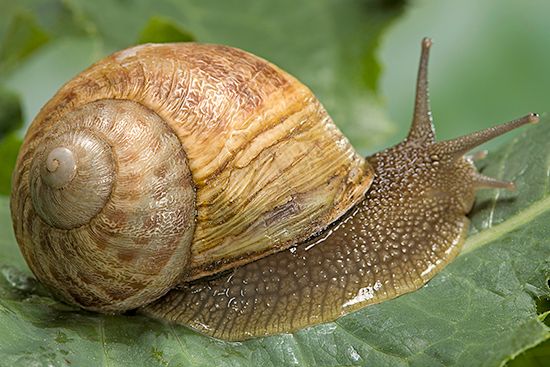
Nudibranchs are marine gastropods belonging to the order Nudibranchia within the subclass Opisthobranchia. While they share the characteristic radula—a feeding organ common to most mollusks—they are distinguished from many other gastropods by the absence of a shell, gills, and a mantle cavity in their adult form.48
They differ from other gastropods in several key ways:
- Morphology: Unlike many shelled gastropods, nudibranchs have evolved a “sluglike” form. They often feature bizarre dorsal outgrowths called cerata, which serve as respiratory surfaces and defensive tools.49
- Defensive Adaptations: Nudibranchs frequently ingest cnidarians and store their stinging nematocysts within their cerata to discharge against predators, a specialized defense not found in most other gastropod groups.4
- Torsion: While most gastropods undergo a developmental process called torsion, nudibranchs exhibit limited torsion or “detort” during metamorphosis, resulting in their mantle cavity (when present) being located at the side or rear of the body.8
- Reproduction: Nudibranchs are simultaneous hermaphrodites, possessing both male and female reproductive organs.8
What role do nudibranchs play in marine ecosystems?
In marine ecosystems, nudibranchs function primarily as specialized predators that help regulate populations of other invertebrates, particularly cnidarians such as sea anemones and hydroids.411
Their role in the ecosystem is defined by several key interactions:
- Predatory Control: By feeding on hydroids and sea anemones, nudibranchs act as a check on these populations. Some species are specialized enough to bite through the chitinous skeletons of hydroids or navigate their stinging tentacles to consume them.412
- Trophic Links: As predators of cnidarians, they occupy a specific niche in the marine food web. In turn, they are part of the diet of various marine organisms, though their own chemical defenses—often sequestered from their prey—serve to deter many potential predators.41112
- Biological Recycling: Through their consumption of cnidarians, nudibranchs participate in the transfer of energy and nutrients within shallow-water habitats, where they are most abundant.412
By sequestering undischarged nematocysts from their prey, nudibranchs demonstrate a unique evolutionary adaptation that allows them to survive and thrive in environments where they might otherwise be vulnerable to predation.1112
Where can nudibranchs be found and what types of habitats do they prefer?
Nudibranchs are found in the shallow waters of all the world’s oceans. They are primarily bottom-dwelling creatures that inhabit a variety of marine environments, ranging from cold northern seas to warm tropical waters.4
Their habitat preferences are largely dictated by the availability of their prey, as they feed chiefly on other invertebrates, particularly cnidarians like sea anemones and hydroids. While most species are bottom creepers that move along the seafloor using a large muscular foot, some, such as those in the family Tethyidae, have the ability to swim. Because they lack a protective shell in their adult form, they often rely on their specialized defensive adaptations—such as the ability to store stinging cells ingested from their prey—to survive in these diverse marine habitats.412
Sources
- mollusk - Features of defense — Encyclopædia Britannica
- coloration - Background matching — Encyclopædia Britannica
- Chemoreception - Predator chemical cues and prey escape — Encyclopædia Britannica
- nudibranch — Encyclopædia Britannica
- nematocyst — Encyclopædia Britannica
- aposematism — Encyclopædia Britannica
- coloration - Warning, or aposematic , coloration — Encyclopædia Britannica
- gastropod - Evolution and paleontology — Encyclopædia Britannica
- opisthobranch — Encyclopædia Britannica
- gastropod - Food and feeding — Encyclopædia Britannica
- cnidarian - Associations — Encyclopædia Britannica
- Sea Creature Words | Nudibranch — Merriam-Webster
- cnidarian - Ecology and habitats — Encyclopædia Britannica
Published on · 3 min read