Murex
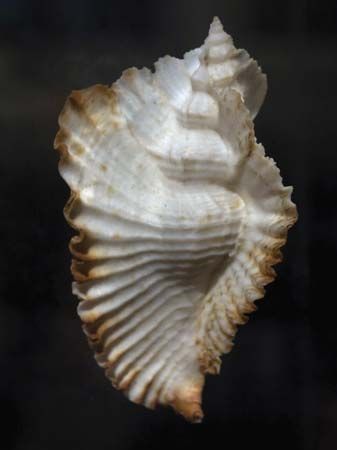
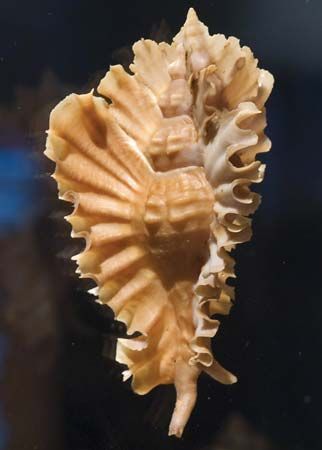
The murex family, known scientifically as Muricidae, consists of marine snails within the class Gastropoda. These mollusks are defined by several key…
What are the key characteristics that define the murex family of mollusks?
The murex family, known scientifically as Muricidae, consists of marine snails within the class Gastropoda. These mollusks are defined by several key characteristics:1
- Shell Morphology: They typically possess heavy or elongated shells that are elaborately ornamented with spines, frills, or knobs. These structures often serve as protection against predators.12
- Feeding Habits: Muricids are carnivorous predators. They feed by drilling holes through the shells of bivalves or other shelled animals, then inserting a long proboscis to ingest their prey. Some species use a specialized spine on the edge of their shell lip to wedge open the valves of clams.12
- Geographic Distribution: While found globally, they are most abundant in tropical seas. Those inhabiting rocky shallows are frequently referred to as rock shells or rock whelks.13
- Dye Production: Many species exude a yellow fluid that turns into a purple dye when exposed to sunlight. Historically, the Mediterranean Murex brandaris was the source of the prized royal Tyrian purple.14
How did the ancient Phoenicians use murex mollusks to create the famous Tyrian purple dye?
The ancient Phoenicians produced the highly prized Tyrian purple dye by extracting a secretion from the glands of Mediterranean sea snails, primarily Bolinus brandaris (formerly known as Murex brandaris).62
The process involved the following steps:
- Extraction: The color-producing substance is contained within a small cyst located near the head of the mollusk. Because each snail yielded only a minute amount of this puslike fluid, the production process was extremely labor-intensive; historical experiments have shown that approximately 12,000 snails were required to produce just 1.4 grams of the dye.62
- Development: Once extracted, the secretion was applied to textile materials, such as wool or linen. The characteristic purple-red color did not appear immediately; it developed only when the substance was exposed to sunlight.6
- Chemical Basis: The principal component of this dye is 6,6’-dibromoindigo, a derivative of indigo.62
Due to the immense effort required to harvest the snails and the resulting scarcity of the pigment, the dye was exceptionally costly. Consequently, garments colored with Tyrian purple became a symbol of imperial and royal status, reserved exclusively for the elite.62
What are some notable species within the murex family, and how do they differ?
The family Muricidae encompasses a diverse range of marine snails, each adapted to specific environments and ecological niches. While they share the characteristic of having elaborately ornamented, spined, or frilled shells, they differ significantly in appearance and behavior.19
Notable species and groups within the family include:
- Dye Murex (Murex brandaris): Native to the Mediterranean, this species is historically significant for the yellow fluid it secretes, which transforms into the royal Tyrian purple dye when exposed to sunlight.1
- Venus Comb (M. pecten): Found in the Indo-Pacific, this striking white snail is defined by its long, slender spines that line its shell, reaching up to 15 cm (6 inches) in length.110
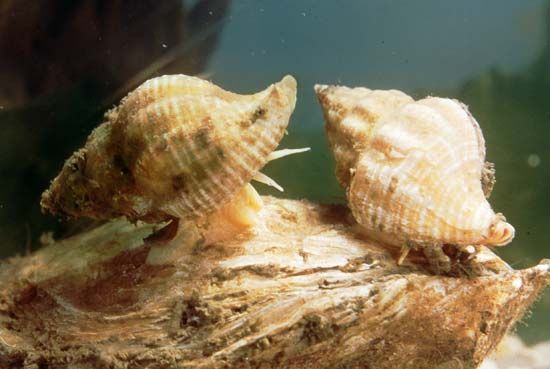
- Oyster Drill (Urosalpinx cinerea): Unlike the more ornamental species, this mollusk is known as a pest in oyster beds, where it uses its radula to drill into the shells of bivalves to feed.1
- Dogwinkles or Dog Whelks (Nucella): These species resemble periwinkles and are typically found feeding on mussels and barnacles.1
- Drupes (Drupa, Acanthina): These are colorful shells primarily found in the Indo-Pacific region.1
- Dwarf Tritons (genus Ocenebra): Similar to the oyster drill, these are often considered pests in commercial shellfish beds.1
What is the taxonomic classification of the murex family within the mollusk phylum?
The murex family, known as Muricidae, is classified within the phylum Mollusca. Within this phylum, its taxonomic hierarchy is as follows:
- Class: Gastropoda (snails and slugs)
- Subclass: Prosobranchia
- Order: Neogastropoda (also referred to as Stenoglossa)
- Superfamily: Muricacea
- Family: Muricidae
It is important to distinguish the family Muricidae (marine snails) from the family Muridae, which is the largest family of rodents and includes true mice and rats.1110
Sources
- murex — Encyclopædia Britannica
- dye - Natural dyes — Encyclopædia Britannica
- gastropod - The shell — Encyclopædia Britannica
- Animal reproductive system - Annelids and mollusks — Encyclopædia Britannica
- murex — Merriam-Webster
- purple — Encyclopædia Britannica
- Tyrian purple — Encyclopædia Britannica
- Tyrian purple — Merriam-Webster
- bivalve - Size range and diversity of structure — Encyclopædia Britannica
- Muricidae — Merriam-Webster
- muricid — Merriam-Webster
- Venus's-comb — Merriam-Webster
- gastropod - Classification — Encyclopædia Britannica
- Muridae — Encyclopædia Britannica
Published on · 3 min read