Moose
Moose (Alces alces) are the largest members of the deer family and are characterized by several distinct physical features:
What are the distinctive physical characteristics of moose?
Moose (Alces alces) are the largest members of the deer family and are characterized by several distinct physical features:
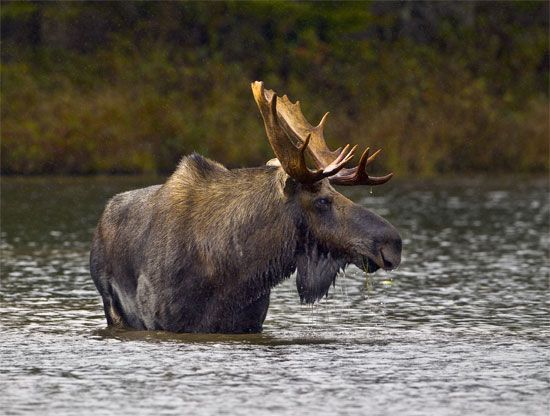
- Size and Build: They are known for their towering stature, with some bulls reaching 2 metres (7 feet) at the shoulder and weighing up to 600 kg (1,300 pounds) in larger subspecies. They possess long legs and a black-colored coat.1
- Muzzle and Bell: Moose have a large, mobile, and sensitive muzzle, which serves as a specialized organ for feeding on submerged aquatic vegetation. They also feature a dangling, hairy dewlap under the throat, commonly referred to as a bell.1
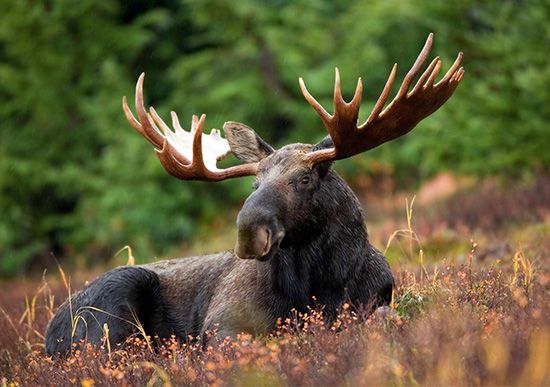
- Antlers: Old bulls are distinguished by their immense, wide, and flat antlers. These are solid, bony outgrowths of the frontal bones that are shed and regrown annually. During their growth phase, they are covered in a fine-haired skin known as velvet. Antlers are primarily secondary sex characteristics used by males for fighting and territorial marking during the rutting season.123
Where are moose typically found in the wild, and what is their preferred habitat?
Moose (Alces alces) are widely distributed across the northern regions of North America and Eurasia. Their habitat preferences are closely tied to their dietary needs and the availability of specific plant communities.14
Preferred Habitat
Moose primarily inhabit areas that provide abundant food sources, particularly deciduous shrubs and woody plants. They favor environments that have been disturbed by natural or human-driven events, such as:14
- Forest Disturbances: They thrive in areas affected by forest fires, avalanches, or flooding, which encourage the growth of early successional vegetation.14
- River Floodplains: The shrub zones along river floodplains are high-quality feeding areas for moose.4
- Wetlands and Waterways: In the summer, moose are frequently found near shallow lakes and streams, where they consume large quantities of aquatic vegetation.14
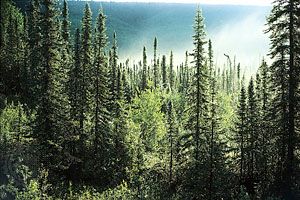
- Taiga Forests: They are significant browsing animals within the taiga, where they rely on twigs and buds during the winter months.4
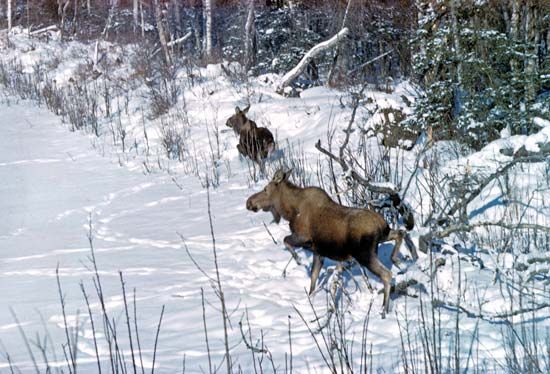
In regions with deep snow, moose may establish a system of trails known as a “moose yard” to navigate their environment more effectively. They generally prefer hard, level ground for maneuverability, especially when defending themselves against predators.1
How do moose adapt to survive in cold climates?
Moose (Alces alces) have developed several behavioral and physiological strategies to survive in the harsh, cold climates of the northern taiga and boreal regions. Their survival is primarily driven by their ability to maintain energy balance and navigate deep snow.14
Behavioral Adaptations
- Moose Yards: In areas with deep snow, moose create a system of packed trails known as a “moose yard.” This allows them to move more efficiently and conserve energy by avoiding the need to wade through deep, powdery snow.1
- Habitat Selection: During winter, moose seek out specific environments that offer both protection and food. They often move to dense conifer stands to shelter from the elements and protect their vulnerable lower haunches from predators. When threatened, they strategically choose hard, level ground—such as wind-swept ridges or frozen lakes—where they have better maneuverability to defend themselves.1
- Dietary Shifts: To maintain their energy balance, moose shift their feeding habits in winter to consume large quantities of woody twigs and buds from conifers like fir and yew, as well as other available woody plants.14
Physiological Resilience
As warm-blooded (endothermic) mammals, moose utilize internal thermoregulation to maintain a constant core body temperature. This involves complex neural and physiological processes, such as regulating blood flow to the skin and utilizing metabolic energy to generate heat. Unlike some smaller mammals that hibernate, moose remain active throughout the winter, relying on their large body size and efficient foraging to survive the cold.516
What is a moose?
The moose (Alces alces) is the largest member of the deer family, Cervidae. These animals are easily recognized by their towering size, dark coloration, long legs, pendulous muzzle, and a dangling hairy dewlap known as a bell. Old bulls are particularly noted for their immense, wide, and flat antlers.11
The name “moose” is common in North America and is derived from the Algonquian word moosh, meaning “stripper and eater of bark.” In Europe, these animals are referred to as elk.8
Moose are found across the northern regions of North America and Eurasia. They are highly adapted to their environments, utilizing their specialized muzzles to feed on aquatic vegetation in shallow waters and browsing on deciduous shrubs and conifers. While they are powerful and capable of defending themselves against large predators like wolves and bears, they are also valued as a game animal and have a long history of interaction with human populations.8
Sources
- moose — Encyclopædia Britannica
- Sex - Sex differences in animals — Encyclopædia Britannica
- artiodactyl - Horns and antlers — Encyclopædia Britannica
- Taiga - Mammals — Encyclopædia Britannica
- Dormancy - Types of hibernation in mammals — Encyclopædia Britannica
- artiodactyl - Migration — Encyclopædia Britannica
- Thermoreception - Behaviour and thermoregulation — Encyclopædia Britannica
- moose — Merriam-Webster
Published on · 4 min read