Taiga
Organisms in the taiga have evolved specialized adaptations to survive long, cold winters and short growing seasons.
How do plants and animals adapt to survive in the harsh taiga environment?
Organisms in the taiga have evolved specialized adaptations to survive long, cold winters and short growing seasons.1
Plant Adaptations
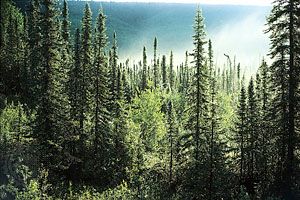
The taiga is dominated by conifers like pine, spruce, and fir, which are well-suited to the environment. Their needle-like or scale-like leaves help conserve water and withstand harsh conditions. Many of these trees are evergreen, allowing them to begin photosynthesis as soon as temperatures permit. Furthermore, species adapted to the cold exhibit high photosynthetic efficiency at cool temperatures, which maximizes biomass gain during the brief summer. Some conifers also rely on forest fires to clear the understory and stimulate seed germination.1234
Animal Adaptations
Animals have developed physical and behavioral strategies to manage the cold and deep snowpack:
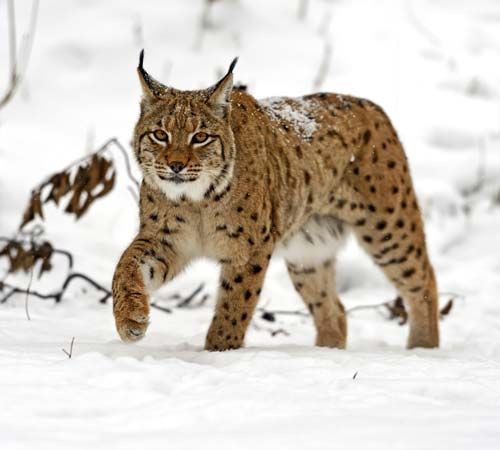
- Camouflage and Mobility: The snowshoe hare changes its fur color to white in winter for camouflage and possesses large feet that act like snowshoes to traverse deep snow. The lynx shares this large-foot adaptation to hunt effectively.5
- Migration and Foraging: Caribou and reindeer migrate long distances to find food, grazing on lichens during winter. Moose survive by browsing on woody twigs and buds when other food sources are scarce.5
What indigenous cultures have traditionally lived in taiga regions?
Indigenous cultures have traditionally inhabited the taiga (boreal forest) regions of North America and Eurasia for millennia, developing sophisticated subsistence strategies adapted to the northern environment.
North American Subarctic Peoples
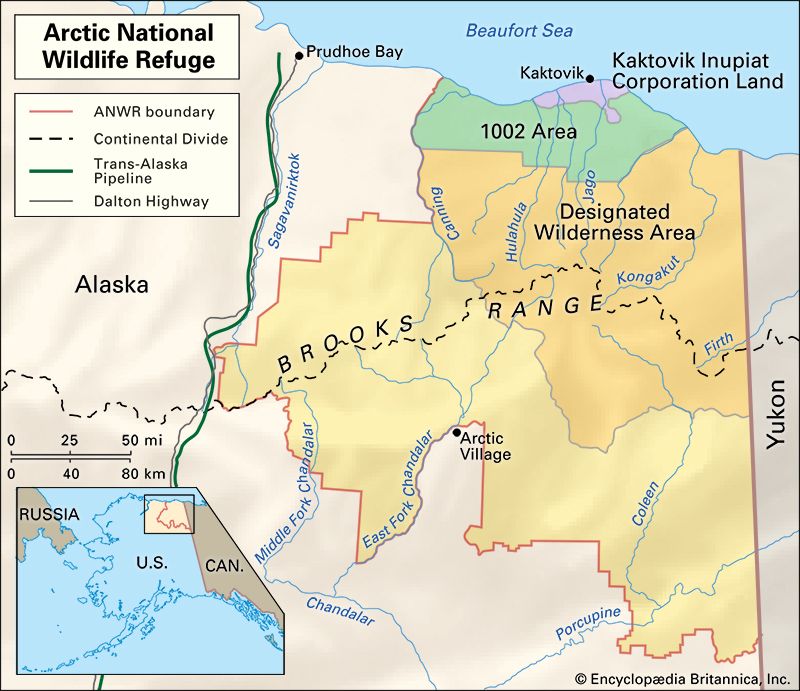
In the North American Subarctic, which encompasses much of Canada and Alaska, Indigenous groups traditionally organized into small, kin-based bands. These societies relied on hunting, trapping, and fishing, with moose, caribou, and beaver serving as primary resources. Prominent groups include:
- Athabaskan-speaking peoples: Such as the Denesuline, Dane-zaa, Dene Tha’, Carrier, Gwich’in, Tanaina, and Deg Xinag.6
- Algonquian-speaking peoples: Including the Innu (Montagnais and Naskapi), Cree, and Ojibwe.6
Eurasian Indigenous Peoples
In northern Eurasia, Indigenous groups often inhabit the taiga year-round or migrate between the forest and tundra. Their traditional livelihoods focus on hunting, fishing, and reindeer husbandry. Key groups include:7
- Sami: The Indigenous inhabitants of northern Fennoscandia, traditionally known for hunting, trapping, and, in mountainous areas, nomadic reindeer pastoralism.8
- Siberian Groups: Including the Nenets, Nganasan, Enets, Khanty, Mansi, Selkup, and Ket. These groups have historically combined fishing and hunting with varying degrees of reindeer husbandry.8
- Komi-Zyryan: Inhabitants of the region west of the Ural Mountains, who have long practiced a mix of farming, cattle keeping, and reindeer herding.8
How does climate change affect the taiga ecosystem?
Climate change significantly impacts the taiga (boreal forest) ecosystem, primarily through rising temperatures that alter its physical and biological stability.
Permafrost Thaw and Carbon Release
A critical concern is the degradation of permafrost, which underlies much of the taiga. As temperatures rise, this frozen ground thaws, exposing long-stored organic matter to microbial decomposition. This process releases significant amounts of carbon dioxide and methane into the atmosphere, potentially creating a positive feedback loop that accelerates global warming.112
Shifts in Vegetation and Albedo
Warming trends are causing shifts in vegetation, including the northward migration of tree species into areas previously dominated by tundra. While increased plant productivity from longer growing seasons may sequester some carbon, the replacement of light-colored, reflective snow and ice with darker coniferous trees reduces the Earth’s albedo. This change causes the surface to absorb more solar radiation, further intensifying local warming.1
Increased Disturbance
Climate change is also linked to more frequent and severe wildfires. Hotter, drier summers increase the risk of large-scale burns, which remove insulating layers of moss and litter, further promoting permafrost thaw and altering forest regeneration patterns.131
What is the taiga biome and where is it typically found?
The taiga, also known as the boreal forest, is a major biome characterized by long, cold winters and short, cool growing seasons. The name, which means “land of the little sticks” in Russian, refers to the northern forests of Siberia and describes a landscape dominated by cone-bearing evergreen trees, such as pine, spruce, larch, and fir.63
Distribution
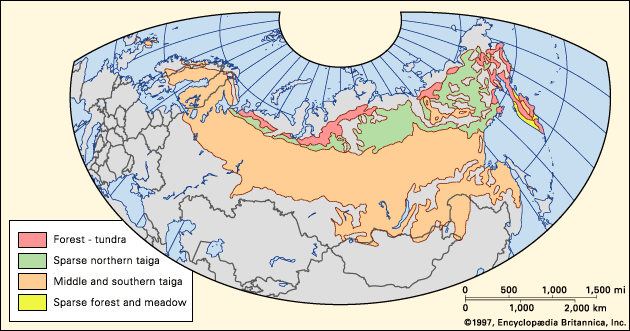
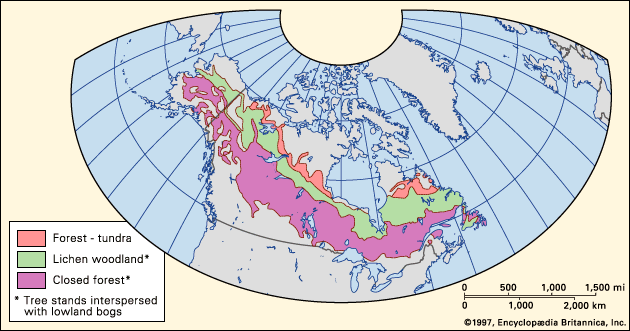
The taiga forms a vast, circumpolar belt across the far Northern Hemisphere, occupying approximately 17 percent of Earth’s land surface. Its typical locations include:6
- North America: It spans much of Canada and Alaska.1
- Eurasia: It extends across Russia, including Siberia, and reaches into northern Finland, Sweden, and Norway, as well as parts of China and Mongolia.1
The biome is generally situated between the tundra to the north and temperate forests or grasslands to the south. Its boundaries are largely determined by temperature, specifically the warmth of the growing season and the severity of winter cold.163
Sources
- Taiga - Climate — Encyclopædia Britannica
- Taiga - Mammals — Encyclopædia Britannica
- Taiga — Encyclopædia Britannica
- conifer - Sporophyte phase — Encyclopædia Britannica
- gymnosperm - Pinophyta — Encyclopædia Britannica
- Taiga - Distribution — Encyclopædia Britannica
- Arctic - Ethnic composition — Encyclopædia Britannica
- Arctic - Peoples of Fennoscandia and northwestern Siberia — Encyclopædia Britannica
- Native American - The Subarctic — Encyclopædia Britannica
- Native American - The Arctic — Encyclopædia Britannica
- American Subarctic peoples - Territorial organization — Encyclopædia Britannica
- Taiga - Soils — Encyclopædia Britannica
- Taiga - Origin — Encyclopædia Britannica
- Taiga - Natural disturbances — Encyclopædia Britannica
- Tundra - Effects of human activities and climate change — Encyclopædia Britannica
- Taiga - Biological productivity — Encyclopædia Britannica
Published on · 4 min read