Mount Agung
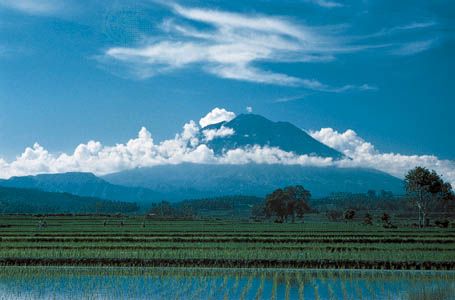
Mount Agung is a volcano located in the northeastern region of Bali, an island and province of Indonesia.
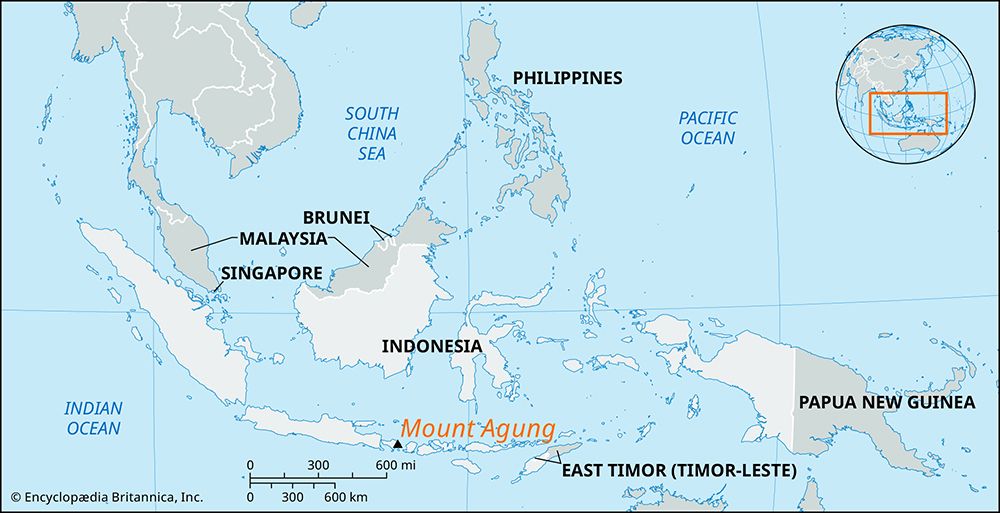
What is the geographical location of Mount Agung in Indonesia?
Mount Agung is a volcano located in the northeastern region of Bali, an island and province of Indonesia.1
Standing at 9,888 feet (3,014 meters), it is the highest point on the island and holds significant cultural and religious importance for the Balinese people, who consider it the “Navel of the World.” The island’s mother temple, Pura Besakih, is situated directly on its slopes.1
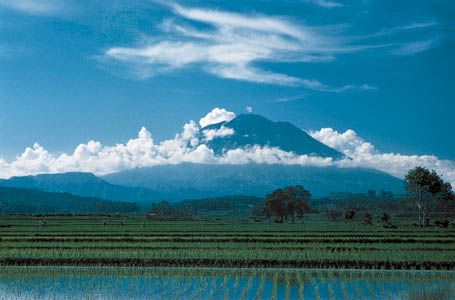
What is the cultural and religious significance of Mount Agung to the Balinese people?
Mount Agung holds profound spiritual importance for the Balinese people, who revere it as the “Navel of the World.”1
The mountain is central to Balinese cosmology and Hinduism on the island. According to local myths, the deities created the mountain as a throne or placed it upon Bali to stabilize the island, which was previously considered unstable and wobbling.1
This deep reverence is reflected in daily religious life:
- Temples: Every Balinese temple features a shrine dedicated to the spirit of the mountain.1
- Pura Besakih: The island’s mother temple is situated directly on the slopes of the volcano.1
- Symbolism: Religious objects, including cremation mounds and temple offerings, are frequently crafted in the shape of mountains to honor the volcano.1
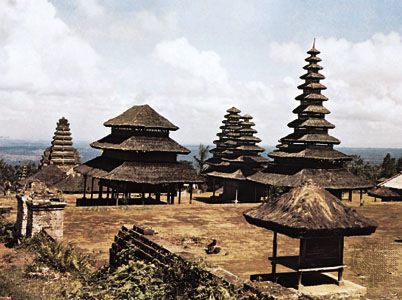
How tall is Mount Agung, and how does it compare to other volcanoes in Indonesia?
Mount Agung rises to an elevation of 10,308 feet (3,142 meters). While it is the highest and most sacred point on the island of Bali, it is not the tallest volcano in Indonesia.12
Several other Indonesian volcanoes exceed Mount Agung in height, including:
- Kerinci (Sumatra): 12,467 feet (3,800 meters)1
- Rinjani (Lombok): 12,224 feet (3,726 meters)1
- Semeru (Java): 12,060 feet (3,676 meters)1
- Slamet (Java): 11,247 feet (3,428 meters)1
- Raung (Java): 10,932 feet (3,332 meters)1
Mount Agung remains a prominent landmark within the region, though it is surpassed in elevation by these major peaks across the Indonesian archipelago.1
How do local myths and legends incorporate Mount Agung into their narratives?
In Balinese mythology, Mount Agung is central to the island’s creation and stability. One prominent legend describes the deities creating mountains to serve as their thrones, selecting Mount Agung as the highest and placing it specifically in Bali.1
Another narrative explains that the island of Bali was originally unstable and prone to wobbling. To anchor and still the land, the deities transported the holy mountain of Hinduism, known as Mahameru, and set it down upon the island, where it was renamed Gunung Agung.1
These myths have deeply influenced Balinese culture, establishing the volcano as the “Navel of the World.” This reverence is physically manifested in daily life, as every Balinese temple includes a shrine dedicated to the mountain’s spirit, and sacred items like cremation mounds and temple offerings are traditionally shaped to resemble the peak.1
Sources
- Mount Agung — Encyclopædia Britannica
- world’s major volcanoes — Encyclopædia Britannica
- Asia - The islands — Encyclopædia Britannica
Published on · 2 min read