Mount Stanley
Mount Stanley is a prominent mountain located in the Ruwenzori Range along the border between the Democratic Republic of the Congo and Uganda in east-central…
What is Mount Stanley?
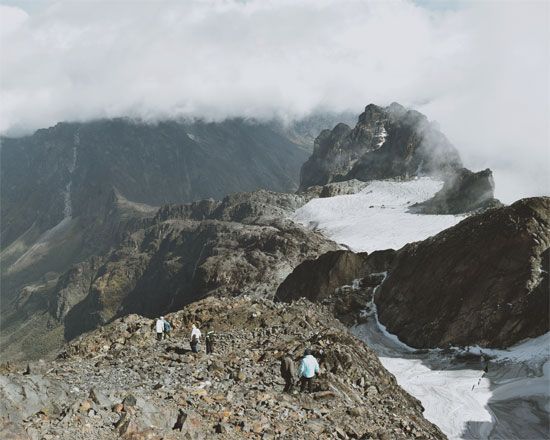
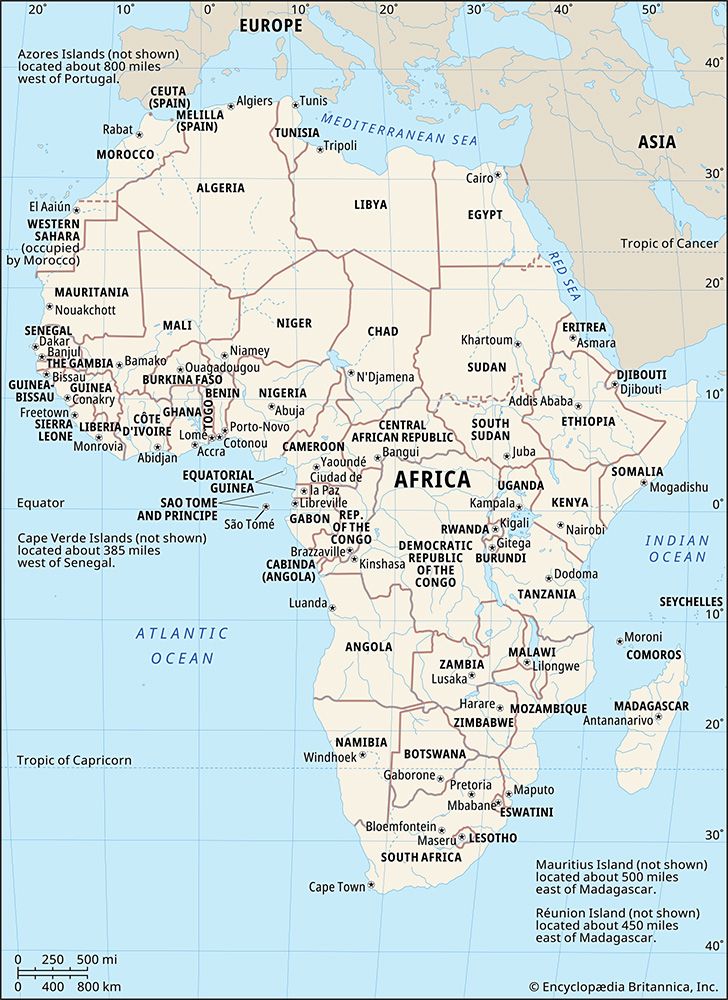
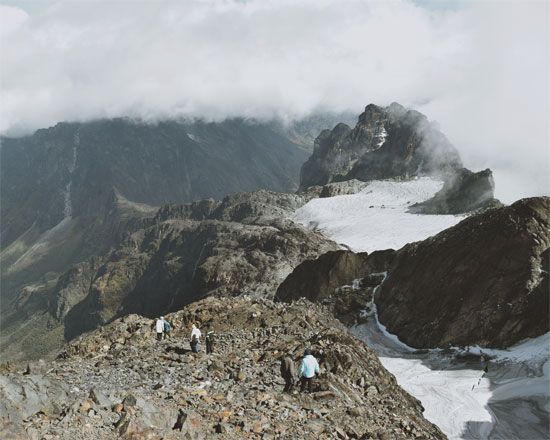
Mount Stanley is a prominent mountain located in the Ruwenzori Range along the border between the Democratic Republic of the Congo and Uganda in east-central Africa. It serves as the highest mountain in the range and features nine of the ten peaks that exceed 16,000 feet (4,900 meters) in elevation.12
The mountain’s highest point is Margherita Peak, which reaches an elevation of 16,762 feet (5,109 meters). The landscape is characterized by the presence of glaciers and glacial lakes. The range was first reached by a European in the late 1880s, the explorer Henry Morton Stanley, for whom the mountain is named. It is also known as Mount Ngaliema.12
What is the significance of Margherita Peak?
Margherita Peak holds significant status as the highest summit of the Ruwenzori Range and the third-highest peak in Africa, surpassed only by Mount Kilimanjaro and Mount Kenya.3
Located on the border between the Democratic Republic of the Congo and Uganda, it serves as the primary summit of Mount Stanley. Rising to an elevation of 16,795 feet (5,119 meters), the peak is historically notable for its 1906 first ascent, which was achieved by an expedition led by the Italian Luigi Amedeo, Duke of Abruzzi. The summit was named in honor of Queen Margherita of Italy.34
How do glaciers exist in central Africa?
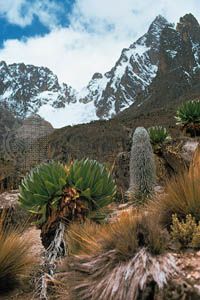
Glaciers exist in central Africa because of the extreme elevation of specific mountain ranges, which creates a mountain climate distinct from the surrounding tropical lowlands. Even though these mountains are located near the Equator, temperatures decrease significantly with altitude, allowing for the formation of permanent ice at the highest peaks.5678
In the Ruwenzori Range, for example, the permanent snow line is found at approximately 14,800 feet (4,511 meters) on the east and 15,900 feet (4,846 meters) on the west. These high-altitude zones remain cold enough to sustain glaciers despite their equatorial latitude. The presence of these ice masses is further supported by moisture-bearing airstreams from the Atlantic and Indian oceans, which frequently shroud the summits in cloud cover and provide the necessary precipitation.98
While these relict glaciers are currently experiencing a period of rapid retreat, they remain a defining feature of the summit zones on Mount Stanley, Mount Kenya, and Kilimanjaro.5
Who was Henry Morton Stanley?
Henry Morton Stanley (1841–1904) was a Welsh-born British-American explorer and journalist best known for his expeditions in central Africa and his role in the development of the Congo region.10
Born John Rowlands, he adopted the name Henry Morton Stanley after moving to the United States. He gained international fame in 1871 for his successful search for the missing missionary David Livingstone, famously greeting him with the words, “Dr. Livingstone, I presume?”10
Following Livingstone’s death, Stanley continued to explore the African interior, confirming the geography of Lake Victoria and identifying the Congo River as the major waterway of the region. His work in the Congo basin later paved the way for the creation of the Congo Free State under King Leopold II. During his final African expedition, he became the first European to reach the Ruwenzori Range, which now includes Mount Stanley, a peak named in his honor.101
Sources
- Mount Stanley — Encyclopædia Britannica
- Stanley, Mount — Merriam-Webster
- Margherita Peak — Encyclopædia Britannica
- mountaineering - History — Encyclopædia Britannica
- East African mountains - Physiography — Encyclopædia Britannica
- Ruwenzori Range — Encyclopædia Britannica
- glacier: Top Questions — Encyclopædia Britannica
- Africa - Factors influencing the African climate — Encyclopædia Britannica
- Africa - Climatic regions — Encyclopædia Britannica
- Henry Morton Stanley — Encyclopædia Britannica
Published on · 2 min read