Negev
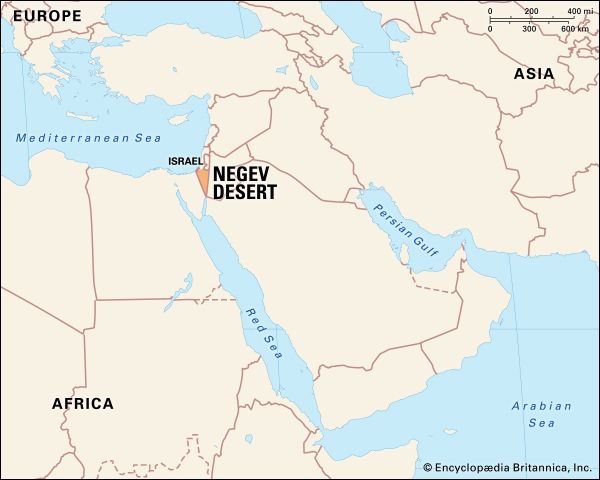
The economy of the Negev region is primarily driven by modern agriculture and the extraction of mineral resources.
What are the main economic activities in the Negev region?
The economy of the Negev region is primarily driven by modern agriculture and the extraction of mineral resources.
Agriculture
Following the implementation of large-scale irrigation projects and the National Water Plan, the northwestern Negev has become a productive agricultural area. Utilizing fertile loess soils and year-round sunlight, the region produces:
- Grains and fodder
- Fruits and vegetables
- Flowers and industrial crops
Mining and Industry
The region is rich in mineral deposits, which support significant industrial activity:
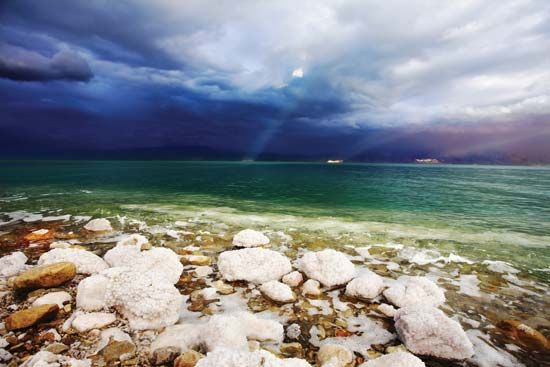
- Mineral Extraction: Potash, bromine, and magnesium are extracted at the Dead Sea, while copper is mined at Timnaʿ.
- Industrial Materials: The region contains deposits of ball clay and glass sand used in the ceramic and glass industries.
- Energy and Chemicals: Phosphate works operate at Oron and Zefaʿ, and natural gas is produced at fields near Beersheba.
How has the Negev been used for scientific research and technological innovation?
The Negev region has become a significant hub for scientific research and technological innovation, primarily centered in the city of Beersheba.
Research and Academic Institutions
Beersheba serves as the primary base for these efforts, hosting the Ben-Gurion University of the Negev, which plays a central role in the region’s intellectual and scientific development. Additionally, the city is home to the Negev Institute for Arid Zone Research, which focuses on the unique challenges and opportunities presented by the desert environment.1
Technological Innovation
The region has evolved into a major center for research and development, with a strong emphasis on:
- Cybersecurity and Aerospace: Beersheba is recognized as a national hub for these high-tech industries.1
- Agricultural Technology: To address the scarcity of water, researchers have perfected drip-irrigation methods that optimize water and fertilizer use. Ongoing efforts include expanding desert farming by utilizing underground brackish water and exploring desalination technologies.5
What are the main geological features and formations found in the Negev desert?
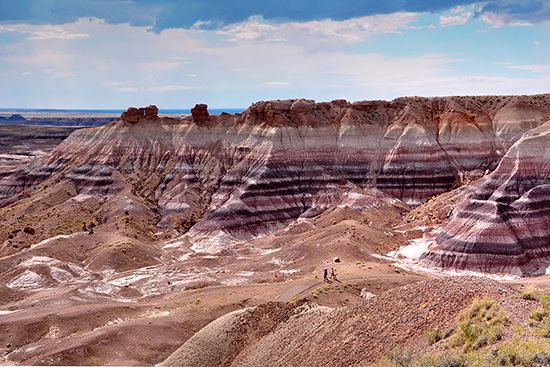
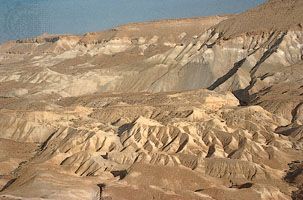
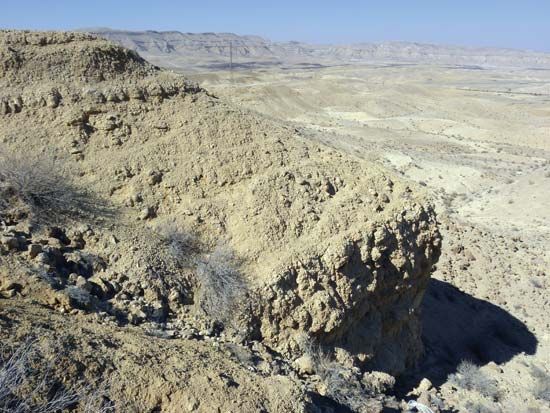
The Negev desert is characterized by a complex geological landscape defined by northeast–southwest folds and frequent faulting. The region is primarily composed of limestones and chalks.1
Key Geological Features
- Makhteshim (Erosion Craters): A unique feature of the region, these large, elongate craters are surrounded by high cliffs. They were formed through the erosion of upward-folded strata (anticlines) combined with horizontal stresses. Notable examples include Makhtesh Ramon and Ha-Makhtesh Ha-Gadol. The floors of these craters often expose geological materials—such as marls and gypsums—that are significantly older than the surrounding plateaus.1
- Wadis and Canyons: The rugged terrain is heavily dissected by wadis, or seasonal watercourses, which are prone to flash flooding during the winter rainy season.1
- Sandstone Hills: As the region narrows toward the south, the landscape transitions into sandstone hills, canyons, and cliffs before reaching the Arava Valley.6
- Loess Soils: The northwestern portion of the region features extensive deposits of fertile loess soil.1
How have Bedouin communities adapted to life in the Negev, and what challenges do they face today?
Bedouin communities in the Negev have historically adapted to the arid environment through a nomadic lifestyle centered on animal herding, primarily sheep and goats. Traditionally, these groups migrated seasonally to follow grazing lands and water sources, maintaining a tribal and patriarchal social structure led by a sheikh and a council of elders.7
Adaptation and Modernization
Over the last century, the traditional way of life has undergone significant transformation due to the expansion of state authority and modernization:
- Sedentarization: Many Bedouin have transitioned to sedentary or semisedentary lifestyles, either voluntarily or in response to government settlement programs and the nationalization of rangelands.7
- Technological Integration: Modern technology has replaced traditional methods; for instance, motor vehicles are now commonly used for transporting livestock, fodder, and water, replacing traditional animal-based transport.78
- Economic Shifts: While many continue to maintain ties to their heritage, Bedouin individuals have increasingly integrated into the broader economy, finding employment in construction, industry, and military or police forces.78
Challenges Today
Bedouin communities face ongoing pressures as they navigate the tension between traditional customs and modern state requirements. The limitation of tribal mobility due to defined international and regional boundaries has restricted traditional grazing practices. Furthermore, as populations have grown, the lack of consistent representation in official statistics and the transition to urban or village-based living have created complex challenges regarding land rights, access to public services, and the preservation of tribal social structures in a rapidly changing society.78
Sources
- Negev — Encyclopædia Britannica
- Israel - Manufacturing — Encyclopædia Britannica
- Israel - Agriculture, forestry, and fishing — Encyclopædia Britannica
- Israel - Mineral resources — Encyclopædia Britannica
- Beersheba — Encyclopædia Britannica
- Israel - Relief — Encyclopædia Britannica
- Bedouin — Encyclopædia Britannica
- Arabian Desert - People of the Arabian Desert — Encyclopædia Britannica
Published on · 3 min read