Ocean Current
Scientists study and measure ocean currents using two fundamental approaches: the Lagrangian and Eulerian methods, alongside indirect estimation techniques.
How do scientists study and measure ocean currents?
Scientists study and measure ocean currents using two fundamental approaches: the Lagrangian and Eulerian methods, alongside indirect estimation techniques.1
Measurement Methods
- Lagrangian Method: This approach tracks individual parcels of water using floats or buoys. Surface currents are often monitored via satellite-tracked buoys, while subsurface currents are tracked acoustically using neutrally buoyant floats.12
- Eulerian Method: This involves measuring the velocity of water flow as it passes a fixed point, such as a moored ship or an anchored line, using a current meter. Modern instruments like the Vector Averaging Current Meter (VACM) use solid-state microelectronics to record speed and direction with high precision.21
- Indirect Techniques: Scientists can estimate currents by calculating water density from temperature and salinity observations to determine pressure gradients. The geostrophic method also allows researchers to compute expected flow rates by balancing pressure gradients with gravity and Coriolis forces.21
Additionally, specialized tools like Doppler-sonar systems measure velocity by analyzing sound scattered off drifting organisms, while numerical modeling helps simulate fluid flow dynamics.21
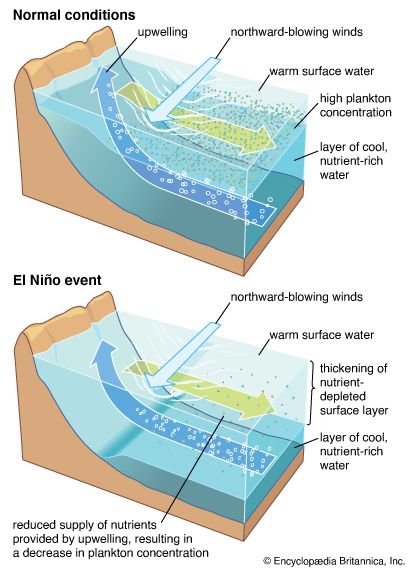
What are upwelling and downwelling in ocean currents, and why are they important?
Upwelling and downwelling are vertical movements of seawater that play a critical role in the global ocean circulation system and the distribution of marine life.3
Definitions and Mechanisms
- Upwelling: This process occurs when surface waters diverge, drawing nutrient-rich, colder water from the depths into the sunlit surface layer. It is often driven by Ekman transport, where wind-induced surface currents move water away from a coastline or a divergence zone, forcing deeper water to rise to replace it.4
- Downwelling: This occurs in regions of convergence, where surface waters accumulate and are forced downward. This process pushes surface water into the deeper water column, effectively transporting heat and dissolved gases to greater depths.4
Importance
The significance of these vertical movements lies in their impact on biological productivity and climate regulation:
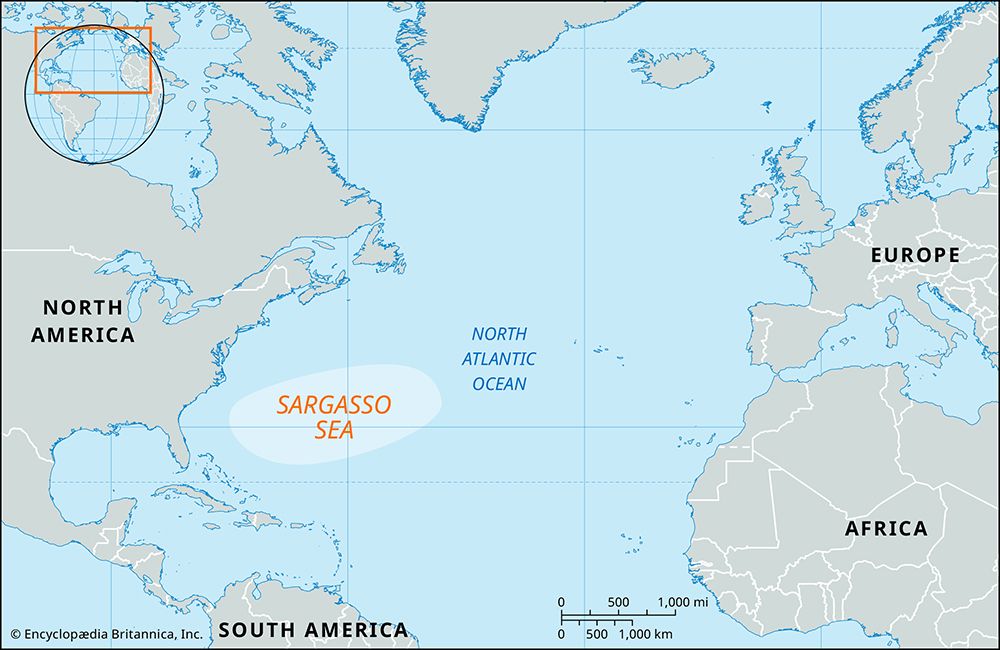
- Biological Productivity: Upwelling regions are among the most productive in the world because they replenish surface nutrients, fueling the growth of phytoplankton and supporting rich fisheries, such as those off the coasts of Peru and California. Conversely, downwelling regions, like the Sargasso Sea, are typically nutrient-poor and support less marine life.54
- Climate and Circulation: These processes extend wind-driven effects into deeper waters and help create baroclinic fields of mass, which influence large-scale geostrophic currents. By exchanging water of varying temperatures and salinities, they are essential components of global heat and freshwater fluxes.43
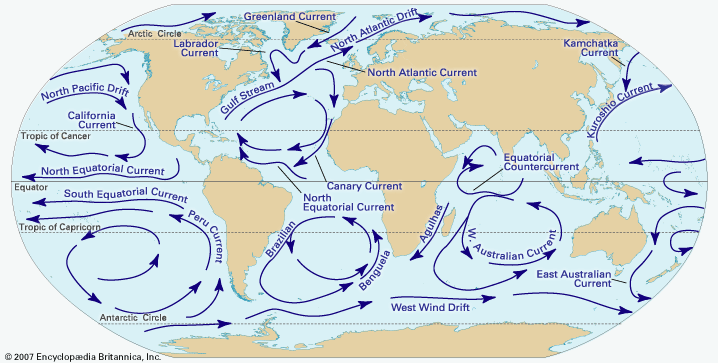
What are the main types of ocean currents?
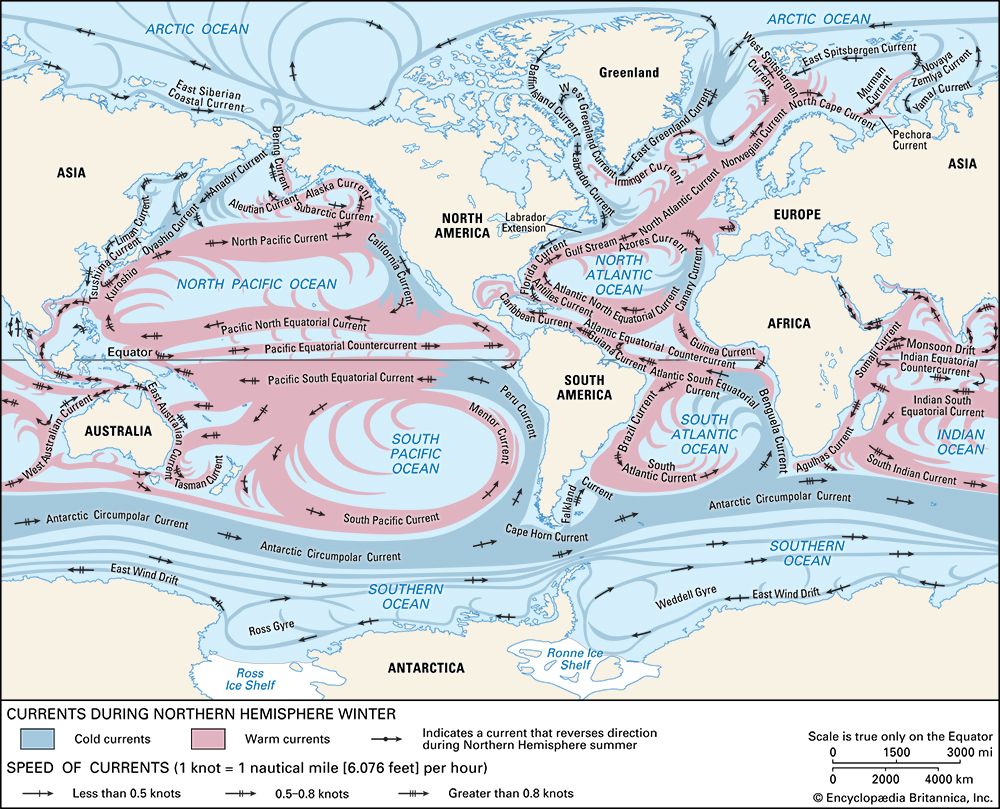
Ocean currents are primarily categorized into two main types based on the forces that drive them: wind-driven circulation and thermohaline circulation.7
Wind-Driven Circulation
This type of circulation dominates the surface layer of the ocean and is the most vigorous form of movement. It is driven by wind stress, which sets surface water in motion.78
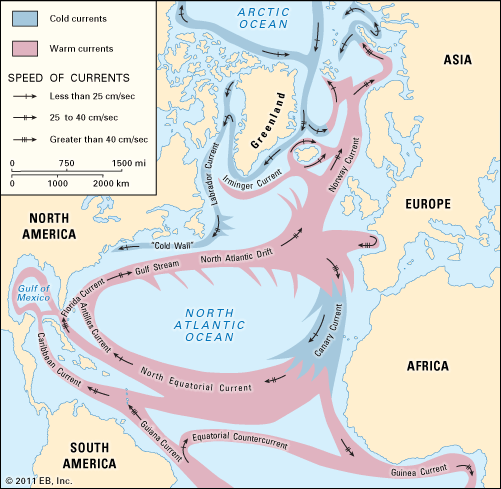
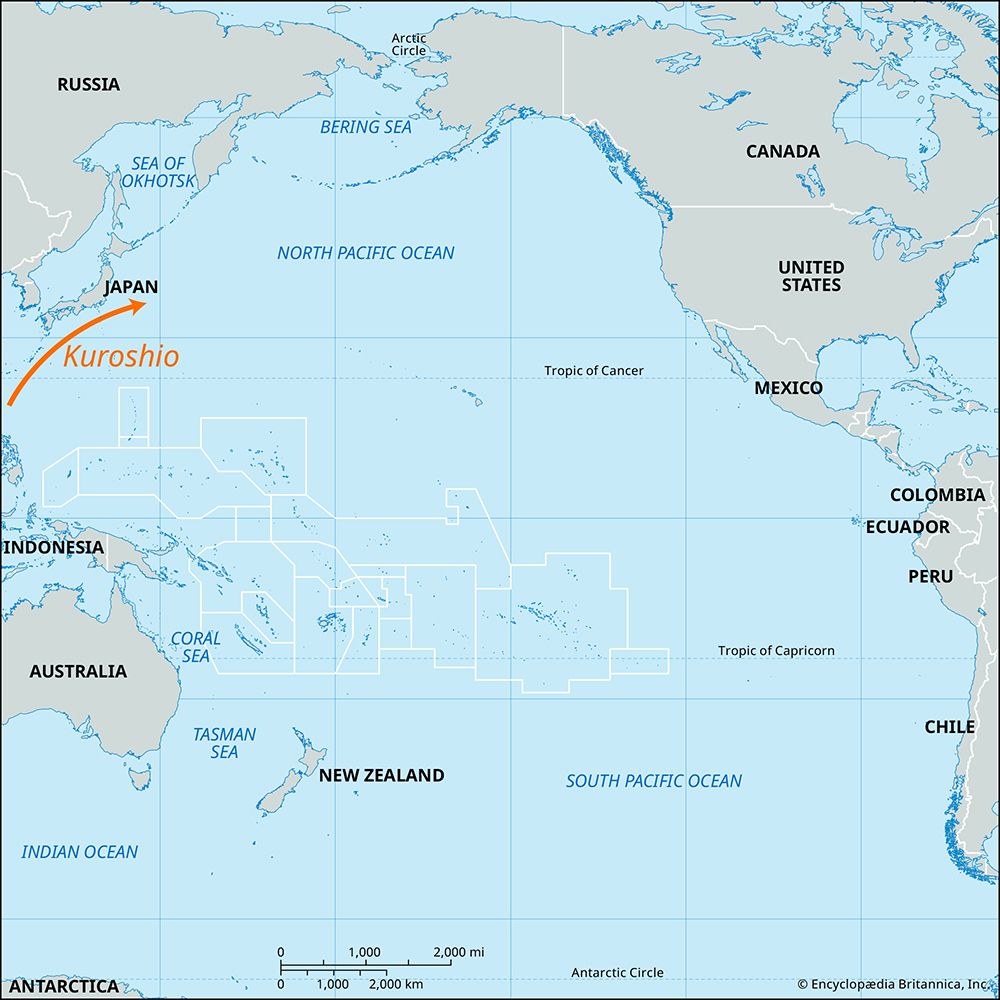
- Gyres: Large, anticyclonic current cells that spiral around a central point. These systems form strong boundary currents, such as the Gulf Stream in the North Atlantic and the Kuroshio in the North Pacific.9
- Ekman Transport: Wind stress causes surface water to move at an angle to the wind direction. Variations in this transport create convergence and divergence zones, leading to vertical movements known as upwelling and downwelling.8
Thermohaline Circulation
Often referred to as the “global conveyor belt,” this circulation is much slower and is driven by horizontal differences in temperature and salinity.7
- Mechanism: Cooling or evaporation increases the density of surface water in polar regions, causing it to sink and spread into the deep ocean.7
- Global Impact: This process replaces deep water with surface water and vice versa, transporting heat and nutrients across vast distances and moderating global climates.7
How do the Coriolis effect and wind patterns influence ocean currents?
Wind patterns and the Coriolis effect are the primary drivers of surface ocean circulation. Together, they dictate the speed, direction, and structure of currents across the globe.65
The Role of Wind Patterns
Wind exerts stress on the ocean surface, setting the top layer of water in motion in the direction of the wind. This interaction creates the Ekman layer, a surface layer roughly 100 meters deep where the movement of water is influenced by both wind stress and the Earth’s rotation. Because wind fields vary geographically, they create zones of convergence and divergence, which drive vertical water movements known as upwelling and downwelling.5
The Coriolis Effect
The Coriolis effect is an apparent force caused by the Earth’s rotation. Because the Earth rotates from west to east, moving bodies—including ocean currents—are deflected from a straight path.6
- Directional Deflection: In the Northern Hemisphere, currents are deflected to the right, while in the Southern Hemisphere, they are deflected to the left.6
- Ekman Transport: Within the Ekman layer, the net movement of water occurs at a 90° angle to the wind direction. This transport is fundamental to forming large-scale gyres and driving the western intensification of boundary currents like the Gulf Stream.510
By acting perpendicular to motion, the Coriolis force ensures that currents circulate in clockwise (anticyclonic) patterns in the Northern Hemisphere and counterclockwise (cyclonic) patterns in the Southern Hemisphere.6
Sources
- undersea exploration - Measurements of ocean currents — Encyclopædia Britannica
- hydrologic sciences - The circulation of the oceans — Encyclopædia Britannica
- ocean current — Encyclopædia Britannica
- Marine ecosystem - Upwelling — Encyclopædia Britannica
- ocean current - Ekman layer — Encyclopædia Britannica
- ocean current - Coriolis effect — Encyclopædia Britannica
- ocean current - Distribution of ocean currents — Encyclopædia Britannica
- thermohaline circulation — Encyclopædia Britannica
- ocean current - Pressure gradients — Encyclopædia Britannica
- ocean current - Equatorial currents — Encyclopædia Britannica
- Ekman spiral — Encyclopædia Britannica
- ocean current - Wind-driven circulation — Encyclopædia Britannica
- ocean current - The subtropical gyres — Encyclopædia Britannica
Published on · 5 min read