Dolphin
Dolphins are toothed whales belonging to three primary families: Delphinidae (oceanic dolphins), Platanistidae, and Iniidae (river dolphins). There are…
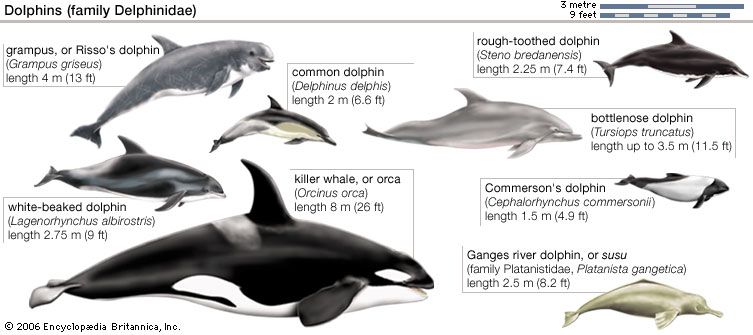
What are some of the different species of dolphins, and how do they vary?
Dolphins are toothed whales belonging to three primary families: Delphinidae (oceanic dolphins), Platanistidae, and Iniidae (river dolphins). There are nearly 40 species within the Delphinidae family alone, which includes animals commonly referred to as whales, such as the killer whale and pilot whales.1
Species vary significantly in habitat, behavior, and physical traits:
- Habitat: While most are marine, some species inhabit major river systems. Coastal species may spend time in both fresh and salt water.1
- Physicality: Most are small, measuring under 3 meters, with spindle-shaped bodies and beaklike snouts. However, they range from tropical to subpolar waters, and their physical adaptations reflect their environments.1
- Behavior: Intelligence and social structure are hallmarks of the group. For example, bottlenose dolphins are known for complex communication, self-awareness, and tool use, such as “sponging” to protect their beaks while foraging.21
- Conservation: Status varies widely; while some are of least concern, others like the Ganges and Indus river dolphins are endangered.1

How intelligent are dolphins, and what evidence supports this?
Dolphins are widely recognized as highly intelligent animals, demonstrating cognitive abilities that include complex social structures, problem-solving, and self-awareness.3
Evidence of Intelligence
- Social Memory: Dolphins possess the longest social memory of any nonhuman species, capable of identifying individuals they have not encountered for over 20 years.3
- Communication: They utilize a sophisticated system of clicks for echolocation and whistles for social interaction. Notably, each dolphin develops a unique “signature whistle” that functions similarly to a human name.3
- Self-Awareness: Experiments show that bottlenose dolphins can recognize their reflections in mirrors, a trait typically associated with humans, great apes, and elephants.3
- Tool Use and Problem Solving: Dolphins engage in complex behaviors like “sponging,” where they wear marine sponges on their snouts to protect them while foraging.3
- Brain Anatomy: While some researchers point to the large size of the dolphin brain—which can exceed the weight of a human brain—others suggest this mass may be primarily dedicated to processing complex acoustic information.4
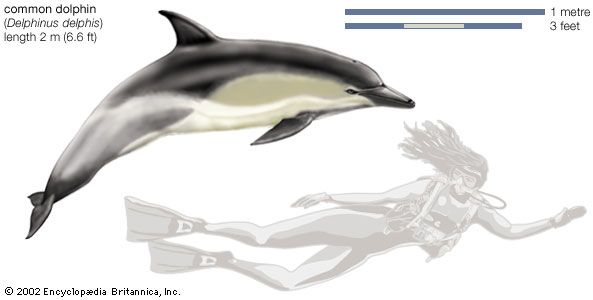
What are some unique adaptations that dolphins have developed for life in the water?
Dolphins have evolved remarkable adaptations to thrive in aquatic environments, balancing the demands of life in water with their needs as mammals.
Physiological Adaptations
- Thermoregulation: To survive in water that conducts heat rapidly, dolphins possess a thick layer of blubber—a fat-rich dermis that provides insulation. They also utilize countercurrent blood exchange, a system that allows them to conserve or dissipate heat by adjusting blood flow between their core and skin surfaces.3
- Diving Efficiency: Dolphins feature a rete mirabile, a network of blood vessels that acts as an oxygen reservoir. This allows them to isolate circulation to vital organs like the brain and heart during deep dives.3
- Respiration: Unlike terrestrial mammals, breathing is a conscious act for dolphins. To avoid drowning while resting, they engage in unihemispheric slow-wave sleep, where one half of the brain remains active to regulate breathing and monitor for threats.56
Sensory and Locomotion Adaptations
- Echolocation: Dolphins use high-frequency sound pulses to navigate and hunt in murky water. This process is supported by a mutated Prestin gene, which enhances their sensitivity to high-frequency echoes.78
- Hydrodynamics: Their body shape and the reduction of external appendages minimize heat loss and facilitate efficient movement. They propel themselves using vertical tail movements, with their bodies acting as a spring to maximize energy efficiency.39
How do dolphins breathe, and how does this differ from fish?
Dolphins and fish have evolved fundamentally different respiratory systems to survive in aquatic environments.
How Dolphins Breathe
As mammals, dolphins breathe air using lungs rather than gills. Because breathing is a conscious activity for them, they must actively choose to surface to inhale, a process known as a blow. Unlike humans, who breathe reflexively, a dolphin that loses consciousness will stop breathing and quickly die.8
To manage this while resting, dolphins utilize unihemispheric slow-wave sleep, where one half of the brain remains awake to regulate breathing and monitor for threats while the other half rests. They are highly efficient, using up to 80 percent of their lung volume in a single breath, compared to only 20 percent in humans.1298
How Fish Breathe
In contrast, most fish extract dissolved oxygen directly from the water using gills. Water flows over these specialized filaments, which are rich in blood vessels, allowing for the exchange of oxygen and carbon dioxide. While some specialized fish, such as lungfish, have evolved primitive lungs or accessory organs to gulp air in oxygen-poor environments, the primary respiratory mechanism for the vast majority of fish remains gill-based extraction from water.1314
Sources
- bottlenose dolphin — Encyclopædia Britannica
- dolphin — Encyclopædia Britannica
- How intelligent are dolphins? — Encyclopædia Britannica
- cetacean - Intelligence — Encyclopædia Britannica
- sound reception - Echolocation in other mammals — Encyclopædia Britannica
- cetacean - Circulation and thermoregulation — Encyclopædia Britannica
- Echolocation — Encyclopædia Britannica
- Do whales sleep? — Encyclopædia Britannica
- cetacean - Sleep — Encyclopædia Britannica
- cetacean - Respiration — Encyclopædia Britannica
- cetacean - Swimming — Encyclopædia Britannica
- How do fish breathe? — Encyclopædia Britannica
- fish - The respiratory system — Encyclopædia Britannica
- thoracic squeeze — Encyclopædia Britannica
- Circulatory system - Fishes — Encyclopædia Britannica
Published on · 4 min read