New Hebrides Trench
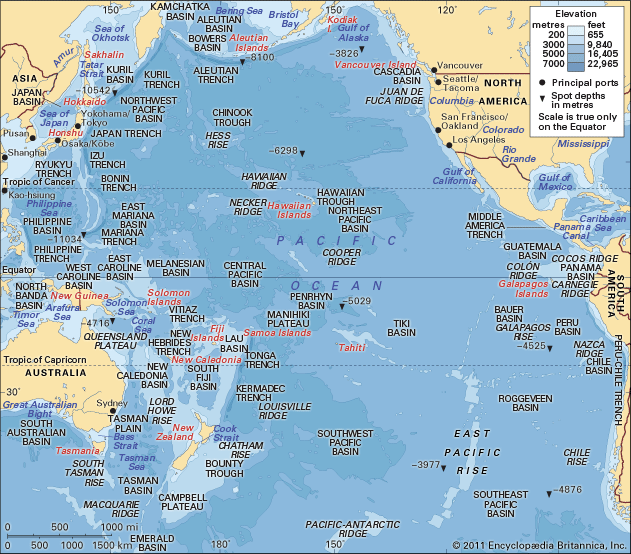
The New Hebrides Trench is a submarine trench located in the southwestern Pacific Ocean on the periphery of the Coral Sea. Situated between the islands of…
What is New Hebrides Trench?
The New Hebrides Trench is a submarine trench located in the southwestern Pacific Ocean on the periphery of the Coral Sea. Situated between the islands of Vanuatu and New Caledonia, it spans approximately 750 miles (1,200 km) in length and 45 miles (70 km) in width.1
Reaching depths of over 25,000 feet (7,600 meters), it contains the deepest soundings in the Coral Sea region. The trench curls around the southern end of Vanuatu and is associated with the New Hebrides seismic zone, a feature whose existence was confirmed by its discovery by a German naval vessel in 1910. Geologically, it is part of a complex system of island arcs and is joined to the north by the Solomon Trench.12
What is a subduction zone?
A subduction zone is a region along a convergent plate boundary where one tectonic plate, typically older and denser, descends beneath another into the Earth’s upper mantle. This process is a fundamental component of plate tectonics, acting as the mechanism by which seafloor is consumed and recycled.345
Key features of subduction zones include:
- Deep Trenches: The site of subduction is marked by a deep oceanic trench, often 5 to 11 km deep, created by frictional drag as the descending plate bends.4
- Seismic Activity: The path of the descending slab, known as the Wadati-Benioff zone, is defined by frequent earthquakes that can occur at depths of up to 700 km.4
- Volcanism: Approximately 80 percent of the world’s known volcanoes occur along subduction zones. These subduction-related volcanoes are often explosive and produce diverse rock types, such as andesite.5
- Metamorphism: High-pressure, low-temperature conditions within the zone cause rocks to recrystallize into unique forms, such as blueschists and eclogites.4
We could dive deeper into how these zones create accretionary wedges or explore specific examples like the Pacific Plate boundaries.
How do island arcs form near trenches?
Island arcs form at convergent plate boundaries where two oceanic plates collide. In this process, the denser plate is forced downward into the mantle in a process known as subduction, creating a deep-sea trench along the convex side of the boundary.67
As the descending slab reaches depths of approximately 100 km (60 miles), it becomes sufficiently hot to release volatile components. These components stimulate the partial melting of the overlying mantle wedge, generating magma. This magma rises through the overriding plate to the surface, where it erupts to form a curved chain of volcanoes. When this activity occurs on the seafloor, the resulting volcanic peaks eventually breach the surface to create a chain of islands parallel to the trench.768
The composition of these islands is primarily basaltic and andesitic, derived from both the semimolten mantle and the melting of the subducting plate and its accumulated sediments.68
What are some other major deep-sea trenches in the Pacific?
The Pacific Ocean basin contains 17 of the Earth’s 20 major deep-sea trenches, which are primarily categorized as either marginal trenches or those associated with island arcs. Notable examples include:9
- Peru-Chile Trench: The longest trench on Earth, extending approximately 5,900 km (3,700 miles) along the western coast of South America.9
- Aleutian Trench: Stretches from the Gulf of Alaska to the Kamchatka Peninsula; it functions as a marginal trench in the east and an island arc system in the west.9
- Kuril Trench: Located east of the Kamchatka Peninsula and the Kuril Islands, this trench reaches depths of 10,542 meters.10
- Tonga and Kermadec Trenches: These trenches extend south from the Fiji Islands toward New Zealand, forming part of a significant structural arc.119
- Other Western Pacific Trenches: This region features a dense network of island arc-associated trenches, including the Japan, Bonin, Ryukyu, Philippine, Java, New Britain, Solomon, and New Hebrides trenches.9
Sources
- New Hebrides Trench — Encyclopædia Britannica
- deep-sea trench - Types — Encyclopædia Britannica
- subduction zone — Encyclopædia Britannica
- plate tectonics - Subduction zones — Encyclopædia Britannica
- volcano - Volcanoes related to plate boundaries — Encyclopædia Britannica
- island arc — Encyclopædia Britannica
- plate tectonics - Island arcs — Encyclopædia Britannica
- volcanism — Encyclopædia Britannica
- Pacific Ocean: Top Questions — Encyclopædia Britannica
- Tonga Trench — Encyclopædia Britannica
- Mariana Trench — Merriam-Webster
- How was the Mariana Trench formed? — Encyclopædia Britannica
- Kuril Trench — Encyclopædia Britannica
Published on · 3 min read