Nuclear Winter
Nuclear winter is a hypothesized environmental catastrophe that could follow a large-scale nuclear war. The concept suggests that the massive firestorms…
What is nuclear winter?
Nuclear winter is a hypothesized environmental catastrophe that could follow a large-scale nuclear war. The concept suggests that the massive firestorms ignited by nuclear explosions would loft millions of tons of smoke, soot, and dust into the stratosphere.1
These particles would form a dense, global cloud layer capable of blocking a significant portion of sunlight from reaching the Earth’s surface for weeks or longer. This reduction in solar energy would lead to a dramatic plunge in global temperatures, potentially causing killing frosts and subfreezing conditions.12
The resulting environmental collapse—characterized by darkness, extreme cold, and high levels of ultraviolet radiation due to ozone depletion—would severely disrupt photosynthesis. This could lead to widespread destruction of vegetation and animal life, ultimately threatening the human population through starvation, exposure, and disease. While the term was coined in 1983 following the influential TTAPS study, the exact severity and long-term consequences of such an event remain a subject of scientific debate.12
How can nuclear explosions cause a nuclear winter?
Nuclear explosions trigger a potential nuclear winter primarily through the creation of massive, uncontrolled firestorms. When nuclear warheads detonate, their intense fireballs ignite vast areas of cities and forests. These fires release enormous quantities of smoke, soot, and dust into the atmosphere.1
The mechanism functions as follows:
- Particle Injection: The heat from these fires lofts smoke and soot to high altitudes, where they can persist for weeks.1
- Sunlight Absorption: Smoke generated from burning petroleum products and plastics is particularly effective at absorbing solar radiation. This material is carried by high-altitude winds, forming a dense, uniform belt of particles that encircles the Northern Hemisphere.1
- Temperature Plunge: By blocking a significant portion of sunlight, these clouds prevent solar energy from reaching the surface. This leads to a dramatic drop in global temperatures—potentially by as much as 11° to 22° C (20° to 40° F)—resulting in widespread killing frosts and subfreezing conditions.1
This environmental disruption, combined with the loss of photosynthesis and increased ultraviolet radiation, would devastate global food supplies and ecosystems.1
What happens to Earth’s climate during a nuclear winter?
During a nuclear winter, Earth’s climate would experience a severe and rapid transformation due to the massive injection of smoke, soot, and dust into the stratosphere.1
The primary climatic impacts include:
- Drastic Cooling: Surface temperatures would plummet, potentially dropping by 11° to 22° C (20° to 40° F) for several weeks. This shift would result in widespread killing frosts and subfreezing conditions across the Northern Hemisphere.1
- Prolonged Darkness: Thick, black clouds formed by burning petroleum and plastics would block out most sunlight, creating conditions of semidarkness that persist for weeks.1
- Atmospheric Disruption: Beyond the cooling effect, the atmosphere would be altered by the depletion of the ozone layer, which normally shields the planet from harmful ultraviolet radiation. This would increase radiation exposure at the surface.1
These combined factors would halt photosynthesis, leading to the destruction of vegetation and animal life, while the collapse of infrastructure and food supplies would threaten human survival. While these hypotheses were popularized by the 1983 TTAPS study, the exact severity of these climatic changes remains a subject of scientific debate.12
How would plants and animals be affected by a nuclear winter?
A nuclear winter would have catastrophic consequences for Earth’s flora and fauna, primarily driven by the sudden, drastic alteration of the global environment. The combination of extreme cold, darkness, and increased radiation would disrupt the fundamental biological processes necessary for life to thrive.1
Impacts on Vegetation and Ecosystems
- Interruption of Photosynthesis: The thick clouds of smoke and soot generated by firestorms would block out most sunlight for weeks. Because photosynthesis relies on solar energy, this darkness would effectively halt plant growth, leading to the widespread destruction of vegetation.1
- Temperature Stress: A plunge in surface temperatures by as much as 11° to 22° C (20° to 40° F) would cause killing frosts and subfreezing conditions, which most plant species are not adapted to survive.1
- Radiation Damage: Nuclear explosions would likely deplete the ozone layer in the stratosphere. This would allow increased levels of ultraviolet radiation to reach the surface, which is known to inhibit photosynthesis, damage epidermal tissues, and increase mutation rates in plant DNA.13
Impacts on Animal Life
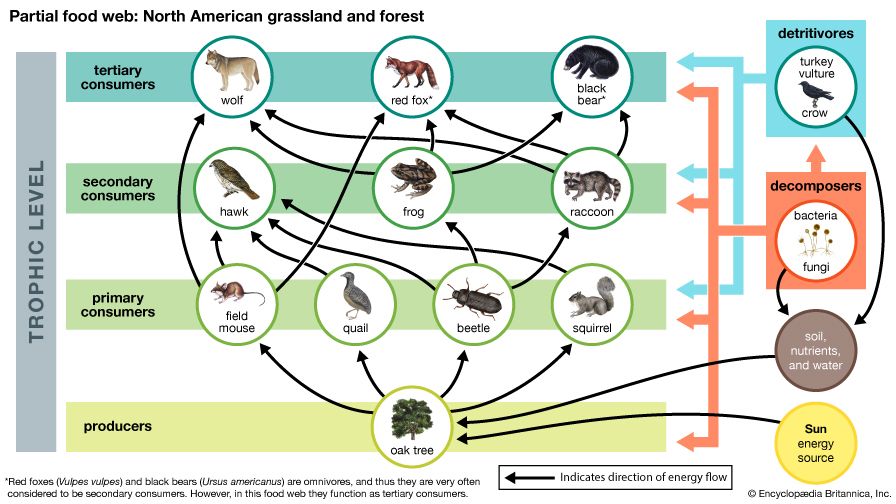
- Food Web Collapse: The destruction of vegetation would trigger a cascading collapse of food supplies, leading to mass starvation among herbivores and, subsequently, predators.1
- Direct Physiological Harm: Animals would face severe stress from extreme cold and exposure to high levels of radiation from nuclear fallout. Furthermore, increased ultraviolet radiation can cause significant genetic damage and tissue injury in many species.13
Sources
- Nuclear winter — Encyclopædia Britannica
- nuclear winter — Merriam-Webster
- human genetic disease - Ultraviolet radiation — Encyclopædia Britannica
- sea ice - Interactions with the oceans , atmosphere , and climate — Encyclopædia Britannica
- Polar ecosystem - Polar environments — Encyclopædia Britannica
- Ozone layer — Encyclopædia Britannica
Published on · 3 min read