Nuculana
Nuculana is a long-lived genus of mollusks (clams) that first emerged during the Silurian Period and persists in marine environments today. These clams are…
What is Nuculana?
Nuculana is a long-lived genus of mollusks (clams) that first emerged during the Silurian Period and persists in marine environments today. These clams are characterized by a small, teardrop-shaped shell that is globous at the front and pointed at the rear.1
The genus serves as the type for the family Nuculanidae, a group of marine bivalves distinguished by their elongated, beaked shells. Anatomically, Nuculana features a hinge region equipped with numerous small pits, ridges, sockets, and teeth, along with two roughened interior areas for muscle attachment. Unlike many sedentary bivalves, Nuculana is an active genus that moves across the substrate. It is also closely related to the extinct genus Nuculopsis, which was once considered a subgenus of Nuculana due to their physical similarities.2314
What are the main characteristics of bivalve mollusks?
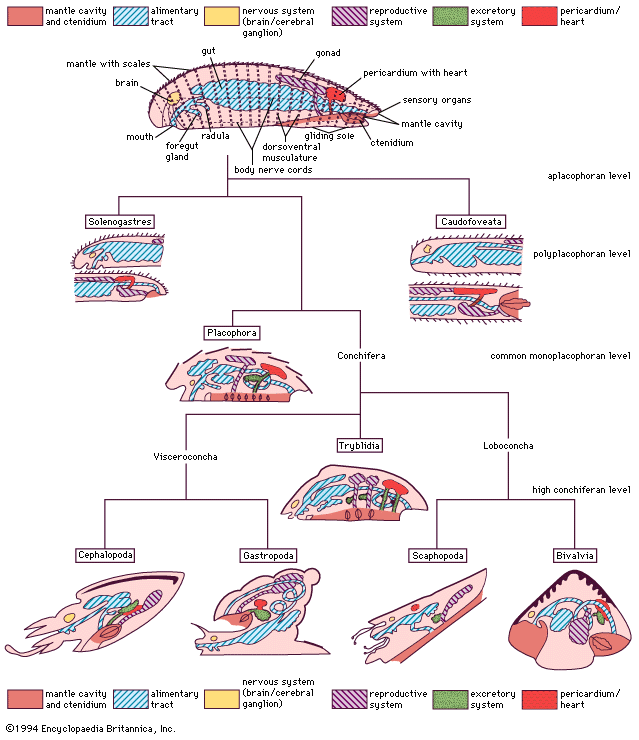
Bivalve mollusks, belonging to the class Bivalvia, are a diverse group of over 15,000 species—including clams, oysters, mussels, and scallops—defined by several key characteristics:
- Shell Structure: Their most recognizable feature is a shell divided into two distinct left and right valves connected by a hinge. Shell morphology, such as lateral compression, often reflects the animal’s habitat, with compressed shapes facilitating rapid burrowing in sediments.56
- Feeding Mechanisms: While primitive bivalves are detritivores, most modern species are suspension feeders. They utilize modified respiratory gills, known as ctenidia, to filter food particles like algae and bacteria from the water.578
- Anatomy: In adaptation to a sedentary or burrowing lifestyle, bivalves have lost the head and the radular rasping organ found in most other mollusks. Many species possess a muscular foot used for digging or, in some cases, secreting byssal threads for attachment to hard surfaces.567
- Habitat and Lifestyle: Bivalves are exclusively aquatic. They occupy diverse niches, ranging from shallow coastal seas to deep-sea environments, and have evolved various strategies—such as burrowing, cementation, or even limited swimming—to avoid predation and secure food.67
How do clams move across the ocean floor?
Clams move across the ocean floor primarily by using a specialized, muscular foot. Unlike the flat, creeping sole found in gastropods, the clam’s foot is bladelike and laterally compressed, making it highly effective for digging into sand or mud.1011
To burrow, the clam extends its foot anteriorly from between its shell valves. By pumping blood into the foot, the clam inflates the tip to create an anchor in the substrate. Once anchored, the pedal retractor muscles contract to pull the shell downward. This process is often assisted by the sharp closure of the shell valves, which forces water out of the mantle cavity to fluidize the sediment, significantly increasing the efficiency of the movement.1011
While most clams use this method for burrowing, some species exhibit variations:
- Fast Burrowers: Species like razor clams are so proficient at this digging mechanism that they can swim short distances if removed from the sediment.107
- Leaping: Some shallow-burrowing cockles use their foot to perform a leaping motion to escape predators.12
What is the significance of the Silurian Period in marine history?
The Silurian Period (443.4 to 419.2 million years ago) was a transformative era in marine history, characterized by the recovery of life following the mass extinctions of the Late Ordovician. As glaciers melted, global sea levels rose significantly, flooding continental margins and creating vast, shallow seas that supported diverse ecosystems.151617
Key developments during this period included:
- Reef Expansion: The widespread flooding of tropical and subtropical regions facilitated the growth of extensive mound-type coral reefs, which served as hubs for marine biodiversity.1517
- Faunal Recovery and Distribution: Unlike the high levels of endemism seen in the Ordovician, Silurian marine life became more globally distributed. This consistency allows geologists to correlate rock layers across different continents. Common seafloor inhabitants included brachiopods, gastropods, crinoids, and trilobites.1715
- Evolution of Fishes: The period saw a rapid diversification of fishes, including both jawless (agnatha) species and the emergence of primitive jawed fishes (gnathostomes).1518
- Pelagic Predators: The rise of suspension-feeders supported a complex food web, leading to an increase in pelagic predators such as nautiloids.18
Sources
- Nuculana — Encyclopædia Britannica
- Nuculanidae — Merriam-Webster
- Nuculopsis — Encyclopædia Britannica
- Nuculana — Merriam-Webster
- bivalve — Encyclopædia Britannica
- bivalve - Reproduction and life cycles — Encyclopædia Britannica
- bivalve - Size range and diversity of structure — Encyclopædia Britannica
- bivalve - Ecology and habitats — Encyclopædia Britannica
- bivalve - Food and feeding — Encyclopædia Britannica
- bivalve - Locomotion — Encyclopædia Britannica
- bivalve - External features — Encyclopædia Britannica
- muscle - Mollusks — Encyclopædia Britannica
- What’s the difference between clams, mussels, and oysters? — Encyclopædia Britannica
- bivalve - Features of defense and aggression — Encyclopædia Britannica
- A Journey Through Time Since the Precambrian - Silurian Period: 443.4 million to 419.2 million years ago — Encyclopædia Britannica
- Silurian Period — Encyclopædia Britannica
- Silurian Period - Paleogeography — Encyclopædia Britannica
- Cambrian explosion — Encyclopædia Britannica
Published on · 3 min read