Olive Shell
An olive shell refers to any marine snail belonging to the family Olividae, which are gastropod mollusks. These snails are primarily found in tropical waters…
What is olive shell?
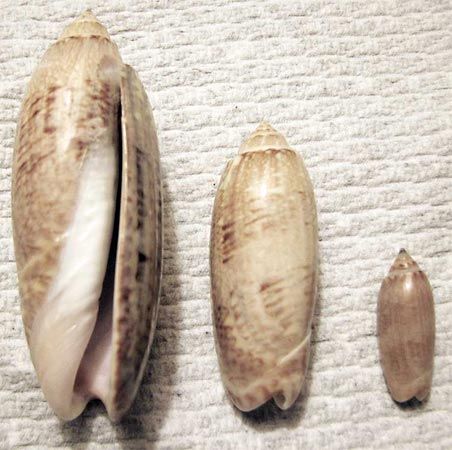
An olive shell refers to any marine snail belonging to the family Olividae, which are gastropod mollusks. These snails are primarily found in tropical waters and are well-known for their distinctive, highly polished shells that feature an agatelike sheen.12
The shell itself is oval-shaped with a pointed apex, a long, narrow aperture, and a characteristic pattern of folds on the body whorl. A unique biological feature of these mollusks is their large foot and a mantle that can envelop the shell. Olive shells are typically found burrowing in sandy bottoms. Well-known species include the lettered olive (Oliva sayana), common in southeastern American waters, and the orange-mouthed olive (O. sericea) of the Indo-Pacific. Fossils of the genus Oliva have been documented as far back as the Eocene Epoch the Eocene Epoch.12
How do olive shells use their mantle to protect their shell?
In olive shells (family Olividae), the mantle is a specialized, fleshy tissue that can extend to envelop the entire exterior of the shell. While the primary biological function of the mantle in mollusks is to secrete and maintain the shell through glandular tissues at its edges, this unique ability to cover the shell in olive snails serves as a protective mechanism.3456
By keeping the shell surface covered, the mantle helps maintain the characteristic high polish and agatelike sheen of the olive shell, which may deter the accumulation of debris or epibionts. Furthermore, because the mantle is a living, sensitive tissue, its ability to extend over the shell allows the snail to protect its hard exterior while burrowing in sandy environments or navigating its habitat. While the mantle is essential for the initial formation and ongoing thickening of the shell layers, its role in olive shells is distinctively active, acting as a protective “skin” that shields the shell from the environment.36
What do olive shells eat in their sandy habitats?
While the provided search results confirm that olive shells (family Olividae) are marine snails that burrow in sandy bottoms, the specific dietary habits of the Olividae family are not detailed in the available information.
The provided documentation notes that gastropods as a class exhibit great ecological diversity, with some members being parasitic and others predatory, but it does not explicitly state the food sources for olive shells specifically.
What are some other types of marine gastropods?
The class Gastropoda is the largest group within the phylum Mollusca, encompassing a vast array of marine, freshwater, and terrestrial species. Marine gastropods exhibit immense ecological diversity, ranging from intertidal grazers to deep-sea predators.91011
Some notable types of marine gastropods include:
- Limpets: Often found in tidal zones, these gastropods are influential grazers that scrape algae from rocks. Many exhibit “homing” behavior, returning to a specific spot after feeding.10
- Cone shells: Members of the family Conidae, these predatory snails use a specialized, harpoon-like radular tooth to inject potent toxins into their prey, which typically include worms, mollusks, or fish.1213
- Moon snails (Naticids): These are burrowing carnivores that use specialized glands to secrete acids and enzymes, allowing them to bore through the shells of other mollusks.10
- Sea slugs (Opisthobranchs): This group includes nudibranchs and sea hares. They are often shell-less or have reduced shells and exhibit varied feeding strategies, including predation on sessile animals like cnidarians.1214
- Periwinkles: These are abundant snails found on rocky shores that play a significant role in consuming organic matter and algae.10
- Pteropods (Sea butterflies): These pelagic gastropods have modified their foot into wing-like structures, allowing them to swim through the water column.10
Sources
- olive shell — Encyclopædia Britannica
- olive shell — Merriam-Webster
- mantle — Encyclopædia Britannica
- gastropod - The visceral hump — Encyclopædia Britannica
- gastropod - The mantle — Encyclopædia Britannica
- mollusk - External features — Encyclopædia Britannica
- gastropod - The shell — Encyclopædia Britannica
- mollusk - Habitats, feeding habits, and associations — Encyclopædia Britannica
- gastropod — Encyclopædia Britannica
- mollusk - Annotated classification — Encyclopædia Britannica
- gastropod - Ecology and habitats — Encyclopædia Britannica
- gastropod - Food and feeding — Encyclopædia Britannica
- cone shell — Encyclopædia Britannica
- slug — Encyclopædia Britannica
- snail — Encyclopædia Britannica
Published on · 3 min read