Oarfish
The oarfish (Regalecus glesne) is a large, ribbon-shaped fish belonging to the family Regalecidae. Found in tropical and subtropical deep waters, it can…
What is oarfish?
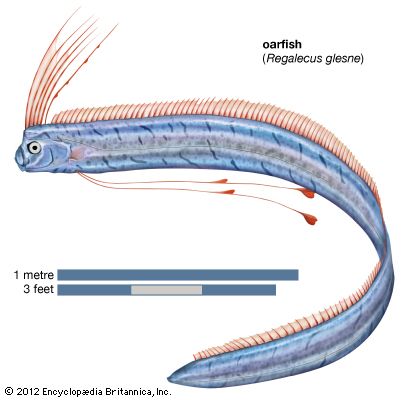
The oarfish (Regalecus glesne) is a large, ribbon-shaped fish belonging to the family Regalecidae. Found in tropical and subtropical deep waters, it can reach lengths of up to 9 meters (30.5 feet) and weigh 300 kg (660 pounds). It is characterized by its thin, silver body, long red pelvic fins, and a prominent red dorsal fin that forms a crest on its head.1
These fish are known for swimming vertically, a behavior that serves as camouflage by hiding their flattened profile from predators and allowing their reflective skin to blend into the dim light of the deep ocean. This orientation also assists them in spotting prey, such as small fish and plankton, against the light from above, while helping them navigate currents efficiently. Due to their unusual appearance and deep-water habitat, they are often associated with historical sightings of “sea serpents”.21
How do deep-sea creatures adapt to high pressure?
Deep-sea creatures have evolved specialized physiological and morphological adaptations to survive the intense hydrostatic pressure found at great ocean depths, which increases by one atmosphere for every 10 meters of depth.3
A primary adaptation is the absence of air-filled compartments, such as lungs or swim bladders, which would otherwise compress or collapse under extreme pressure. While many surface-dwelling bony fish use swim bladders to regulate buoyancy, deep-sea and bottom-dwelling species have either significantly reduced these organs or lost them entirely. Some deep-sea fish that retain buoyancy organs may use oils, which are less dense than water, rather than gas.3456
Beyond structural changes, life at these depths is supported by unique biological strategies. Many organisms rely on chemoautotrophic bacterial associations for sustenance, while others feed on organic matter descending from the upper ocean layers. Additionally, some deep-sea inhabitants utilize bioluminescence to navigate the darkness, attract prey, or avoid detection by predators.76
What other animals are mistaken for sea serpents?
Many reports of sea serpents—mythological marine creatures traditionally resembling enormous snakes—are likely the result of misidentifying well-known animals. Because no captured specimen has ever proven to be a previously unknown species, experts suggest that several real-world animals are frequently mistaken for these monsters.9
Commonly cited candidates for these misidentifications include:
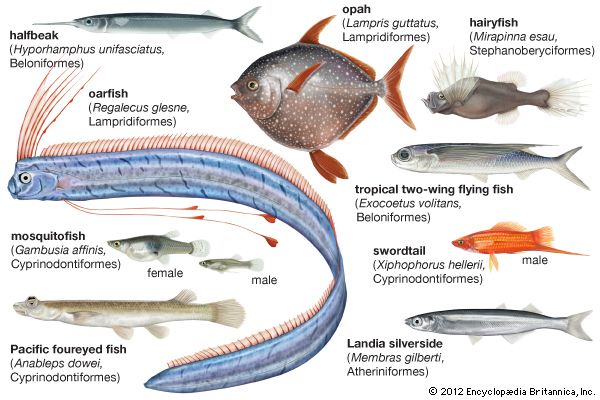
- Oarfish: Their long, ribbon-like bodies and crest-like fins often lead to their identification as sea serpents.91
- Giant Squids: When swimming at the surface with their long arms trailing, they can mimic the appearance of a cylindrical, serpent-like creature with a flattened head.9
- Porpoises: When swimming in a line and surfacing repeatedly, they can create the illusion of a single, large creature moving in vertical undulations.9
- Basking Sharks, Sea Lions, and Marine Worms (Nemertines): These animals are also frequently suggested as explanations for sightings.9
- Seaweed: Large, floating masses of seaweed have often been mistaken for gigantic animals.9
What is the difference between the mesopelagic and bathypelagic zones?
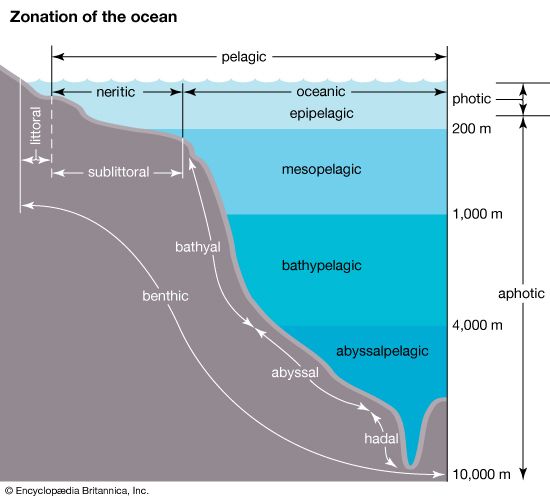
The primary difference between the mesopelagic and bathypelagic zones lies in their depth and position within the ocean’s vertical structure. Both are part of the pelagic environment, which encompasses the open waters of the ocean beyond the continental shelf.11
- Mesopelagic Zone: This layer is located immediately below the epipelagic (photic) zone. It ranges from approximately 200 to 1,000 meters below the surface.11
- Bathypelagic Zone: This zone lies beneath the mesopelagic layer, extending from 1,000 to 4,000 meters deep.1211
While the mesopelagic zone serves as a transition area where some light may still penetrate, the bathypelagic zone is characterized by its position within the aphotic zone, a region of permanent darkness that occupies the vast majority of the ocean’s volume.11
Sources
- oarfish — Encyclopædia Britannica
- Why do oarfish swim vertically? — Encyclopædia Britannica
- life - Temperature and desiccation — Encyclopædia Britannica
- swim bladder — Encyclopædia Britannica
- Biosphere - Hydrostatic pressure — Encyclopædia Britannica
- fish - The respiratory system — Encyclopædia Britannica
- Biosphere - Atmospheric pressure — Encyclopædia Britannica
- Marine ecosystem - Physical and chemical properties of seawater — Encyclopædia Britannica
- sea serpent — Encyclopædia Britannica
- myth - Relationships of mixture — Encyclopædia Britannica
- bathypelagic zone — Encyclopædia Britannica
- Marine ecosystem - Geography, oceanography, and topography — Encyclopædia Britannica
Published on · 3 min read