Ribbonfish
The term ribbonfish refers to any of several species of deep-sea, marine bony fishes that make up the family Trachipteridae within the order Lampridiformes.
What is ribbonfish?
The term ribbonfish refers to any of several species of deep-sea, marine bony fishes that make up the family Trachipteridae within the order Lampridiformes.12
These fishes are characterized by their slender, laterally compressed, and elongate bodies, which give them their ribbon-like appearance. They are further distinguished by a long dorsal fin that originates behind the head, an absence of anal fins, and upward-pointing caudal fins. The family includes three genera: Trachipterus, Desmodema, and Zu.12
These creatures are found in all major oceans, inhabiting deep-sea environments. The largest species, Trachipterus arcticus, can reach lengths of up to 2 meters (6.5 feet) and is typically found in cold northern waters.1
What are some other types of deep-sea fish?
Deep-sea fishes are highly specialized organisms that have evolved unique adaptations to survive in extreme environments characterized by high pressure, cold temperatures, and darkness. These fishes are generally categorized based on whether they inhabit the mid-water column or the ocean floor (benthic zone).3
Mid-water Deep-Sea Fishes
These species often possess large mouths, enlarged eyes, and bioluminescent organs used to attract prey or mates. Notable groups include:3
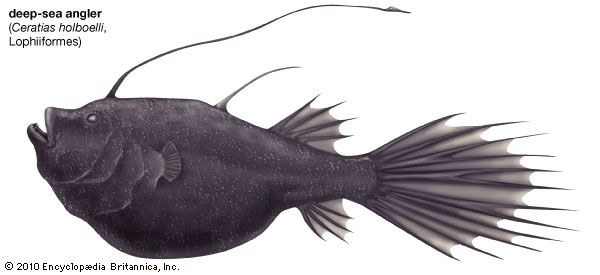
- Anglerfishes: Specifically the suborder Ceratioidei, which use a modified dorsal fin spine as a luminous “fishing rod” to lure prey.34
- Viperfishes: Predators known for their long, fanglike teeth and luminescent organs along their bodies.35
- Bristlemouths: Members of the family Gonostomatidae, considered among the most abundant fishes on Earth.3
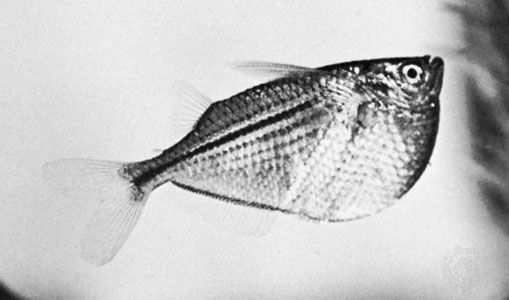
- Lantern fishes and Hatchetfishes: These utilize distinct arrangements of light organs, or photophores, for species recognition and camouflage.6
Bottom-Living (Benthic) Fishes
Benthic forms typically have smaller eyes, smaller mouths, and often lack bioluminescence. Examples include:3
- Grenadiers (family Macrouridae): Common along continental slopes.37
- Batfishes (family Ogcocephalidae): Often awkward swimmers that use their pectoral fins to “walk” on the seafloor.37
- Cusk eels (family Ophidiidae): A dominant family at extreme depths, with some species found as deep as 4,000 fathoms.37
How do deep-sea creatures adapt to high water pressure?
Deep-sea creatures have evolved specialized physiological adaptations to survive the intense hydrostatic pressure of the deep ocean, which increases by one atmosphere for every 10 meters of depth.10
A primary adaptation is the reduction or complete loss of air-filled cavities. While many surface-dwelling fishes use a swim bladder to control buoyancy, these gas-filled organs would be crushed under the extreme pressure of the deep sea. Consequently, many deep-sea and bottom-living species have either replaced these gas bladders with oil-filled structures or eliminated the organ entirely to avoid the structural instability caused by gas compression.310
By lacking air compartments, these animals avoid the physiological challenges faced by surface-dwelling divers, such as the risk of decompression sickness or the need to manage rapid volume changes in gas-filled spaces. These evolutionary traits, alongside other specialized features like bioluminescence and modified sensory organs, allow deep-sea life to thrive in one of the most extreme environments on Earth.1011
What is the difference between a ribbonfish and an oarfish?
While both the ribbonfish and the oarfish belong to the same order, Lampridiformes, they are distinct species belonging to different families.
Key Differences
Feature
Ribbonfish
Oarfish
Family
Trachipteridae
Regalecidae
Size
Reaches up to 2 meters (6.5 feet)
Can grow to about 9 meters (30.5 feet)
Physical Traits
Upward-pointing caudal fins; lacks anal fins
Long, red, oarlike pelvic fins; red dorsal crest
Habitat
Found in all major oceans, including cold northern waters
Found throughout tropical and subtropical deep waters
The ribbonfish is characterized by its laterally compressed, elongate body and a dorsal fin that extends from behind the head. In contrast, the oarfish is a much larger, sinuous fish known for its shiny silver color and a prominent, manelike red dorsal crest, often cited as the source of “sea serpent” sightings.1213
Sources
- ribbonfish — Encyclopædia Britannica
- ribbonfish — Merriam-Webster
- deep-sea fish — Encyclopædia Britannica
- anglerfish — Encyclopædia Britannica
- Bioluminescence - The role of bioluminescence in behavior — Encyclopædia Britannica
- viperfish — Encyclopædia Britannica
- viperfish — Merriam-Webster
- abyssal zone — Encyclopædia Britannica
- paracanthopterygian - Ecology and behavior — Encyclopædia Britannica
- fish - The respiratory system — Encyclopædia Britannica
- Biosphere - Hydrostatic pressure — Encyclopædia Britannica
- Mechanoreception - Generalized hydrostatic pressure — Encyclopædia Britannica
- oarfish — Encyclopædia Britannica
Published on · 3 min read