Thermohaline Circulation
Thermohaline circulation is the primary driver of deep water formation, a process where surface water becomes dense enough to sink into the deep ocean. This…
What is the connection between thermohaline circulation and the formation of deep water masses?
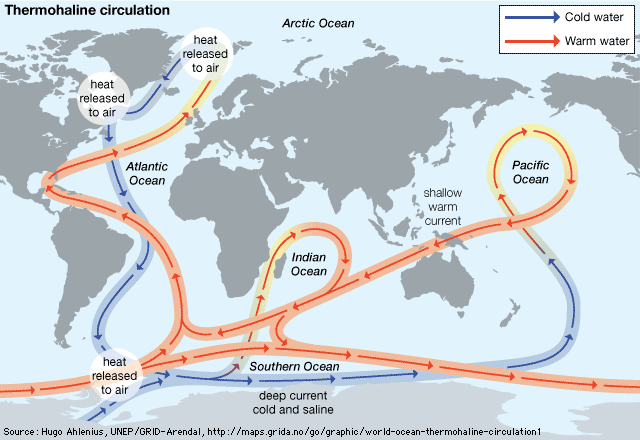
Thermohaline circulation is the primary driver of deep water formation, a process where surface water becomes dense enough to sink into the deep ocean. This density is determined by temperature and salinity, which is why the system is named “thermohaline”.123
In polar regions, such as the North Atlantic and near Antarctica, surface waters lose heat to the atmosphere or undergo evaporation, increasing their density. Once this water becomes sufficiently dense, it sinks via convection until it reaches a depth where its density matches the surrounding water. These sinking plumes create distinct water masses—such as North Atlantic Deep Water and Antarctic Bottom Water—which then spread across the global ocean floor. This sinking motion is essential for the global circulation system, as it necessitates the slow upwelling of deeper water to replace the surface volumes that have descended.124
What role do wind-driven currents play in thermohaline circulation?
While thermohaline circulation and wind-driven circulation are distinct systems, they are interconnected through the physical movement of water across the ocean’s layers.
Wind-driven currents, which dominate the upper ocean, influence thermohaline processes primarily through Ekman transport. As wind varies across the ocean surface, it creates zones of convergence and divergence. Convergence zones force surface water downward in a process called downwelling, while divergence zones draw deeper water toward the surface through upwelling.27
These vertical movements extend wind-driven effects into deeper waters, influencing the density structure of the ocean. For instance, by accumulating or removing surface water, these processes help create the baroclinic fields of mass that drive geostrophic motion well below the surface layer. Furthermore, while thermohaline circulation is driven by horizontal differences in temperature and salinity, the global circulation pattern relies on the slow upwelling of deep water to replace the surface volumes that sink in polar regions, a return flow that is influenced by the broader dynamics of the ocean’s general circulation.278
What role does the thermohaline circulation play in global climate regulation?
Thermohaline circulation (THC) is a critical component of the global climate system, primarily functioning as a massive conveyor belt that redistributes heat across the planet. By transporting warm surface waters from the tropics toward the high latitudes, the circulation moderates the climate of coastal regions, most notably in northwestern Europe.2111213
The process involves a large-scale overturning of the ocean, where warm, saline water moves poleward and releases heat into the atmosphere upon reaching colder regions. As this water cools, it becomes denser and sinks, forming deep water masses that eventually return toward the equator, facilitating a continuous global heat exchange. This mechanism is essential for maintaining regional temperature and precipitation patterns.2131112
Because the ocean acts as a vast heat reservoir, the stability of this circulation is vital for climate regulation. Scientists monitor the system closely, as significant influxes of freshwater from melting ice could potentially weaken the sinking motion that drives the circulation, thereby altering global climate patterns.142
What is the difference between surface currents and deep ocean currents in thermohaline circulation?
Surface currents and deep ocean currents represent two distinct, yet interconnected, components of the global ocean circulation system. Their primary differences lie in their driving forces, speeds, and depth of penetration.
Surface Currents
Surface currents are primarily wind-driven. They are characterized by:815
- Driving Force: Friction from wind blowing across the sea surface.5
- Structure: They are organized into large, anticyclonic cells known as gyres that span entire ocean basins.81516
- Speed: These currents are relatively vigorous, with characteristic speeds ranging from 5 to 50 cm per second.5
- Depth: They generally dominate the upper ocean, typically extending to depths of less than 1,000 meters, though they can reach the seafloor in low-stratification polar regions.1516
Deep Ocean Currents
Deep ocean currents are the primary component of thermohaline circulation, often referred to as the “global conveyor belt”. They are characterized by:15
- Driving Force: Differences in water density, which are controlled by variations in temperature and salinity /temperature) and salinity.815
- Structure: These currents form when cold, dense surface water sinks in polar regions—such as the North Atlantic or near Antarctica—and spreads slowly across the ocean floor.215
- Speed: They are much more sluggish than surface currents, typically moving at about 1 cm per second.15
- Depth: This flow extends to the seafloor and forms patterns that envelop the global ocean, continually replacing deep water with surface water and vice versa.15
Sources
- ocean current - Thermohaline circulation — Encyclopædia Britannica
- thermohaline circulation — Encyclopædia Britannica
- water mass — Encyclopædia Britannica
- thermohaline — Merriam-Webster
- Pacific Ocean - Temperature — Encyclopædia Britannica
- Pacific Ocean - Deepwater circulation — Encyclopædia Britannica
- Ekman layer — Encyclopædia Britannica
- ocean current - Distribution of ocean currents — Encyclopædia Britannica
- ocean current - Ekman layer — Encyclopædia Britannica
- ocean current - Wind-driven circulation — Encyclopædia Britannica
- convection: Top Questions — Encyclopædia Britannica
- Atlantic Meridional Overturning Circulation: Top Questions — Encyclopædia Britannica
- Climate - Thermohaline circulation — Encyclopædia Britannica
- Climate - Climate and the oceans — Encyclopædia Britannica
- ocean current - Pressure gradients — Encyclopædia Britannica
- seawater - Density of seawater and pressure — Encyclopædia Britannica
- Indian Ocean - Deep ( thermohaline ) circulation — Encyclopædia Britannica
- ocean current — Encyclopædia Britannica
- ocean current - Geostrophic currents — Encyclopædia Britannica
Published on · 3 min read