Ekman Spiral
The Ekman spiral is a theoretical model describing how wind-driven ocean currents change direction and speed with depth due to the Coriolis effect and…
What is Ekman spiral?
The Ekman spiral is a theoretical model describing how wind-driven ocean currents change direction and speed with depth due to the Coriolis effect and friction. Proposed by Swedish oceanographer V. Walfrid Ekman, the model suggests that surface water is deflected 45° from the wind direction—to the right in the Northern Hemisphere and to the left in the Southern Hemisphere.123
As depth increases within the Ekman layer, current speed decreases due to the loss of momentum, and the direction of the water flow rotates further away from the wind direction. At the base of this layer, the water motion becomes opposite to the direction of the surface wind. While this spiral is a foundational concept in oceanography, it represents an idealized condition that is not always perfectly replicated in nature. The net movement of water within this layer, known as Ekman transport, occurs at a 90° angle to the wind.123
How does Ekman transport contribute to the process of upwelling?
Ekman transport is the net movement of surface water at a 90° angle to the direction of the wind, caused by the combined effects of wind stress and the Coriolis force. This transport plays a critical role in creating regions of water divergence, which drive the process of upwelling.34
When wind-driven Ekman transport causes surface waters to move away from a specific area—such as along certain coastlines or at divergence zones like the Equator—it creates a deficit of surface water. To compensate for this loss, deeper, nutrient-rich subsurface water is drawn upward into the sunlit layer of the ocean.34
This process is ecologically significant because it brings essential nutrients to the surface, fueling the rapid reproduction of phytoplankton. These organisms form the base of the food web, supporting abundant marine life and some of the world’s most productive fisheries, such as those found off the coasts of Peru and northwestern Africa.345
Why is the Coriolis effect weaker near the Equator?
The Coriolis effect is not merely “weaker” near the Equator; it is effectively non-existent for horizontal deflections at that location.
The magnitude of the Coriolis force is determined by the formula Cf=c(2ωsinϕ)C_f = c(2\omega \sin \phi), where cc is the velocity of the moving object, ω\omega is the angular velocity of Earth, and ϕ\phi is the latitude. Because the sine of the latitude (sinϕ\sin \phi) is 0 at the Equator (0° latitude), the horizontal component of the Coriolis force becomes zero.27
In essence, the Coriolis effect arises because Earth is a rotating reference frame where the tangential velocity of a point on the surface varies with latitude—reaching its maximum at the Equator and zero at the poles. Since there is no change in this tangential velocity relative to the direction of motion at the Equator, an object moving along the surface does not experience the apparent deflection seen at higher latitudes.27
What role do ocean currents play in supporting marine ecosystems?
Ocean currents are essential to the health and productivity of marine ecosystems by acting as a global transport system for life and vital resources.89
Nutrient Distribution and Productivity
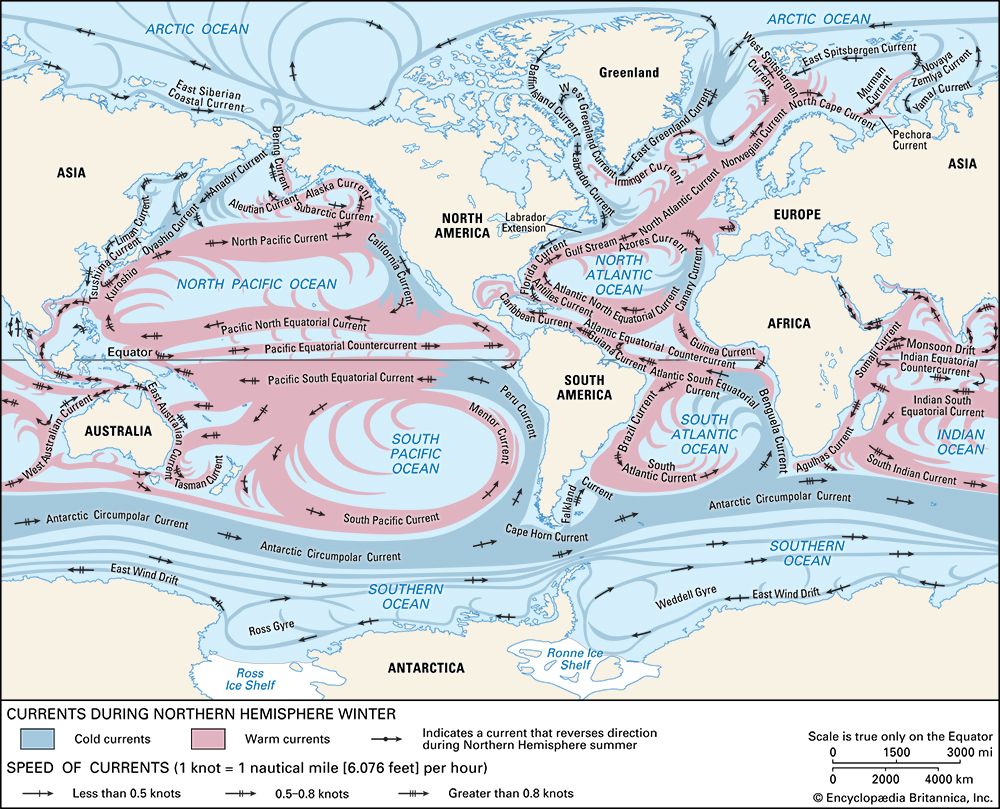
Currents facilitate the vertical and horizontal movement of nutrients, which is fundamental to primary productivity. By moving water between the seafloor and the surface, currents bring nutrient-rich deep water into the sunlit zone, fueling the growth of phytoplankton. This process supports the base of the marine food web, as seen in highly productive regions influenced by currents like the California Current, the Benguela Current, and the Peru Current.8109
Species Dispersal and Habitat
Currents influence the geographic range and survival of marine organisms by:
- Larval Transport: Mainstream currents such as the Gulf Stream and East Australian Current carry larvae over vast distances, allowing species to colonize new areas and maintaining genetic connectivity between populations.11
- Migration and Recruitment: Many species, such as eels, rely on specific current patterns for successful migration and recruitment to their habitats.11
- Climate Regulation: By redistributing heat from the tropics toward the poles, currents like the North Atlantic Current moderate regional climates, creating stable environments that support diverse ecosystems.89
Sources
- Ekman spiral — Encyclopædia Britannica
- ocean current - Coriolis effect — Encyclopædia Britannica
- ocean current - Ekman layer — Encyclopædia Britannica
- Ekman layer — Encyclopædia Britannica
- Marine ecosystem - Upwelling — Encyclopædia Britannica
- Equatorial current — Encyclopædia Britannica
- Coriolis force — Encyclopædia Britannica
- How Do Ocean Currents Affect the Biosphere? — Encyclopædia Britannica
- Marine ecosystem - Ocean currents — Encyclopædia Britannica
- plankton - Plankton and biological productivity — Encyclopædia Britannica
- Atlantic Meridional Overturning Circulation — Encyclopædia Britannica
Published on · 3 min read