Ochnaceae
Ochnaceae is a family of plants within the order Malpighiales that consists of approximately 27 genera and 495 species of tropical trees and shrubs, along…
What is Ochnaceae?
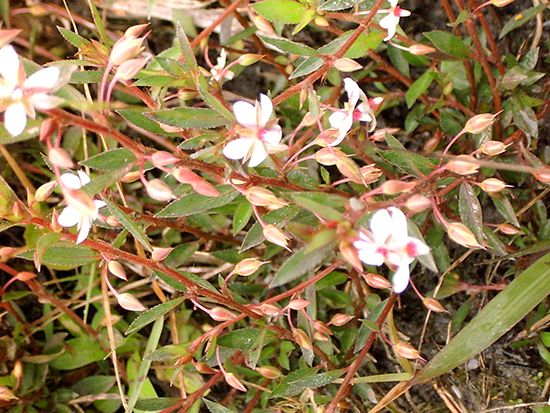
Ochnaceae is a family of plants within the order Malpighiales that consists of approximately 27 genera and 495 species of tropical trees and shrubs, along with a small number of herbs. Many of these plants are native to Brazil.1
Key characteristics of the family include:
- Foliage: Members typically feature alternate, simple leaves characterized by closely parallel lateral veins and distinct stipules.1
- Flowers: The flowers generally possess five petals and five sepals.1
- Diversity: The largest genus is Ouratea, which includes about 200 species, while the genus Ochna contains nearly 90 species.1
- Ornamental Use: Certain species, such as the carnival bush (Ochna multiflora), are cultivated as ornamentals due to their distinctive appearance, which includes yellow flowers and sepals that turn scarlet after the petals fall.1
What are the defining characteristics of the order Malpighiales?
The order Malpighiales is a vast and diverse group of flowering plants comprising 40 families, over 700 genera, and nearly 16,000 species. While it is morphologically coherent, it is notoriously difficult to define by a single set of characters, as it lacks highly distinctive, universal traits.3
However, several characteristics are commonly observed across the order:
- Foliage: Leaves are frequently toothed and stipulate.3
- Floral Structure: The basic floral construction resembles that of basal eudicots. Flowers typically feature free sepals and petals, often 10 free stamens, a nectary, and superior ovaries composed of three to five fused carpels.3
- Seed Characteristics: Seeds generally contain little endosperm, and the seed coat typically possesses a fibrous layer.3
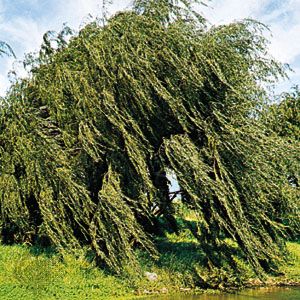
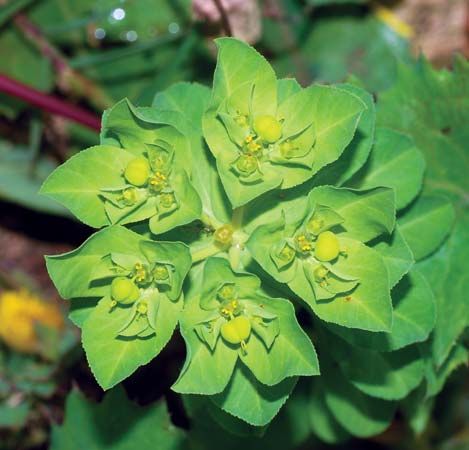
Malpighiales is classified within the Rosids I group of the core eudicots and is supported as a strong clade through molecular analysis. The order includes well-known families such as Salicaceae (willow family), Violaceae (violet family), and Euphorbiaceae (spurge family).3
How do tropical plants adapt to their environments?
Tropical plants have evolved diverse adaptations to survive the intense competition for resources and the constant pressure of herbivory in their environments.
Competition for Resources
- Light: Because only about 1 percent of sunlight reaches the forest floor, many plants have adapted to grow as epiphytes, which live on other plants to access light without soil contact. Others, like lianas, use hooks to climb toward the canopy. Stranglers begin as epiphytes before sending roots to the ground to eventually overtake their host.
- Nutrients: To thrive in nutrient-poor soils, many trees form symbiotic mycorrhizal associations with fungi to efficiently absorb phosphorus. Plants also utilize shallow root systems to capture nutrients from rapidly decomposing surface litter.
Defense Against Herbivory
- Chemical and Structural Defenses: Plants produce defensive chemicals like alkaloids or latex to deter herbivores. Structural defenses include spines, thorns, and toughened leaves.
- Growth Strategies: Many plants protect young, nutrient-rich leaves with higher concentrations of chemical defenses. Others use synchronous leaf production to satiate herbivores, or they rely on defensive mutualisms, such as ants that protect the plant from insects.
What are some other examples of ornamental plants found in tropical regions?
Tropical regions are home to a vast array of ornamental plants, many of which are prized for their striking foliage or vibrant flowers. Beyond the well-known orchids, here are several notable examples:
Foliage Plants
Many tropical plants are cultivated for their decorative leaves, which often feature unique patterns, textures, or variegations:
- Aroids: This family includes the philodendrons, such as the Swiss cheese plant, as well as dumb canes, Chinese evergreens, and pothos.
- Prayer Plants: Species of Maranta and the peacock plant (Calathea makoyana) are noted for their intricate leaf designs and nocturnal movement.
- Other Decorative Foliage: Crotons offer brilliant, multicolored leaves, while the aluminum plant and various Peperomia species provide unique textures and silver-patterned foliage.
Flowering and Structural Plants
- Bromeliads: These plants, including genera like Billbergia and Cryptanthus, are often grown for their colorful bracts and rosette forms.
- Flowering Herbs: Peace lilies and Anthurium are popular for their elegant, flowerlike spathes.
- Palms: Iconic in tropical landscapes, such as the royal palms found in the Rio de Janeiro Botanical Garden.
Sources
- Ochnaceae — Encyclopædia Britannica
- Ochnaceae — Merriam-Webster
- Malpighiales — Encyclopædia Britannica
- Malvales — Encyclopædia Britannica
- Eating the rainforest — Encyclopædia Britannica
- epiphyte — Encyclopædia Britannica
- Tropical rainforest - General structure of the rainforest — Encyclopædia Britannica
- houseplant - Foliage plants — Encyclopædia Britannica
- houseplant - Types of houseplants — Encyclopædia Britannica
- Rio de Janeiro Botanical Garden — Encyclopædia Britannica
- horticulture - Tropical zones — Encyclopædia Britannica
Published on · 3 min read