Kori Bustard
The kori bustard (Ardeotis kori) is a large bird native to Africa, notable for being the world’s heaviest living flying animal. These birds inhabit…
What is Kori bustard?
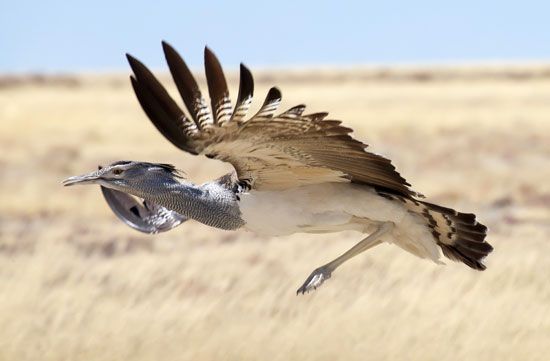
The kori bustard (Ardeotis kori) is a large bird native to Africa, notable for being the world’s heaviest living flying animal. These birds inhabit grasslands, semidesert areas, and thornveld in two distinct regions: East Africa and Southern Africa.1
Adult males can reach up to 1.3 meters (4.2 feet) in height and weigh 18.1 kg (40 pounds) or more, while females are significantly smaller. As omnivores, they forage primarily on the ground for insects, small vertebrates, and plant matter. Because they lack a hind toe, they cannot perch in trees, making them ground-dwellers that prefer walking over flying.1
Currently classified as near threatened, the species faces population declines due to habitat loss, collisions with power lines, and exposure to agricultural poisons. They utilize a polygynous mating system where males congregate in leks to perform elaborate displays for females.1
What is sexual dimorphism and how does it affect Kori bustards?
Sexual dimorphism refers to the distinct differences in appearance—such as size, color, or structure—between males and females of the same species. These variations often arise through sexual selection, where specific traits provide an advantage in securing mates, even if those traits might otherwise be disadvantageous for survival.31
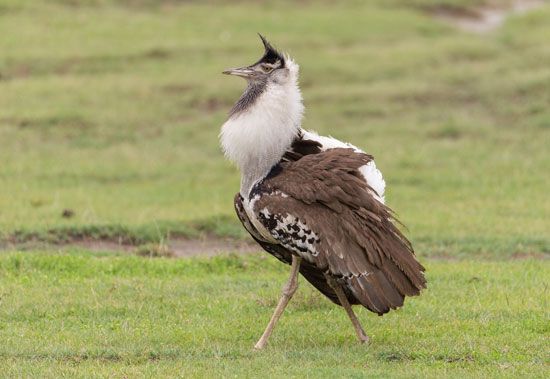
In the case of the kori bustard, sexual dimorphism is pronounced, particularly regarding size. Adult males are significantly larger than females, measuring up to 1.3 meters (4.2 feet) tall and weighing 18.1 kg (40 pounds) or more. Females are roughly 20 percent shorter and weigh about half as much as their male counterparts.4
This size difference is closely linked to their polygynous mating system. During the breeding season, males congregate in leks to compete for the attention of females. Males perform elaborate displays, such as puffing out their throats to four times their normal size and fanning their plumage to appear as large as possible. This behavior, combined with their physical stature, is intended to woo females, allowing successful males to mate with multiple partners.45
Why are Kori bustards considered near threatened?
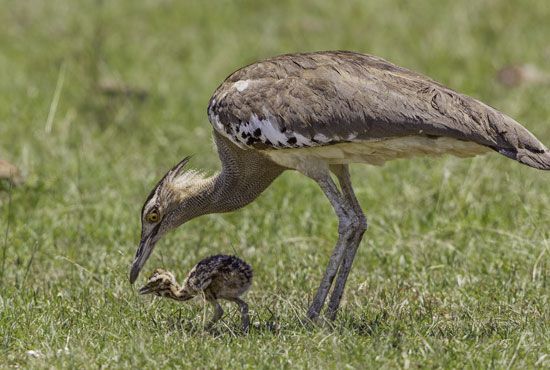
The kori bustard has been classified as near threatened by the International Union for Conservation of Nature (IUCN) since 2013 due to significant population declines and a narrowing of their geographic range.14
Several human-related factors contribute to this status:
- Infrastructure and Agriculture: Collisions with electrical power lines are a notable cause of mortality, particularly in Southern Africa. Additionally, the birds are frequently exposed to poisons intended for locusts and other agricultural pests.14
- Habitat Alteration: The conversion of natural grasslands and scrubland into grazing land has caused ecological disturbances, leading to a reduction in the species’ historical range.14
- Direct Exploitation: Kori bustards have historically been hunted for meat, and between 1990 and 2010, many individuals were captured in Tanzania for the pet trade.14
These combined pressures have resulted in an estimated population decline of up to 29 percent between 1970 and 2016.14
What are some other examples of large flightless or heavy flying birds?
Birds exhibit a wide range of adaptations related to size and the ability to fly. When birds lose the power of flight, they are often able to reach much larger body sizes, as they are no longer constrained by the physical limitations of aerial locomotion.67
Flightless Birds
Many flightless birds belong to a group known as ratites, which are characterized by a smooth, keel-less breastbone that cannot anchor the large muscles required for flight. Notable examples include:89
- Ostrich: The largest living bird, capable of reaching 2.75 meters (9 feet) in height and weighing up to 150 kg (330 pounds).6
- Emu, Cassowary, and Rhea: Other prominent ratites adapted for running.89
- Kiwi: A smaller, flightless bird native to New Zealand.89
- Extinct Giants: The moa of New Zealand and the elephant bird of Madagascar were massive, with some species reaching over 3 meters (10 feet) in height. The elephant bird Vorombe titan is considered the largest bird to have ever lived, weighing up to 860 kg (1,895 pounds).1069
- Penguins: Unlike ratites, penguins have retained a keel, but it has evolved to support paddlelike wings for swimming rather than flight.9
Heavy Flying Birds
For birds that do fly, size is limited by the relationship between weight and wing area; as a bird grows, its weight increases by the cube of its dimensions, while its wing area only increases by the square. Despite these constraints, some species are remarkably heavy:67
- Trumpeter swan: One of the heaviest flying birds, weighing up to 17 kg (37 pounds).6
- Wandering albatross: While not necessarily the heaviest, it possesses the greatest wingspan of any living bird, reaching up to 3.5 meters (11.5 feet).6
Sources
- Kori bustard — Encyclopædia Britannica
- kori bustard — Merriam-Webster
- Sexual dimorphism — Encyclopædia Britannica
- Kori bustard: Top Questions — Encyclopædia Britannica
- sexual selection — Encyclopædia Britannica
- Ratite — Encyclopædia Britannica
- Bird: Top Questions — Encyclopædia Britannica
- Flightless bird — Encyclopædia Britannica
- Bird - General features — Encyclopædia Britannica
- Falconiform - Flapping, soaring , and diving — Encyclopædia Britannica
- Bird - Flightlessness — Encyclopædia Britannica
- Charadriiform - Adaptations for flight — Encyclopædia Britannica
Published on · 4 min read