Pamlico Sound
Pamlico Sound is a shallow body of water located along the eastern coast of North Carolina, U.S. As the largest sound on the East Coast, it is separated from…
What is Pamlico Sound?
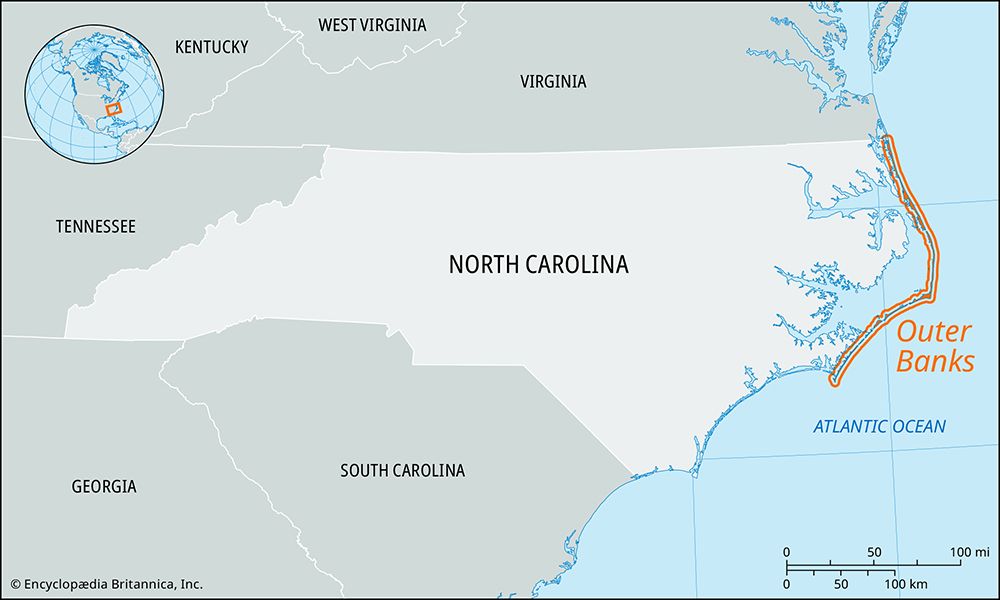
Pamlico Sound is a shallow body of water located along the eastern coast of North Carolina, U.S. As the largest sound on the East Coast, it is separated from the Atlantic Ocean by the Outer Banks, a chain of narrow barrier islands that includes Cape Hatteras.1
The sound extends approximately 80 miles from Roanoke Island to Cedar Island, with widths ranging from 15 to 30 miles and a maximum depth of 26 feet. It is connected to Albemarle Sound to the north and receives water from several rivers, including the Neuse and the Tar-Pamlico. The area is ecologically significant, serving as a nesting ground for various waterfowl, and supports commercial and recreational fishing for species such as blue crabs and oysters. The name of the sound is derived from the Pamlico people.1
How do barrier islands like the Outer Banks form?
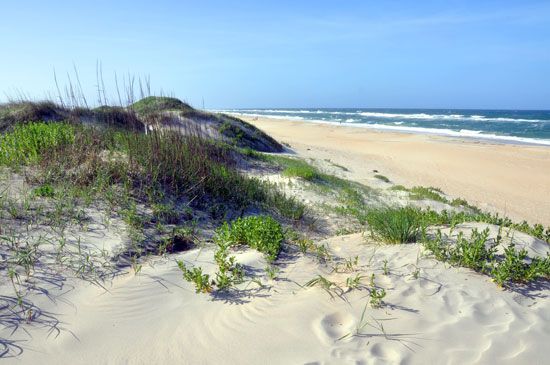
Barrier islands, such as the Outer Banks, are long, sandy landforms that develop parallel to the coast through the interaction of waves, currents, and wind. They typically form in areas with low-lying coasts where the coastal slope is flatter than the equilibrium slope required by incoming waves.4567
The formation process involves several key factors:
- Deposition: Waves and longshore currents transport and deposit sand along the shore, building up an equilibrium profile.46
- Wind Action: Once a barrier begins to accumulate, wind can further raise the elevation by forming coastal dunes.47
- Sea Level Dynamics: As sea level rises, the land behind these growing barriers often floods, creating a lagoon between the island and the mainland.7
- Alternative Origins: Some barriers may form through the extension of a spit that eventually encloses a bay, or through the accumulation of material from glacial outwash streams.7
These islands serve as vital buffers, protecting the mainland from the full force of the ocean while being periodically reshaped by tidal inlets and storm activity.45
What are the main differences between a sound and a bay?
While both are coastal features, a bay and a sound are distinguished by their formation and physical characteristics.
A bay is a concavity or reentrant of a coastline, typically semicircular or nearly circular in shape. Bays are often formed by the differential erosion of rock types, where softer rocks are worn away more rapidly than harder, more resistant formations. They are generally sheltered and can vary significantly in size, from small coastal indentations to massive bodies of water like Hudson Bay.9
In contrast, a sound is typically a long, broad inlet of the ocean that runs generally parallel to the coast. It may also function as a long passage of water that connects two larger bodies of water or separates a mainland from an island. Unlike the semicircular nature of a bay, a sound is defined by its elongated, channel-like geometry. While a bay is often a protected indentation, a sound often serves as a connecting corridor between larger maritime areas.109
Who were the Pamlico people?
The Pamlico were an Algonquian-speaking Indigenous people who resided along the Pamlico River in present-day Beaufort County, North Carolina, at the time of their first contact with Europeans. They were sedentary agriculturists whose population was devastated by a smallpox epidemic in 1696.13
By 1710, only 75 survivors remained in a single village. During the Tuscarora War (1711–1713), the Pamlico joined forces with the Tuscarora and other tribes to resist white settlers. Following the conflict, the Tuscarora entered into a treaty with the English that included an agreement to exterminate the Pamlico. The remaining survivors were likely absorbed into the Tuscarora population as slaves. The name of the Pamlico Sound—the largest sound on the U.S. East Coast—is derived from this tribe.131
Sources
- Pamlico Sound — Encyclopædia Britannica
- Pamlico — Merriam-Webster
- Albemarle Sound — Encyclopædia Britannica
- Outer Banks — Encyclopædia Britannica
- coastal landforms - Barrier island/estuarine systems — Encyclopædia Britannica
- lagoon - Barrier bars and sediment sources — Encyclopædia Britannica
- lagoon - Waves , tides, and surf — Encyclopædia Britannica
- barrier island — Merriam-Webster
- bay — Encyclopædia Britannica
- sound — Merriam-Webster
- sound — Merriam-Webster
- bays — Merriam-Webster
- Pamlico — Encyclopædia Britannica
Published on · 3 min read