Pandanus
Pandanus plants, commonly known as screw pines, are native to the tropical and subtropical regions of the Old World, also referred to as the Paleotropics.…

In which regions of the world are pandanus plants commonly found?
Pandanus plants, commonly known as screw pines, are native to the tropical and subtropical regions of the Old World, also referred to as the Paleotropics. They are widely distributed across coastal areas, marshy environments, and forests in Asia, Africa, and Oceania.12
These plants are particularly abundant in the Malay Archipelago, Melanesia, and Madagascar. Additionally, they are found in several other locations, including:2
- Pacific and Indian Oceans: Hawaii, Micronesia, and the Seychelles.12
- East and Southeast Asia: Southern China, Japan, Thailand, Malaysia, and Indonesiacom/place/Malaysia), and Indonesia.12
- Other regions: New Zealand, Sri Lanka, the Philippines, and northern Australia.2
While they primarily thrive in tropical habitats, some species are cultivated as ornamentals or houseplants in warmer regions globally.12
What are the distinctive physical characteristics of pandanus plants?
Pandanus plants, commonly known as screw pines, possess several distinctive physical characteristics that make them easily identifiable:
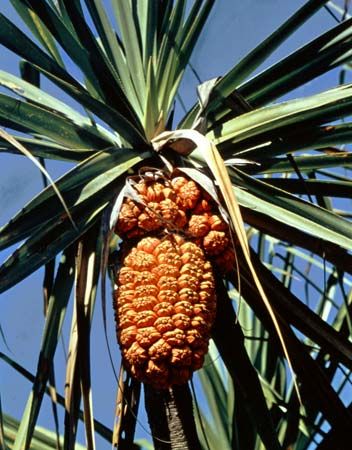
- Growth Habit: These plants typically feature slender, palmlike stems. Many species grow as trees reaching up to 20 meters (about 65 feet) in height, while others exist as shrubs. A defining feature is the presence of large, often massive aerial prop or stilt roots that emerge from the trunk and stems to provide support.12
- Leaf Arrangement: The plants are named for their leaves, which are arranged in three or four close, twisted ranks around the stem. This spiral configuration creates a screwlike helix at the branch tips.12
- Leaf Structure: The leaves are long, narrow, and swordlike. They are typically leathery and rigid, featuring parallel veins and spiny margins and midribs.12
- Flowers: The flowers are simple and lack petals. They are usually densely clustered and dioecious, meaning male and female flowers are produced on separate plants.12
- Fruits: Many species produce heavy, ball-shaped or conelike aggregate fruits. These are formed by the coalescence of developing ovaries from adjacent flowers. The fruits often contain hollow spaces, allowing them to float and aid in dispersal.12
What symbolic or cultural significance do pandanus plants have in various societies?
While the provided search results do not detail specific symbolic or spiritual meanings, they highlight the deep cultural integration of Pandanus plants in various societies, particularly in Polynesia and Southeast Asia.
In traditional Polynesian cultures, the plant is highly valued for its versatility and aesthetic contributions to daily life. The fruit is prized as a form of chewing gum and is a key component in the creation of floral necklaces and headpieces, where its strong, pleasant color is particularly appreciated. Furthermore, the leaves serve as essential raw materials for weaving fine mats, which are significant cultural items in many Pacific island societies.13
Beyond its aesthetic and utilitarian roles, the plant is deeply embedded in regional traditions:
- Culinary Significance: In Southeast Asia, the leaves of P. amaryllifolius are a staple in cooking, while the essence of P. tectorius flowers, known as kewra water, is used as a flavoring in North Indian cuisine.3
- Practical Utility: Across its range, the plant provides vital materials for thatching, baskets, ropes, and sails for small boats, reflecting its importance in the material culture of coastal and island communities.3
We could dive deeper into the specific weaving techniques used for these leaves or explore the historical trade of Pandanus products across the Pacific.
What are some common species of pandanus, and how do they differ?
The genus Pandanus comprises approximately 600 to 700 species, which vary significantly in their size, habitat, and primary uses. While they share the characteristic “screw pine” appearance, they are distinguished by their specific adaptations and utility:
- Thatch Screw Pine (P. tectorius): Native to Micronesia and Hawaii, this species is widely used for its leaves in weaving mats, hats, and baskets. Its flowers produce an essence known as kewra water, used as a flavoring in North Indian cuisine.1
- Common Screw Pine (P. utilis): Often grown as an ornamental houseplant, this species is valued for its edible fruits and seeds, as well as its leaves, which are utilized for fiber products.12
- Pandan (P. amaryllifolius): This species is primarily recognized for its culinary importance in Southeast Asia, where its leaves are used to flavor various dishes.1
- Nicobar Islands Breadfruit (P. leram): Notable for its edible, starchy fruits, this species serves as a food source in its native regions.12
- Dwarf Pandanus (P. pygmaeus): A smaller species frequently cultivated as a greenhouse subject.1
- Candelabrum Tree (P. candelabrum): An African species grown as an outdoor ornamental; it is also noted for its potential role as an indicator of diamond-bearing kimberlite deposits.1
Sources
- pandanus — Encyclopædia Britannica
- Pandanales - Pandanaceae — Encyclopædia Britannica
- Polynesian culture - Gardening of Polynesian culture — Encyclopædia Britannica
Published on · 4 min read