Paraná Pine
The Paraná pine (Araucaria angustifolia) is an important evergreen conifer native to the mountains of southern Brazil, Paraguay, and Argentina. Despite its…
What is Paraná pine?
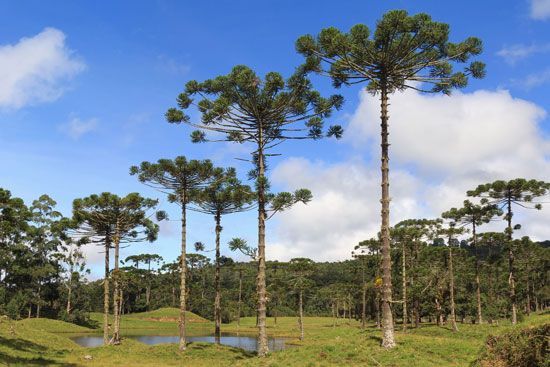
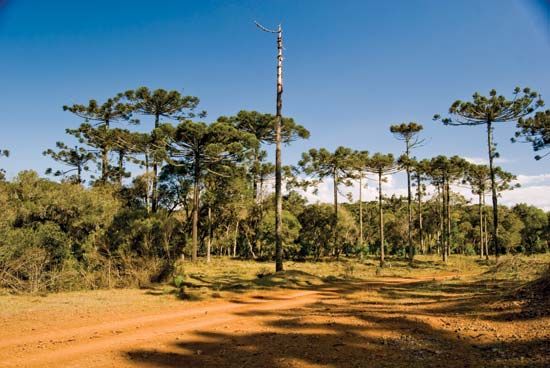
The Paraná pine (Araucaria angustifolia) is an important evergreen conifer native to the mountains of southern Brazil, Paraguay, and Argentina. Despite its common name, it is not a true pine.1
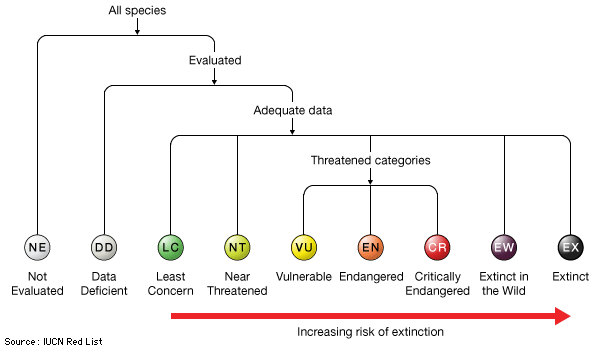
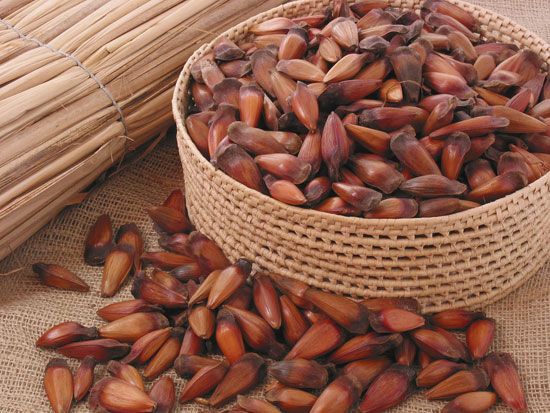
The tree can reach heights of 30 metres (100 feet) and features a long, bare trunk with a crown of upturned, tufted branches. It is a dioecious species, meaning male and female cones grow on separate individuals, and its seeds are edible. While valued for its timber and used as an ornamental, the species is critically endangered in its native range due to logging and habitat loss. Protecting such vulnerable species is essential for maintaining global biodiversity.12
What is the difference between a true pine and a conifer like the Paraná pine?
The term “pine” is often used colloquially for many conifers, but botanically, a “true pine” refers specifically to the genus Pinus within the family Pinaceae. While the Paraná pine (Araucaria angustifolia) is a conifer, it belongs to an entirely different family, Araucariaceae.4156
The primary differences between them include:
- Family and Classification: True pines belong to the family Pinaceae, which is the largest and most widespread conifer family in the Northern Hemisphere. The Paraná pine belongs to the family Araucariaceae, a group with distinct evolutionary lineages found primarily in the Southern Hemisphere.617
- Reproductive Structures: True pines are monoecious, meaning both male and female cones grow on the same tree. In contrast, the Paraná pine is typically dioecious, with male and female cones appearing on separate individual trees.4857
- Leaf Morphology: True pines typically have needlelike leaves that grow in bundles (fascicles). The Paraná pine features sharp, triangular, leathery, and scalelike leaves that are spirally arranged along the branches.4857
- Cone Structure: In true pines, the seed-bearing cones have spirally arranged scales that are often fused to bracts. Araucariaceae cones are generally more massive, with highly reduced scales that are completely fused to much larger bracts, often producing a single large seed per scale.486
Why is the Paraná pine considered a critically endangered species?
The Paraná pine (Araucaria angustifolia) is classified as critically endangered within its native range primarily due to two major human-driven factors:
- Logging: The species has been historically targeted as an important source of timber, leading to significant population declines.1
- Habitat Loss: The conversion of its native mountain forest environments in southern Brazil, Paraguay, and Argentina into other land uses has severely restricted the tree’s natural range.1
The loss of such unique species is a serious environmental concern, as preserving biodiversity is a fundamental ethical responsibility to ensure the health of our planet’s ecosystems.1
What is a monkey puzzle tree and how is it related to the Paraná pine?
The monkey puzzle tree (Araucaria araucana) is an evergreen conifer native to the Andes Mountains of South America. Known for its stiff, spirally arranged, needle-pointed leaves, it can reach heights of up to 50 meters and live for over 700 years. Its common name stems from the observation that its prickly, dense network of branches would pose a significant challenge to any monkey attempting to climb it.92
The monkey puzzle tree and the Paraná pine (Araucaria angustifolia) are closely related as members of the same genus, Araucaria, and the same family, Araucariaceae. Both species share key characteristics, including:
- Dioecious nature: Male and female cones are typically borne on separate individual trees.92
- Edible seeds: Both species produce seeds that are considered edible.92
- Growth habits: They are both valued as ornamental trees due to their distinct, symmetrical, and often whorled branching patterns.2
We could dive deeper into the evolutionary history of the Araucariaceae family or discuss other notable species within the Araucaria genus.
Sources
- Paraná pine — Encyclopædia Britannica
- Araucaria — Encyclopædia Britannica
- Paraná pine — Merriam-Webster
- Pinaceae — Encyclopædia Britannica
- conifer — Encyclopædia Britannica
- conifer - Annotated classification — Encyclopædia Britannica
- pine - Physical description and natural history — Encyclopædia Britannica
- pine — Encyclopædia Britannica
- monkey puzzle tree — Encyclopædia Britannica
Published on · 3 min read