Parchment Worm
The term "parchment worm" refers to any species within the genus Chaetopterus, which are segmented worms belonging to the class Polychaeta and the phylum…
What is parchment worm?
The term “parchment worm” refers to any species within the genus Chaetopterus, which are segmented worms belonging to the class Polychaeta and the phylum Annelida.1
These marine animals are named for the U-shaped tubes they construct on the sea bottom, which are lined with a distinct parchmentlike material. A well-known example is C. variopedatus, found in both the Atlantic and Pacific oceans, which can grow to approximately 25 cm (10 inches) in length. They are classified under the family Chaetopteridae.12
How do parchment worms filter feed?
Parchment worms (Chaetopterus) are filter feeders that utilize a specialized mechanism to strain nutrients from the water within their U-shaped burrows.
To capture food, the worm uses a bag of mucus secreted by specialized body appendages. As the worm pumps water through its burrow, this mucus bag acts as a filter, straining particles from the water. The mesh of this bag is remarkably fine, with openings approximately 40 angstroms wide, allowing the worm to trap even single molecules of large proteins.
The feeding process is cyclical: every 20 minutes, the worm consumes the food-laden mucus bag and replaces it with a new one to continue the process.1
What are other types of marine annelids?
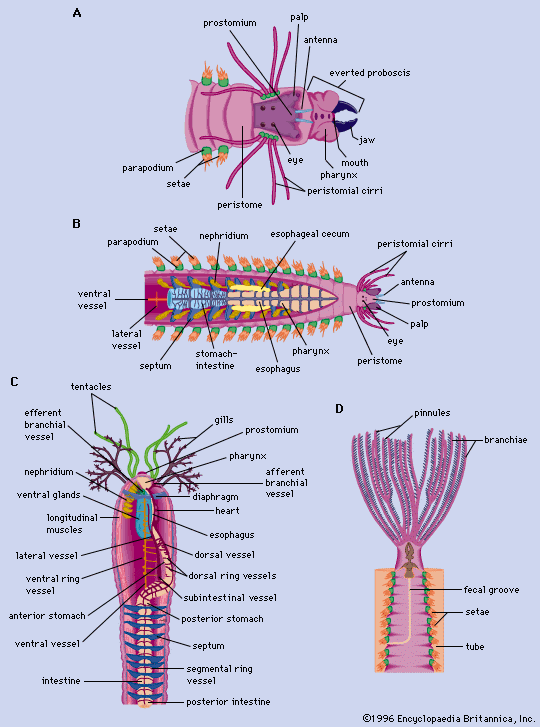
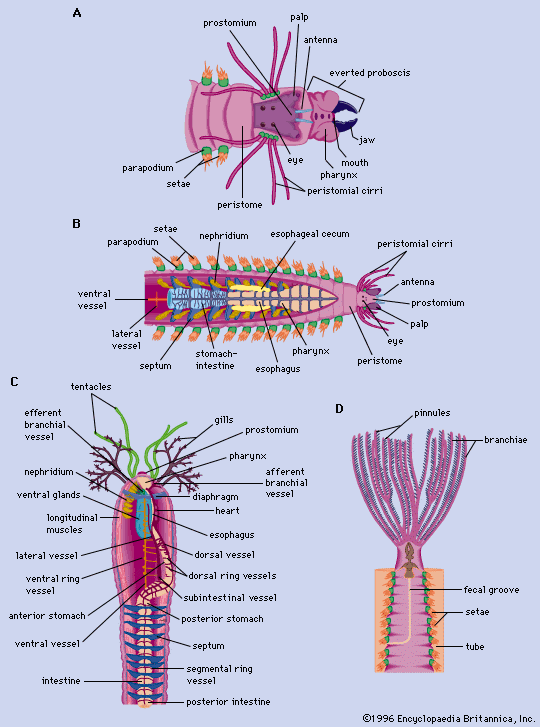
Marine annelids are primarily classified within the class Polychaeta, a diverse group of over 8,000 species known for their well-defined body segmentation and parapodia—flat, lobelike outgrowths equipped with tiny bristles called setae. These worms are generally categorized into two informal groups: the errantia (free-moving forms) and the sedentaria (tube-dwelling forms).45
Common examples of marine polychaetes include:
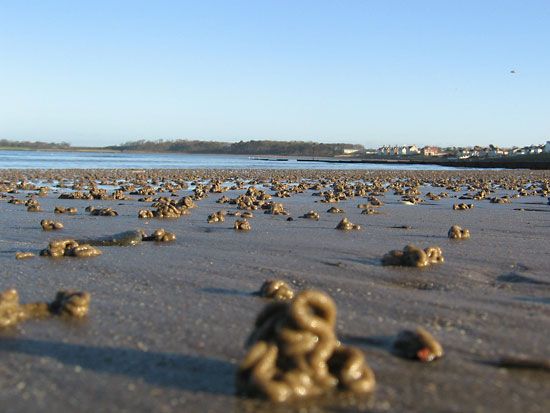
- Lugworms (Arenicola): Large, burrowing worms that live in sandy sea bottoms or intertidal zones. They ingest sand to feed on decayed organic matter and are frequently used as fishing bait.467
- Peacock worms (Sabella): A type of fanworm that constructs tubes from mud and mucus. They use a crown of feathery, striped tentacles to trap suspended particles for food and respiration.8
- Rag worms, bloodworms, and sea mice: Other well-known members of the polychaete class that exhibit a wide range of sizes and behaviors, from free-swimming carnivores to specialized bottom-dwellers.4
- Palolo worms: Notable for their massive swarming behavior during breeding, which makes them a traditional food source in parts of the South Pacific.4
How do U-shaped tubes protect these worms?
U-shaped tubes provide essential protection and structural support for sedentary polychaetes. These tubes are constructed from substances secreted by the worm’s epidermis, such as mucus, parchment, or calcium carbonate, often reinforced with adhered sediment.9
By living within these protective shells, the worms are shielded from environmental hazards and predators. The tube also facilitates the worm’s specialized lifestyle; for instance, it allows the animal to maintain a stable position while extending its gills or tentacles to gather food and exchange gases. Additionally, many tube-dwelling species possess an external fecal groove, which allows them to efficiently move waste away from their living space, ensuring the tube remains a clean and functional environment.9
We could dive deeper into the specific materials different species use to build their tubes or explore how these structures influence the evolution of sedentary behaviors.
Sources
- parchment worm — Encyclopædia Britannica
- parchment worm — Merriam-Webster
- Feeding behaviour - Types of food procurement — Encyclopædia Britannica
- polychaete — Encyclopædia Britannica
- annelid — Encyclopædia Britannica
- peacock worm — Encyclopædia Britannica
- lugworm — Encyclopædia Britannica
- lugworm — Merriam-Webster
- worm tube — Merriam-Webster
- tube worm — Encyclopædia Britannica
- annelid - Polychaetes — Encyclopædia Britannica
Published on · 2 min read