Polychaete
Polychaetes utilize a combination of muscular action and specialized body structures to achieve locomotion, with methods varying significantly between…
How do polychaetes move and what structures do they use for locomotion?
Polychaetes utilize a combination of muscular action and specialized body structures to achieve locomotion, with methods varying significantly between free-moving and sedentary species.12
Locomotion in Free-Moving Polychaetes
Free-moving polychaetes rely on a hydrostatic skeleton, utilizing coelomic fluid as a medium against which circular, longitudinal, and parapodial muscles work.23
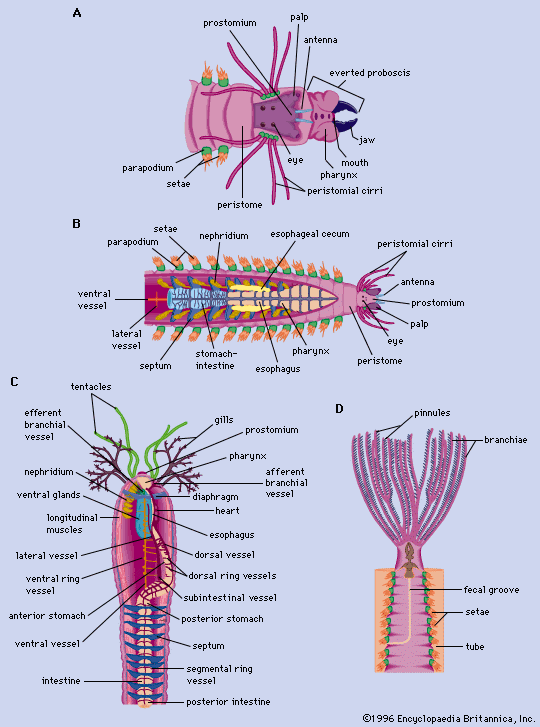
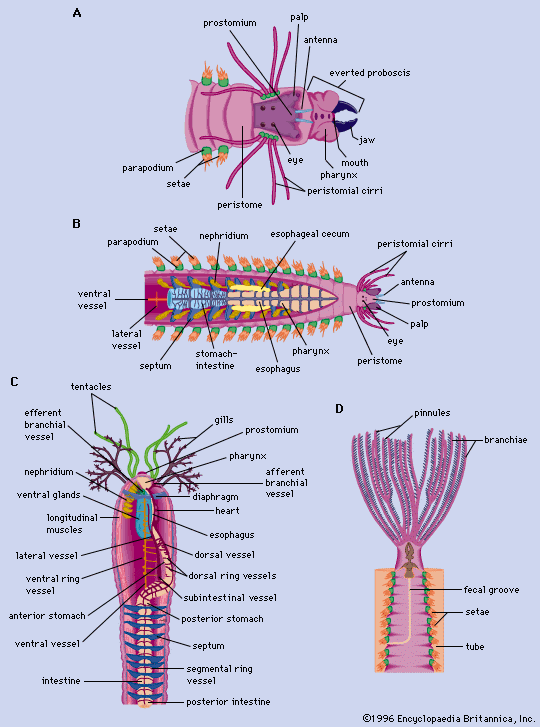
- Parapodia: Most segments bear paired, lobelike outgrowths called parapodia, which are essential for movement. During slow crawling, the worm uses a sweeping motion of these appendages.142
- Aciculae: These needlelike processes are projected beyond the parapodium to gain traction on the surface during the backward, effective stroke. During the forward recovery stroke, the aciculae retract, lifting the parapodium free.24
- Undulations: For rapid movement, polychaetes produce body undulations through the contraction of longitudinal muscles, which are stimulated by the backward stroke of the parapodia.2
Locomotion in Sedentary and Burrowing Forms
- Burrowing: Species that lack anterior appendages often move similarly to earthworms, employing peristaltic waves or a contract-anchor-extend method to navigate through soil or mud.25
- Tube-dwelling: In sedentary forms, such as the Sabellidae, movement is restricted to the interior of their tubes. In these species, parapodia are often reduced or absent, and specialized setae called uncini function to facilitate movement within the tube.2
Can you describe some of the most common or well-known species of polychaetes?
Polychaetes, a diverse class of marine worms, are categorized into free-moving (errantia) and tube-dwelling (sedentaria) forms. Here are some of the most well-known species:
- Rag worms: These are common marine or shore worms, also known as sandworms, pileworms, or mussel worms. They feature retractable jaws and numerous parapodia used for locomotion. Species such as Nereis virens are frequently used by fishermen as bait.71
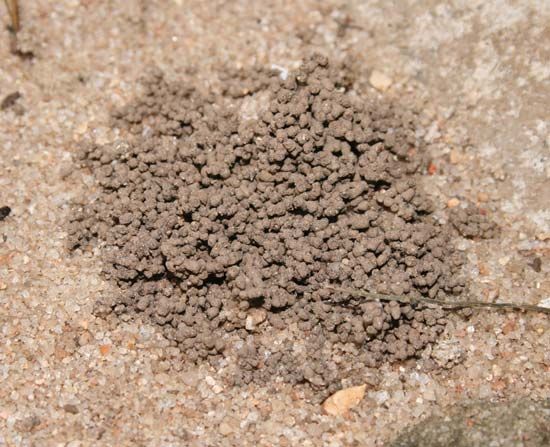
- Lugworms: Belonging to the genus Arenicola, these worms burrow deep into sandy sea bottoms. They are characterized by a segmented body with a row of feathery gills along their sides. They are well-known for the coiled casts of excrement they leave on the surface at low tide.89
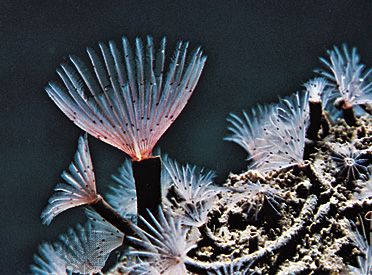
- Feather-duster worms: Members of the family Sabellidae, these worms construct tubes out of mud or sand. They are named for their vibrant, multicoloured crown of tentacles, which they extend for feeding and respiration but retract quickly when threatened.10
- Scale worms: These worms are often found in commensal relationships, living in the tubes of other polychaetes or on the bodies of hosts like starfish. Some species, such as Halosydna, possess specialized cells that allow them to produce light.11
- Palolo worms: These are notable for their unique reproductive swarming behavior, where they emerge in great abundance at breeding time. In parts of the South Pacific, they are harvested and consumed as human food.1
What types of feeding strategies do different polychaete species employ?
Polychaete feeding strategies are highly diverse, reflecting an evolutionary interplay between their structural anatomy—particularly the anterior end—and their specific ecological niches. These strategies are generally categorized by the type of food procurement:114
Filter Feeding
Filter feeders strain suspended organic and inorganic particles from the water column.115
- Tentacular feeding: Species such as the peacock worm (Sabella) extend ciliated, feathery tentacles to trap passing particles in mucus, which are then transported to the mouth.141516
- Mucous-bag feeding: The parchment worm (Chaetopterus) pumps water through its burrow and captures fine material in a secreted mucous bag, which it periodically consumes and replaces.114
Deposit Feeding
Deposit feeders consume material found within or on the surface of seafloor sediments.1413
- Surface-deposit feeding: These worms may use an unarmed pharynx or long, ciliated tentacles to collect material from the surface.14
- Burrowing: Many polychaetes ingest sediment directly as they burrow, extracting organic nutrients from the substrate.1413
Predatory and Selective Feeding
Many free-moving polychaetes are selective feeders that actively hunt or scavenge.114
- Carnivorous feeding: These species often possess a pharynx equipped with powerful jaws (e.g., Glycera) to seize and swallow prey.14
- Selective scavenging: Some species analyze their environment using sensory organs to choose specific food items, a behavior often associated with higher mobility and complex nervous systems.1
What is the evolutionary history of polychaetes and how long have they existed on Earth?
Polychaetes are believed to have evolved in marine environments, potentially originating from an ancestral flatworm that developed through the trochophore larva stage. Because polychaetes lack hard body parts, their fossil record is limited, consisting primarily of tubes and jaws.19
Evidence of their existence dates back to the Precambrian era, with some burrows and tubes interpreted as belonging to wormlike creatures from more than 620 million years ago. More definitive evidence appears in the Cambrian Period (approximately 570 to 500 million years ago), which contains the earliest records of their tough, chitinous jaws known as scolecodonts. While some theories have attempted to link polychaetes to conodonts—which appear in the fossil record as early as the Late Cambrian—significant differences in composition and growth patterns have largely discredited this hypothesis. Polychaetes appear to have undergone radiative evolution, where various characteristics were modified independently, making it difficult to identify a single ancestral order.1920
Sources
- polychaete — Encyclopædia Britannica
- annelid - Locomotion — Encyclopædia Britannica
- skeleton - Skeletomusculature of a mobile coelenterate — Encyclopædia Britannica
- Animal - Types of skeletons and their distribution — Encyclopædia Britannica
- Locomotion - Fossorial invertebrates — Encyclopædia Britannica
- annelid - Polychaetes — Encyclopædia Britannica
- rag worm — Encyclopædia Britannica
- feather-duster worm — Encyclopædia Britannica
- annelid - Distribution and abundance — Encyclopædia Britannica
- lugworm — Encyclopædia Britannica
- annelid - Ecology — Encyclopædia Britannica
- lugworm — Merriam-Webster
- annelid - Behaviour and associations. — Encyclopædia Britannica
- Feeding behaviour - Types of food procurement — Encyclopædia Britannica
- annelid - Food and feeding — Encyclopædia Britannica
- Filter feeding — Encyclopædia Britannica
- benthos — Encyclopædia Britannica
- peacock worm — Encyclopædia Britannica
- annelid - Evolution and paleontology — Encyclopædia Britannica
- Polychaete hypothesis — Encyclopædia Britannica
Published on · 4 min read