Parrot Fish
Parrotfish play a vital role in maintaining the health of coral reef ecosystems through their unique feeding habits. Using their characteristic birdlike…
How do parrotfish contribute to coral reef ecosystems?
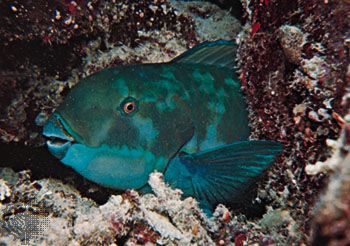
Parrotfish play a vital role in maintaining the health of coral reef ecosystems through their unique feeding habits. Using their characteristic birdlike beaks—formed by fused teeth—they scrape algae and soft coral tissue from the reef surface.1
By grazing on algae, these fish prevent it from overgrowing and smothering the coral, which is essential for the survival and growth of the reef structure. As they feed, they also grind up bits of coral with specialized platelike teeth in their throats, a process that contributes to the natural bioerosion and sediment production within the reef environment.1
How do parrotfish change their sex, and why do they do this?
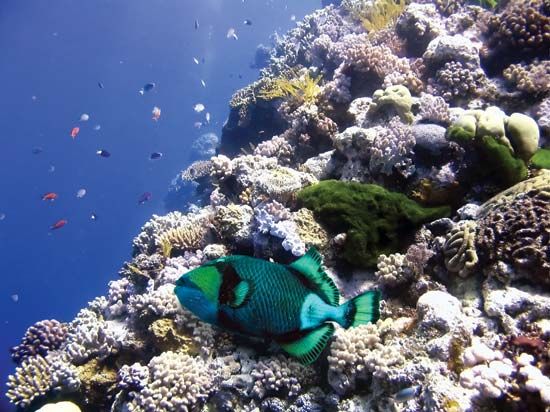
Parrotfish are protogynous hermaphrodites, meaning individuals function as females first and later transition into males.2
This biological process is driven by both physiological and ecological factors. Because bony fish gonads originate from simple tissue lacking fixed male or female elements, they are evolutionarily adaptable to pressures favoring sex change.2
The shift to male status is often linked to the following advantages:
- Energy Efficiency: Producing eggs requires significant energy, which is more easily managed by smaller individuals. As a fish grows larger, the energy demands of egg production may become less efficient compared to the reproductive role of a male.2
- Mating Systems: In many promiscuous mating systems, reproductive success is higher for larger, more experienced individuals. Transitioning to a male once the fish has reached a larger body size allows it to compete more effectively for mates.2
What are the unique physical characteristics of parrotfish?
Parrotfish, belonging to the family Scaridae, possess several distinct physical characteristics adapted for life on tropical reefs:
- Body Shape: They are typically elongated, deep-bodied, and blunt-headed, often covered in large scales.1
- Beak and Teeth: Their most defining feature is a birdlike beak formed by the fusion of jaw teeth, which is strong enough to scrape algae and coral from reef surfaces. Additionally, they possess heavy, pavementlike throat teeth used to crush the coral they ingest.13
- Coloration: These fish are known for their vibrant and variable colors. Their appearance often changes significantly based on age, size, and sex. For instance, the blue parrotfish transitions from a vertically barred pattern to a solid blue color as it matures. In many species, males and females exhibit different color patterns entirely.14
- Size: They can reach lengths of up to 1.2 meters (4 feet) and weigh approximately 20 kilograms (45 pounds), though some species are smaller.1
What is the economic importance of parrotfish in certain regions?
While parrotfish are edible, they are not considered to be of great economic importance as a group. Their primary value lies in their ecological role within tropical reef environments rather than as a significant commercial fishery.1
Sources
- parrot fish — Encyclopædia Britannica
- Reproductive behaviour - Fishes — Encyclopædia Britannica
- fish - The digestive system — Encyclopædia Britannica
- coloration - Age-related changes — Encyclopædia Britannica
Published on · 2 min read