Patch Dynamics
Patch dynamics shifts the focus of conservation from maintaining static, equilibrium-based states to managing ecosystems as dynamic, shifting mosaics. This…
What are the implications of patch dynamics for conservation and habitat management?
Patch dynamics shifts the focus of conservation from maintaining static, equilibrium-based states to managing ecosystems as dynamic, shifting mosaics. This perspective offers three primary implications for habitat management:
- Disturbance Management: Because natural disturbances like fire or grazing drive ecosystem heterogeneity, managers can effectively support conservation and ecological restoration by mimicking these natural disturbance regimes rather than suppressing them.
- Prioritizing Processes: Successful management should focus on maintaining ecosystem resilience and essential ecological processes (such as nutrient cycling) rather than aiming for rigid, predefined species compositions. This approach acknowledges that populations naturally fluctuate over time.
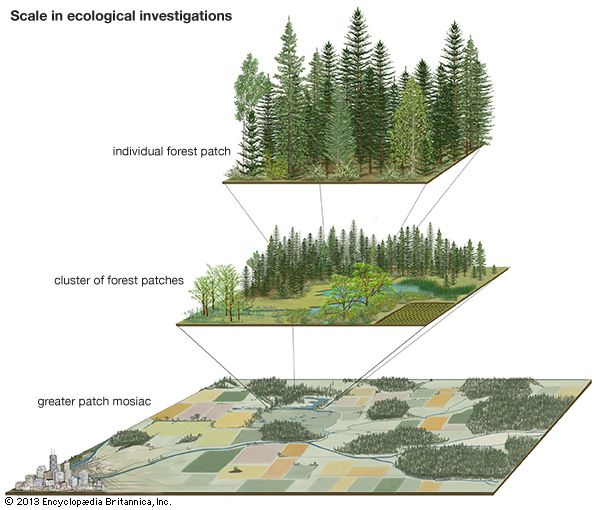
- Landscape-Scale Perspective: Since ecological processes operate across multiple scales, managers must adopt a landscape approach. This requires looking beyond individual patches to consider the broader environmental context, as the surrounding landscape significantly influences the dynamics of any specific habitat.
How do patch dynamics contribute to ecological succession?
Patch dynamics contributes to ecological succession by framing ecosystems as mosaics of patches that are constantly undergoing change due to ecological disturbances. Rather than viewing succession as a linear progression toward a static climax community, this perspective emphasizes that disturbances—such as windthrows, fires, or disease—create gaps within an ecosystem that initiate successional processes at a local scale.12
The relationship between patch dynamics and succession functions through several key mechanisms:
- Gap Initiation: When a disturbance creates an opening (a patch) in an environment like a forest canopy, it alters local conditions by increasing access to resources such as light and precipitation. This event triggers secondary succession within that specific patch.13
- Species Turnover: Within these patches, succession proceeds as species modify their environment. Pioneer species initially exploit the disturbed conditions, but as they alter factors like soil composition or shade, they are gradually replaced by species better suited to the modified habitat.2
- Shifting Mosaic Steady State: Because disturbances occur at different times and intensities across a landscape, the ecosystem as a whole exists as a collection of patches at various stages of successional development. This creates a “shifting mosaic steady state,” where the landscape remains relatively stable even as individual patches fluctuate through successional cycles.1
How do patches form and change over time in different ecosystems?
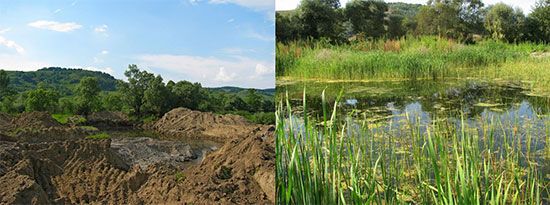
In ecology, patches are discrete spatial components of an ecosystem that vary in size, shape, composition, and duration. They form primarily through ecological disturbances, such as fires, floods, disease outbreaks, or human-induced land-use changes, which disrupt the continuity of a biological community.16
Formation and Dynamics
Patches are created when disturbances reduce populations or eliminate species from specific areas, effectively carving a mosaic into the landscape. The formation and subsequent evolution of these patches are influenced by several factors:1
- Disturbance Characteristics: The intensity, frequency, and scale of a disturbance determine the initial state of a patch. For instance, a small windthrow in a forest creates a canopy gap, while a large wildfire can fragment a continuous area into multiple distinct patches.613
- Size and Recovery: Patch size significantly impacts how an area changes over time. Small patches often recover rapidly through short-distance migration from surrounding areas, whereas large patches may persist longer as distinct features because they require more time for colonization by species from distant source populations.7
- Successional States: Patches can exist in different states, including potential (ready for colonization), active (currently undergoing colonization or succession), and degraded (abandoned or disturbed). Over time, patches undergo ecological succession, where early-arriving “fugitive” species are eventually replaced by more competitive, shade-tolerant species as the patch matures.813
Ecosystem Examples
- Forests: Composed of canopy gaps and clusters of trees of varying ages, where light and resource availability drive successional changes.1
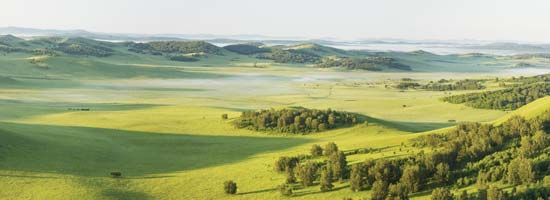
- Grasslands: Mosaics created by fire, grazing, and the heterogeneous distribution of soil nutrients.1
- Deserts: Often feature “fertility islands” where individual shrubs trap soil and water.1
- Aquatic Systems: Rivers contain patches like pools, riffles, and sandbars, while marine environments exhibit spatial patchiness in plankton distribution.18
What is the relationship between patch dynamics and landscape ecology?
Patch dynamics and landscape ecology are deeply intertwined, as both fields view ecosystems as spatially heterogeneous mosaics rather than static, uniform entities. Patch dynamics provides the theoretical framework for understanding how these mosaics function, while landscape ecology applies this perspective across broad geographic scales.1
The relationship is defined by several key concepts:
- Spatial Heterogeneity: Both fields emphasize that ecosystems consist of interactive spatial components (patches) that vary in size, composition, and duration. Landscape ecology treats these patches as the fundamental units of a landscape, which may encompass diverse areas like forests, grasslands, and urban zones.1
- The Role of Disturbance: Patch dynamics identifies ecological disturbances—such as fires, floods, or human land-use changes—as the primary drivers of spatial patterns. Landscape ecology relies on this understanding to analyze how these disturbances shape the structure and function of landscapes over time.1
- Hierarchical Structure: Through hierarchical patch dynamics, researchers recognize that ecological processes operate across multiple scales. A landscape is viewed as a nested mosaic where patch-level dynamics (like tree-gap succession) influence larger regional patterns.1
- Shift from Equilibrium: Both disciplines reject the traditional “equilibrium paradigm,” which assumed ecosystems return to a fixed state. Instead, they focus on the “shifting mosaic steady state,” where the landscape remains stable even as individual patches fluctuate.1
This synthesis has led to a modern “landscape approach” to conservation, which prioritizes ecosystem processes and resilience over the preservation of static, target end points.1
Sources
- patch dynamics — Encyclopædia Britannica
- ecological disturbance - Disturbance intensity and the pace of recovery — Encyclopædia Britannica
- patch dynamics: Top Questions — Encyclopædia Britannica
- ecological succession — Encyclopædia Britannica
- plant - Succession and zonation — Encyclopædia Britannica
- ecological disturbance - Spatial distribution — Encyclopædia Britannica
- ecological disturbance - Size distribution of patches — Encyclopædia Britannica
- community ecology - Types of succession — Encyclopædia Britannica
- ecological disturbance - Characteristics of disturbance and recovery — Encyclopædia Britannica
Published on · 4 min read