Nightjar
Nightjars communicate primarily through vocal and mechanical sounds, which serve as essential signals for mating and establishing territory. Their…
How do nightjars communicate, and what sounds do they make?
Nightjars communicate primarily through vocal and mechanical sounds, which serve as essential signals for mating and establishing territory. Their vocalizations are often so distinct that they have led to onomatopoeic names for various species, such as the whippoorwill and chuck-will’s-widow.1
The sounds produced by true nightjars vary by species:
- Vocalizations: Many produce slowly or rapidly repeated “churring” sounds, which can sometimes sound toadlike. Others emit warbled or whistled songs that may be repeated hundreds of times without interruption. These primary songs are unique to each species and are considered the most important mechanism for species recognition.1
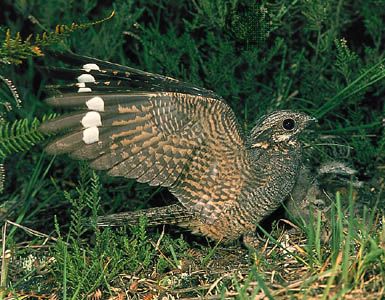
- Mechanical sounds: In addition to vocal calls, many nightjars produce mechanical sounds during displays, such as the clapping or whirring of their wings.1
Depending on the species, these sounds may be performed while the bird is in flight or while it is perched.1
Are there any conservation concerns related to nightjar species, and if so, what are they?
While the provided search results do not explicitly detail current population trends or specific conservation status rankings for nightjar species, they do highlight a significant biological vulnerability.
Because nightjars rely on catching flying insects during two brief periods of activity each day, they are highly susceptible to involuntary fasting if inclement weather prevents them from feeding. To mitigate this, some species have evolved the ability to enter torpidity—a state of reduced metabolic activity—to conserve energy during food shortages. The poorwill is notably the only species known to engage in regular, prolonged annual hibernation as a survival strategy.1
This reliance on specific environmental conditions suggests that habitat loss or climate-driven changes in insect availability could pose significant risks to these birds. Protecting the ecosystems that support their insect prey is an essential ethical imperative for ensuring the survival of these unique nocturnal species.
What are some unique adaptations that nightjars have developed for their nocturnal lifestyle?
Nightjars have evolved several specialized adaptations to thrive in their nocturnal and crepuscular environments:
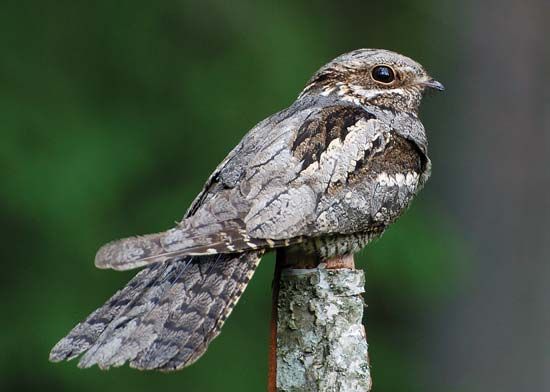
- Physical Morphology: True nightjars are characterized by large eyes for improved night vision, a flat head, and a wide mouth fringed with bristles, which aids in capturing flying insects on the wing. Their soft plumage allows for silent flight, enabling them to hunt stealthily.6
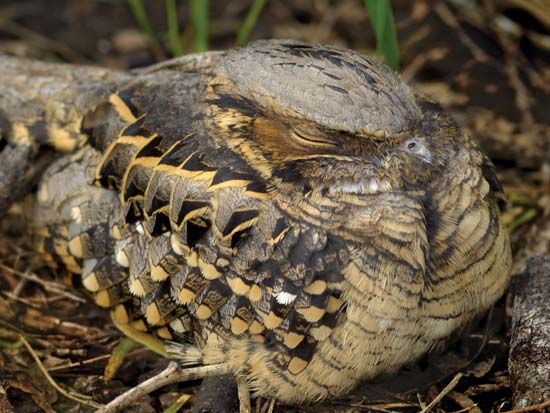
- Protective Camouflage: They possess cryptic coloration in shades of gray, brown, or reddish-brown, which helps them blend into their surroundings while roosting on the ground, rocks, or tree trunks during the day.6
- Energy Conservation: Because they are limited to brief feeding periods at dawn and dusk, nightjars are vulnerable to food shortages. To survive, they can enter torpidity, a state of reduced metabolic activity and lowered body temperature. The poorwill is uniquely known for engaging in regular, prolonged annual hibernation to endure winter conditions.57
- Roosting Behavior: While many roost on the ground, some species perch lengthwise along horizontal tree branches to remain inconspicuous.1
Where are nightjars typically found, and what kind of habitats do they prefer?
True nightjars are found almost worldwide, inhabiting temperate to tropical regions, with the notable exception of New Zealand and certain oceanic islands.18
Habitat Preferences
Nightjars are highly adaptable and occupy a diverse range of environments, spanning from semidesert areas to humid regions, and from sea level up to altitudes of 4,000 meters (approximately 13,100 feet).9
They show a distinct preference for open areas, including:
- Savannas and Grasslands: These environments provide ample space for hunting night-flying insects.9
- Forest Clearings and Edges: Even when they inhabit woodlands, nightjars typically utilize these areas for diurnal concealment or nesting, while performing the majority of their feeding in clearings or at the forest edge.9
- Open Forests and Brushwood: They generally avoid dense, closed-canopy forests, favoring more open growth structures.9
Because they do not build traditional nests, their choice of habitat is also influenced by the availability of suitable ground or, in some cases, rooftops for laying their eggs.8
Sources
- Nightjar — Encyclopædia Britannica
- Caprimulgiform - Vocalizations — Encyclopædia Britannica
- Why do birds chirp at night? — Encyclopædia Britannica
- nightjar — Merriam-Webster
- Caprimulgiform - Hibernation — Encyclopædia Britannica
- Caprimulgiform - Natural history — Encyclopædia Britannica
- Torpor — Encyclopædia Britannica
- Caprimulgidae — Encyclopædia Britannica
- Caprimulgiform - Habitat — Encyclopædia Britannica
Published on · 3 min read