Peacock Spider
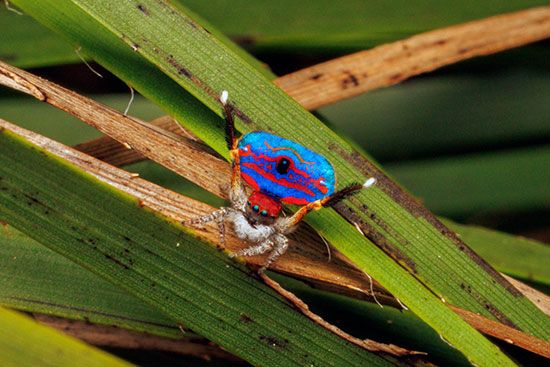
The peacock spider (genus Maratus) is a group of nearly 100 species of tiny jumping spiders primarily native to Australia. Most are smaller than a grain of…
What is peacock spider?
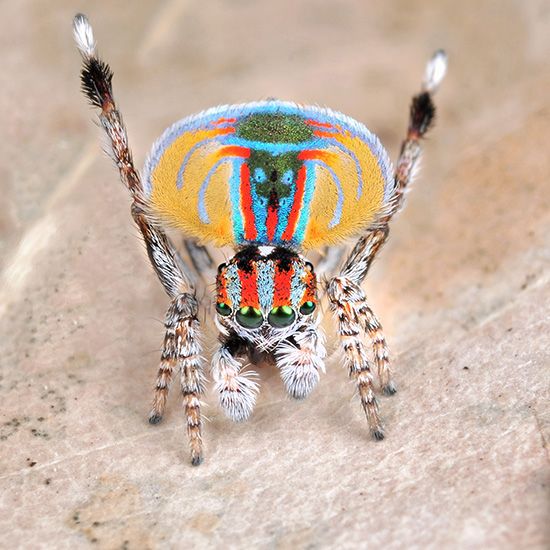
The peacock spider (genus Maratus) is a group of nearly 100 species of tiny jumping spiders primarily native to Australia. Most are smaller than a grain of rice, ranging from 1.6 to 6 mm in length.12
These spiders are famous for their intense sexual dimorphism. While females are typically drab, males possess brilliant, iridescent abdominal flaps that they unfold like a peacock’s tail to impress mates. During courtship, males perform elaborate dances, rhythmically flicking their elongated third pair of legs and vibrating their abdomens to produce “rumble-rumps”. This display is high-stakes: if a female is unimpressed, she may engage in sexual cannibalism and eat the male.12
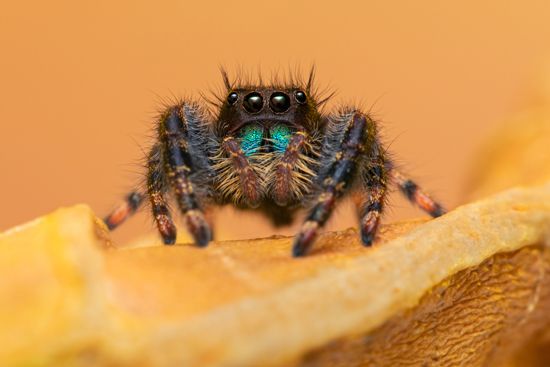
Peacock spiders are agile, day-active hunters with excellent vision, using their hydraulic legs to pounce on prey like flies and moths without spinning webs. While public interest has surged due to social media, the conservation status of most species remains unknown due to limited research.2
How do jumping spiders hunt without using webs?
Jumping spiders are highly effective ambush predators that do not rely on webs to capture their prey. Instead, they utilize their exceptional vision and agility to hunt actively during the day.3
Their hunting process typically involves the following:
- Visual Tracking: Jumping spiders possess eight eyes, including two large, forward-facing eyes with internal focusing mechanisms that function like a telescope. This allows them to perceive fine details and track potential prey from a distance.3
- Stalking: Once prey is spotted, the spider stalks it until it is within a range of approximately 5 to 10 cm (2 to 4 inches).4
- Pouncing: Using an internal hydraulic system, they can explosively straighten their fourth pair of legs to leap many times their own body length, pouncing on the insect to deliver a lethal bite.34
Some species, such as those in the genus Portia, exhibit advanced intelligence and problem-solving skills, allowing them to employ complex hunting behaviors even when targeting other web-building spiders.3
What other animals exhibit sexual cannibalism?
Sexual cannibalism—the consumption of a mate during courtship or copulation—is a behavior observed across several invertebrate groups, including arachnids, insects, and cephalopods.5
While the behavior is often viewed as an evolutionary puzzle, it typically provides females with essential nutrients that can improve the quality or quantity of their offspring. For males, the act may be a strategic trade-off to ensure their genes are passed on, especially in species where mating opportunities are rare.5
Notable examples include:
- Redback Spiders (Latrodectus hasselti): Males often appear to sacrifice themselves voluntarily, positioning their bodies at the female’s mouthparts after mating. This occurs in approximately 65 percent of matings.5
- Praying Mantises (Hierodula membranacea): Unlike the redback spider, the male giant Asian mantis actively attempts to avoid being eaten by approaching the female from a distance and positioning himself to minimize the risk of attack.5
- Octopuses: Observations have documented females consuming their mates, though this sometimes occurs only after multiple mating sessions.5
We could dive deeper into the evolutionary theories behind why this behavior persists despite the high cost to the male.
Why do some male animals evolve such bright colors?
The evolution of bright colors in male animals is primarily driven by sexual selection, an evolutionary process where certain traits provide individuals with a reproductive advantage over others of the same sex and species.67
Reproductive Signaling
Bright coloration often functions as a reproductive signal to attract and arouse potential mates (intersexual selection) or to intimidate competitors (intrasexual selection). These displays serve several key purposes:86
- Evidence of Fitness: Bright colors can signal to females that a male is healthy and genetically robust. In some species, such as the house finch, color intensity is derived from diet, signaling the quality of the male’s territory and his ability to provide resources.6
- Dominance and Intimidation: Vivid colors can signify vitality and dominance to other males. For example, the mandrill uses its red nose, and Jackson’s chameleons use their yellow-green bodies to signal status during contests.6
- Species Recognition: Courtship coloration aids in the reproductive isolation of species, ensuring that individuals attract appropriate mates.8
The Evolutionary Trade-off
While these bright traits increase “sex appeal,” they often conflict with natural selection because they make the animal more visible to predators. However, the reproductive benefits of these traits—such as increased mating success—outweigh the survival risks. To mitigate these risks, many animals keep their bright colors concealed until they are needed for courtship or threat displays, or they utilize rapid color-changing mechanisms.6789
Sources
- Nine Incredible Jumping Spiders - Peacock spider: A tiny dancer — Encyclopædia Britannica
- peacock spider — Encyclopædia Britannica
- jumping spider — Encyclopædia Britannica
- spider - Stalking prey — Encyclopædia Britannica
- Why Do Some Animals Eat Their Mates After Sex? — Encyclopædia Britannica
- coloration - Reproductive signals — Encyclopædia Britannica
- Why are male animals more colorful? — Encyclopædia Britannica
- sexual selection — Encyclopædia Britannica
- coloration — Encyclopædia Britannica
- coloration - Optical functions: combination of concealing and advertising coloration — Encyclopædia Britannica
Published on · 4 min read