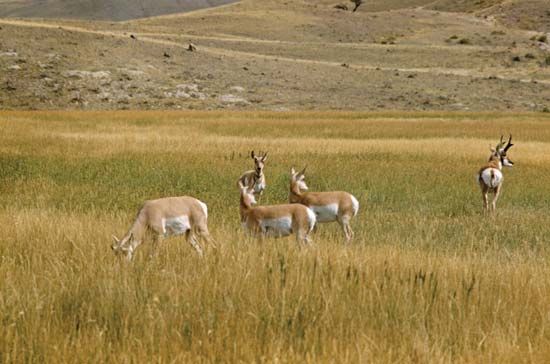
Pronghorn
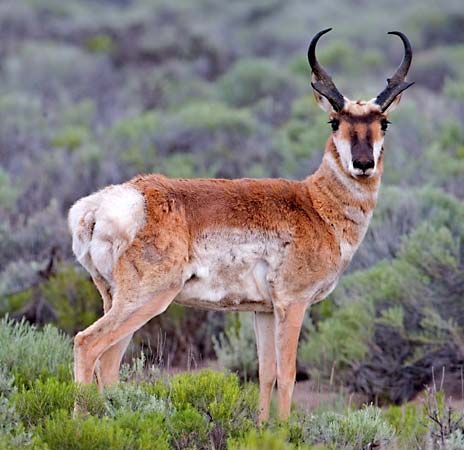
Pronghorns are native to North America, where they are found ranging from Alberta, Canada, down to northern Mexico.
Where are pronghorns primarily found, and what is their natural habitat?
Pronghorns are native to North America, where they are found ranging from Alberta, Canada, down to northern Mexico.12
Regarding their natural habitat, these animals are specifically adapted to open plains and semideserts. Unlike many other ruminant species that occupy diverse environments such as forests or savannas, the pronghorn is a specialized denizen of these expansive, arid landscapes. Their physical characteristics, including their exceptional speed and acute vision, evolved to help them survive and evade predators within these open, unobstructed terrains. While they were nearly driven to extinction in the 19th century, conservation efforts have successfully restored their populations, though specific groups like the Sonoran and peninsular pronghorns remain endangered.12
What are the unique physical characteristics of the pronghorn?
The pronghorn (Antilocapra americana) possesses several unique physical characteristics that distinguish it from other ruminant species:
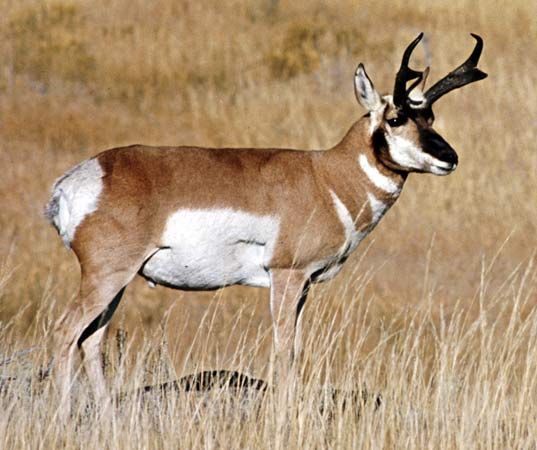
- Branching Horns: It is the only animal in the world with branching horns that are shed and regrown annually. Both sexes grow horns, though they are typically longer in males.13
- Exceptional Speed: As the fastest long-distance runner in the animal kingdom, the pronghorn can maintain speeds of nearly 35 miles per hour over several miles and reach top sprint speeds of about 55 miles per hour. This is facilitated by special cushions on their hooves and an ability to intake large quantities of oxygen.2
- Acute Vision: They possess eyes as large as those of elephants, providing them with extraordinary vision that allows them to identify predators from up to 1 kilometer (0.6 mile) away.1
- Warning Signal: Pronghorns feature a large, circular white patch of long hair on their rump. They can suddenly erect this patch to signal danger to others, creating a flash of white visible to humans from 2–3 kilometers away.1
How are pronghorns different from true antelopes, despite their similar appearance?
Although pronghorns and antelopes share a similar appearance as hoofed ruminant mammals, they are not closely related and belong to entirely different families.21
The primary differences include:
- Taxonomy: The pronghorn (Antilocapra americana) is the sole living member of the family Antilocapridae, native exclusively to North America. In contrast, “antelope” is a general term for over 90 species within the family Bovidae, which also includes cattle, sheep, and goats. Most true antelopes are found in Africa and Asia.21
- Horns: This is the most striking distinction. Pronghorns have unique, branching horns with a bony core covered by a sheath; they shed these sheaths annually. True antelopes have unbranched horns that are never shed and remain with the animal for life.21
- Locomotion: While both are adapted for speed, the pronghorn is a more highly evolved runner than any Old World antelope, capable of reaching speeds of 70 km (43 miles) per hour to outrun extinct Pleistocene predators.21
What unique features do pronghorns have that help them detect predators from far away?
Pronghorns possess remarkable physical adaptations that allow them to detect potential threats across the vast, open plains they inhabit. Their primary tool for long-distance detection is their vision: they have eyes as large as those of elephants, which provide them with astonishingly acute sight, enabling them to identify predators from distances of up to 1 kilometer (0.6 mile).1
In addition to their visual acuity, pronghorns utilize a specialized social signaling mechanism to alert their herd to danger. They feature a large, circular white patch of long hair on their rump. When a predator is spotted, the pronghorn can suddenly erect this patch, creating a bright flash of white that serves as a warning signal to other members of the group. This visual alert is highly effective, as it can be seen by humans from 3–4 kilometers (2–2.5 miles) away, ensuring that the entire herd is quickly alerted to the presence of a threat.1
Sources
- pronghorn — Encyclopædia Britannica
- What is the difference between a pronghorn and an antelope? — Encyclopædia Britannica
- The Fastest Animals on Earth — Encyclopædia Britannica
- artiodactyl - Annotated classification — Encyclopædia Britannica
- pronghorn — Merriam-Webster
Published on · 3 min read