Pelican
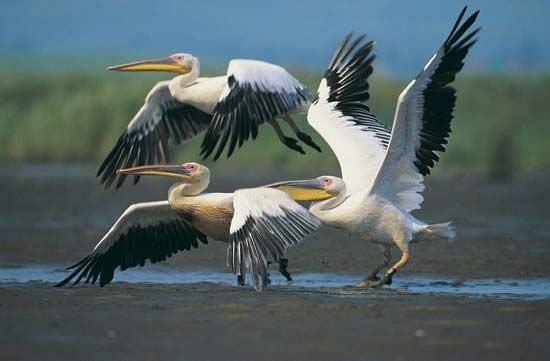
Pelicans are among the largest living birds, characterized by their significant size, long necks, and buoyant bodies. Their most distinguishing physical…
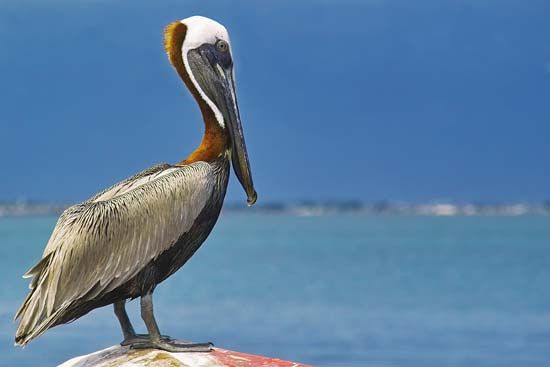
What are the distinguishing physical characteristics of pelicans?
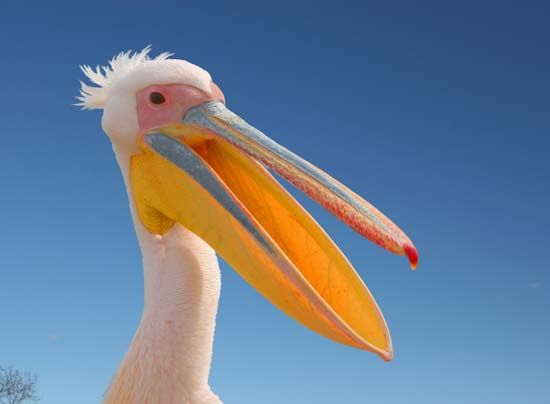
Pelicans are among the largest living birds, characterized by their significant size, long necks, and buoyant bodies. Their most distinguishing physical feature is a long, hooked bill equipped with a large, elastic, and highly distensible gular (throat) pouch used for catching fish.1234
Key physical characteristics include:
- Size and Build: They can reach lengths of up to 180 cm (70 inches) with wingspans of 3 metres (10 feet) and weights up to 13 kg (30 pounds). Their skeletons are extensively pneumatized, consisting of hollow, thin-walled bones reinforced with internal struts.25
- Plumage and Feet: Pelicans possess water-repellent plumage and large, fully webbed feet (totipalmate), which contribute to their buoyancy and swimming ability.53
- Respiration: Their nostrils are almost closed, and they possess a system of air sacs under the skin that provides buoyancy and may offer protection during water entry.53
- Appearance: The sexes are similar in appearance, though males are generally larger. Some species exhibit crests, and their facial skin and pouches can be colorful, particularly during the breeding season.23
Where are pelicans typically found, and what are their preferred habitats?
Pelicans are found across many parts of the world, inhabiting a variety of environments including lakes, rivers, and seacoasts. While they are widespread in the tropics, they also penetrate far into temperate zones. Unlike some other seabirds that venture far out to sea, pelicans generally do not stray far from land, though they may commute between their feeding grounds and areas used for roosting or breeding.39
Regarding their preferred habitats for reproduction, pelicans typically seek out sites that are free from mammalian predators. They commonly breed in colonies on islands, which may include islands located within lakes or offshore. In addition to islands, they may nest in other protected locations, such as on cliffs or in trees standing in water. Because safe nesting space is often limited, they frequently crowd together in these colonial sites to ensure successful reproduction.103
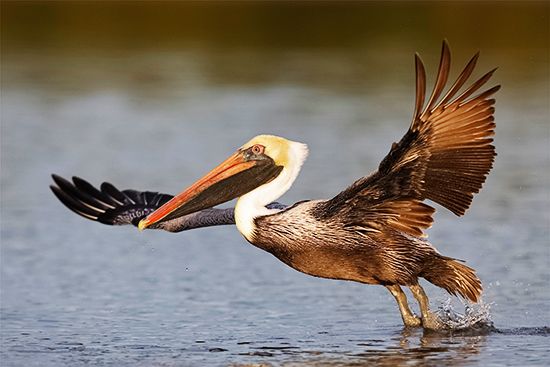
What unique adaptations do pelicans have for fishing and eating?
Pelicans possess specialized anatomical features that make them highly efficient at capturing and consuming prey. Their most notable adaptation is a long, hooked bill equipped with a large, elastic, and highly distensible gular (throat) pouch, which functions as a dip-net to scoop up fish. Contrary to common misconceptions, this pouch is not used for storage; captured fish are swallowed immediately.1237
Their fishing methods vary by species and environment:
- Cooperative Fishing: Most pelican species swim in formation, often forming a crescent or circle to herd schools of fish into shallow water. By splashing and paddling, they panic the fish, making them easier to capture as they attempt to escape.123
- Plunge-Diving: The brown pelican is a notable exception to the group-swimming method; it frequently forages offshore and captures prey by performing a spectacular plunge from the air.123
- Opportunistic Feeding: Beyond fish, pelicans have been observed using their herding techniques to capture other prey, such as ducklings.12
Once the prey is caught, the pelican’s unique bill structure ensures the catch is secured before it is ingested.7
Are there different species of pelicans, and how do they differ?
There are seven or eight recognized species of pelicans, all belonging to the single genus Pelecanus within the family Pelecanidae. While they share a common family identity, they exhibit variations in size, plumage, and behavior.133
Key Distinctions Among Species
- Size and Appearance: Pelicans are among the largest living birds, with some species reaching lengths of 180 cm (70 inches) and wingspans of 3 metres (10 feet). While the sexes are similar in appearance, males are generally larger than females. Some species are distinguished by the presence of crests.133
- Plumage: Depending on the species, plumage can be white, brown, or gray. The two best-known species are the white pelicans: the North American white pelican of the New World and the European white pelican of the Old World.313
- Foraging Behavior: Most species are social, swimming in formation to herd fish into shallow water. The brown pelican is a notable exception; it is smaller than other species and typically forages offshore by plunge-diving from the air.134
- Habitat and Migration: While many species are migratory, others have specific regional preferences, such as the brown pelican, which breeds along tropical and subtropical shores.13
Sources
- Pelecaniform - General features — Encyclopædia Britannica
- Pelecaniform - Distinguishing characteristics — Encyclopædia Britannica
- Pelican — Encyclopædia Britannica
- Pelecaniform - Annotated classification — Encyclopædia Britannica
- Bird - Skeleton — Encyclopædia Britannica
- Wing — Encyclopædia Britannica
- Beak — Encyclopædia Britannica
- Charadriiform - Adaptations for feeding — Encyclopædia Britannica
- Pelecaniform - Distribution and abundance — Encyclopædia Britannica
- Pelecaniform - Importance to humans — Encyclopædia Britannica
- Pelecaniform - Reproduction — Encyclopædia Britannica
- Pelecaniform - Feeding ecology — Encyclopædia Britannica
- Pelecaniform - Distinguishing taxonomic features — Encyclopædia Britannica
Published on · 3 min read