Flyway
A flyway is a regular, established route used by migrating birds, bats, or butterflies to travel between their northern breeding grounds and southern…
What is a flyway and how does it relate to bird migration?
A flyway is a regular, established route used by migrating birds, bats, or butterflies to travel between their northern breeding grounds and southern wintering areas. These routes are not always narrow paths; while they may constrict to a few hundred meters at specific geographic bottlenecks like mountain passes or water crossings, they can also span hundreds of kilometers in width across broad regions.1
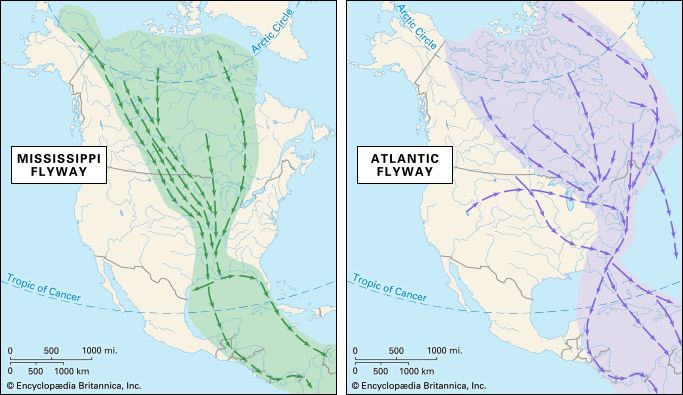
Flyways are deeply integrated into the phenomenon of bird migration, as they are often determined by a combination of geographical features—such as river valleys, coastlines, and mountain ranges—and meteorological conditions. In North America, for example, major migratory paths include the Atlantic Coast, Mississippi, Central, and Pacific flyways.123
While many birds follow these traditional routes used by their ancestors, migration itself is a complex behavior driven by internal physiological rhythms and environmental cues, such as day length and food availability. Birds often adjust their flight paths based on wind direction and force, sometimes traveling in large, cohesive flocks to conserve energy.452
What are some of the major global flyways used by migratory birds?
Migratory birds follow established routes known as flyways, which are often shaped by geographical features such as river valleys, coastlines, and mountain ranges. While these routes can be hundreds of kilometers wide, they often constrict into narrow corridors at specific bottlenecks, such as mountain passes or water crossings.16
In North America, the Atlantic flyway is a prominent example, extending between the Atlantic Ocean and the Appalachian Mountains, with various branches reaching across New England and the Hudson River valley. Other major flyways globally are defined by the movement of birds between northern breeding grounds and southern wintering areas. For instance, many birds of prey and storks from eastern Europe utilize a route that funnels them through the Bosporus, across the eastern Mediterranean, and eventually over the Suez Canal into Africa.31
It is important to note that while these flyways provide structure, many birds travel along broad fronts, adjusting their paths based on wind conditions and ecological requirements. Organizations like BirdLife International work globally to identify and safeguard the critical habitats along these routes to prevent species extinction.67
How do birds navigate during their long-distance migrations?
Birds navigate during long-distance migrations using a sophisticated combination of sensory mechanisms that allow them to maintain a constant direction and reach specific destinations. Their navigational toolkit includes:
- Magnetic Sensitivity: Birds possess a sensitivity to the intensity and direction of the Earth’s magnetic field, which acts as a fundamental compass for orientation.89
- Celestial Navigation: Birds utilize celestial bearings to orient themselves. During the day, they use the Sun as a compass, compensating for its movement across the sky using an internal clock. At night, many migratory species navigate by the stars, determining their latitude and longitude based on the arrangement of the night sky.89
- Orientation vs. Navigation: Scientists distinguish between “compass orientation,” which allows a bird to fly in a constant direction, and “true navigation,” or goal orientation, which enables a bird to determine its position relative to a specific target.8
These abilities form a complex navigational “grid” that ensures birds can successfully complete their journeys across vast distances.8
We could dive deeper into how specific species, such as homing pigeons or seabirds, utilize these senses to return to precise locations.
How do different species of birds use the same flyway?
Different species often utilize the same flyway because these routes are dictated by shared geographical features—such as river valleys, coastlines, and mountain ranges—that provide optimal conditions for migration. While these flyways can span hundreds of kilometers in width, they often funnel diverse populations into narrow corridors at specific bottlenecks, such as mountain passes or water crossings.31
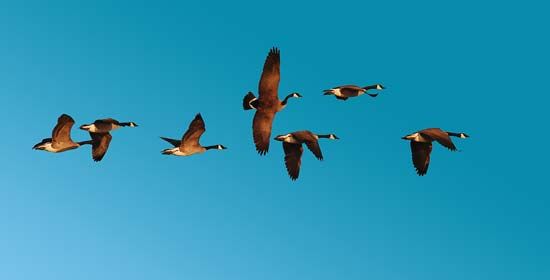
When multiple species share a flyway, they often exhibit gregarious behavior, with birds of similar habits sometimes traveling together. For example, various species of shorebirds have been observed migrating in mixed groups. To maximize efficiency, many species adopt organized formations, such as the characteristic “V” shape used by geese, ducks, pelicans, and cranes, which helps members of the flock conserve energy.3
While sharing a route, species may diverge in their specific migratory timing—some are diurnal (daytime) migrants, while others are nocturnal—and their altitude preferences, which helps minimize direct competition for resources during the journey.3
Sources
- flyway — Encyclopædia Britannica
- Migration - Origin and evolution of migration — Encyclopædia Britannica
- Migration - Modes of migration — Encyclopædia Britannica
- Migration - In North America — Encyclopædia Britannica
- Migration - Physiological stimulus of migration — Encyclopædia Britannica
- Atlantic flyway — Merriam-Webster
- BirdLife International — Encyclopædia Britannica
- Migration - Birds — Encyclopædia Britannica
- Homing — Encyclopædia Britannica
- Migration - Ecological significance of migration — Encyclopædia Britannica
- community ecology - Types of competition — Encyclopædia Britannica
- community ecology - The effects of competition — Encyclopædia Britannica
Published on · 3 min read