Periwinkle
The premise that periwinkle snails have been used historically by humans for purposes beyond cuisine is not explicitly supported by the provided search…
How have periwinkle snails been used historically by humans, beyond cuisine?
The premise that periwinkle snails have been used historically by humans for purposes beyond cuisine is not explicitly supported by the provided search results. While the common periwinkle is widely recognized as an edible marine snail, the available documentation focuses primarily on their biological classification, distribution, and role as a food source for shore birds.12
Although seashells in general have been utilized throughout history for creating jewelry, buttons, inlays, and even as currency, the provided information does not specifically attribute these historical applications to the shells of the periwinkle (Littorinidae family). The literature highlights that periwinkles are valued for their ecological role and their status as a food source, but it does not detail specific non-culinary human uses for this particular group of gastropods.312
What role do periwinkle snails play in marine ecosystems?
Periwinkle snails, which belong to the family Littorinidae, play a significant role in marine ecosystems primarily as a food source and as active members of the littoral zone.
- Trophic Role: These snails serve as a vital food source for various shore birds, particularly ducks, which rely on them as a staple in their diet.1
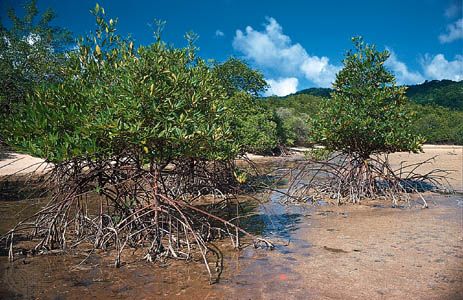
- Habitat and Feeding: As primarily herbivorous gastropods, periwinkles inhabit diverse environments, including rocky shores, mud flats, and the roots of mangrove trees. Their presence across these zones—from high-tide marks to tidal estuaries—helps them integrate into the food webs of both rocky and marshy coastal habitats.1
- Adaptability: Their ability to thrive in varied conditions, such as the hardy common periwinkle which withstands wave action, allows them to maintain stable populations that support local predators across different coastal regions.1
What are the different species of periwinkle snails, and how do they differ?
The term “periwinkle” refers to marine snails in the family Littorinidae. While there are approximately 80 species worldwide, they are characterized by their broad, conical shells and their ability to withstand desiccation in littoral zones.14
It is important to clarify that the term “periwinkle” is also used in botany to describe plants of the genus Vinca (family Apocynaceae), which are unrelated to the marine snails discussed here.5
Distinctions Among Marine Periwinkles
Species within the Littorinidae family differ primarily in their size, habitat preference, and reproductive strategies:
- Common Periwinkle (Littorina littorea): This is the largest and most widespread northern species, reaching up to 4 centimeters in length. It possesses a solid, dark gray, turbinate shell designed to withstand heavy wave action on rocky shores.1
- Reproductive Variations: Species differ significantly in how they produce offspring:
- L. saxatilis: Inhabits high-shore areas and is often exposed to air for long periods. It retains embryos in a brood sac, releasing them as fully developed, tiny crawling snails.1
- L. littorea: Releases embryos in transparent, saucer-shaped egg cases that eventually hatch into free-swimming veliger larvae.1
- Other species: Some deposit embryos in gelatinous masses directly onto rocks or other hard substrates.1
Where are periwinkle snails commonly found in marine environments?
Periwinkle snails, members of the family Littorinidae, are widely distributed throughout littoral (shore) zones. Their specific habitats depend on the species and environmental conditions:
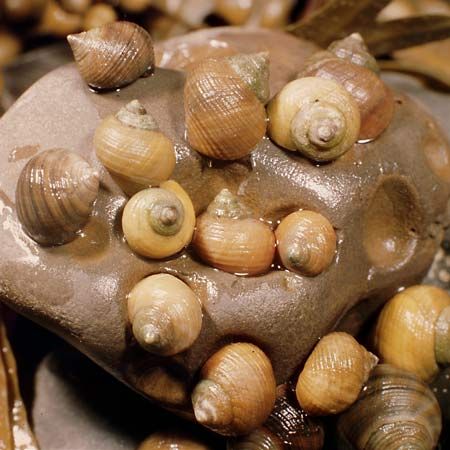
- Rocky Shores and Structures: Most periwinkles are commonly found on rocks, stones, or man-made pilings located between the high- and low-tide marks.1
- Muddy and Estuarine Environments: Some species inhabit shallow muddy bottoms and the banks of tidal estuaries, including areas where the water salinity is only moderate.1
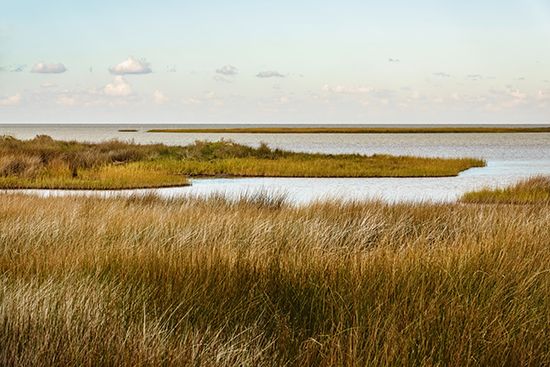
- Vegetated Areas: They are frequently found among the roots and blades of marsh grass.1
- Tropical Habitats: Certain tropical forms are specialized to live on the prop roots or trunks of mangrove trees.1
While the term “periwinkle” is sometimes colloquially applied to freshwater snails in parts of the southern United States, true marine periwinkles are defined by their adaptation to these coastal, salt-water environments.12
Sources
- periwinkle — Encyclopædia Britannica
- periwinkle — Merriam-Webster
- seashell — Encyclopædia Britannica
- Periwinkle — Encyclopædia Britannica
- Littorinidae — Merriam-Webster
- Littorina — Merriam-Webster
Published on · 3 min read