Phosphorus Cycle
Phosphorus moves from terrestrial to aquatic ecosystems primarily through the natural process of weathering of bedrock, which releases phosphorus into the…
How does phosphorus move from terrestrial ecosystems to aquatic ecosystems?
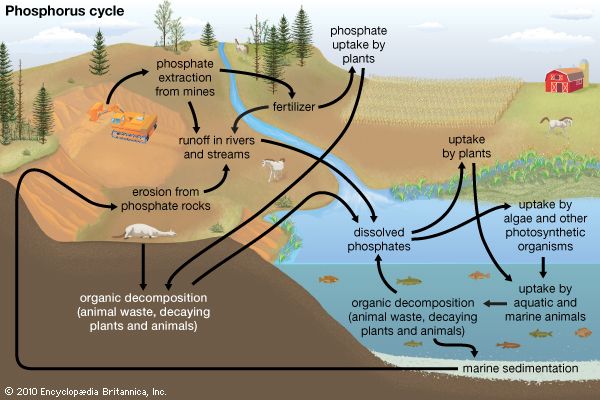
Phosphorus moves from terrestrial to aquatic ecosystems primarily through the natural process of weathering of bedrock, which releases phosphorus into the environment. Once available, this nutrient is transported into aquatic systems through runoff that carries soil, organic debris, and products of the decay of terrestrial organisms into rivers, lakes, and coastal waters.123
Human activities significantly accelerate this movement, a process known as cultural eutrophication. The application of fertilizers to agricultural fields and the discharge of sewage and detergents introduce excess phosphorus into water bodies. This nutrient loading can trigger explosive growth of algae and microorganisms, leading to water blooms that deplete oxygen levels, potentially causing hypoxia and harming aquatic life. Ultimately, much of the phosphorus that enters these systems is transported toward the ocean, where it accumulates in ocean sediments.132
How do human activities impact the phosphorus cycle?
Human activities have significantly altered the natural phosphorus cycle, primarily by accelerating the movement of this essential nutrient from land into aquatic ecosystems. While phosphorus naturally cycles through weathering and biological decay, human intervention has dramatically increased the flux of this element into the environment.12
Key impacts include:
- Agricultural Runoff: The application of fertilizers to crops and the erosion of soil from agricultural fields introduce large quantities of phosphorus into rivers and lakes.13
- Waste Discharge: The use of phosphorus-rich detergents and the release of untreated or partially treated sewage serve as major point sources of nutrient loading in water bodies.13
- Cultural Eutrophication: This excess phosphorus triggers explosive growth of algae and microorganisms, known as water blooms. These blooms block light and, upon decomposition, deplete oxygen, leading to hypoxia and the suffocation of fish and other aquatic life.13
On a global scale, human-driven inputs of phosphorus into the oceans have more than doubled compared to prehuman levels, contributing to the degradation of estuaries and coastal systems worldwide.3
How does weathering of rocks contribute to the phosphorus cycle?
Weathering is the primary mechanism by which phosphorus is introduced into terrestrial and aquatic ecosystems. Because phosphorus lacks a volatile gaseous state, it remains trapped in bedrock and sedimentary deposits until it is released through natural processes.13
The contribution of weathering to the phosphorus cycle occurs through several key stages:
- Release from Bedrock: Physical and chemical weathering breaks down rocks, liberating phosphorus from its mineral form into the environment.13
- Biological Availability: Once released, phosphorus is often converted into soluble phosphate (PO₄³⁻). This process is frequently aided by microorganisms that produce acids capable of transforming insoluble phosphorus compounds into forms that can be utilized by plants and algae.3
- Ecosystem Integration: After being released, phosphorus enters the soil, where it cycles between living organisms and organic debris. It is then taken up by plants and passed through the food chain to animal consumers.13
- Unidirectional Transport: Phosphorus moves from land into aquatic environments via runoff and leaching. Much of this eventually settles in ocean sediments, where it remains until tectonic activity or upwelling returns it to the surface.13
What are the main sources of phosphorus in nature, and how is it made available to living organisms?
In nature, phosphorus is primarily stored in rock and sedimentary deposits, with the apatite series of minerals serving as the most significant natural source. Because phosphorus is highly reactive, it does not exist in a free state but is found combined with other elements as phosphate ions3. The largest reservoirs of this element are found in ocean sediments.315
Phosphorus is made available to living organisms through several key processes:
- Weathering and Leaching: Physical and chemical weathering of bedrock releases phosphorus into the environment.35
- Microbial Action: Because much of the phosphorus in rocks is insoluble, microorganisms play a vital role by producing acids that convert these compounds into soluble phosphate, which can then be absorbed by plants and algae.35
- Biological Cycling: Once absorbed, phosphorus moves through the food chain as it is consumed by animals. Upon the death and decay of these organisms, phosphates are released back into the soil or water for recycling.35
Sources
- Biosphere - The cycling of phosphorus and other essential nutrients — Encyclopædia Britannica
- eutrophication — Encyclopædia Britannica
- Phosphorus cycle — Encyclopædia Britannica
- chemical industry - Phosphorus — Encyclopædia Britannica
- phosphorus - Occurrence and distribution — Encyclopædia Britannica
Published on · 3 min read