Pickerel Frog
The pickerel frog (Lithobates palustris, formerly Rana palustris) is a dark-spotted frog native to eastern North America, where it typically inhabits…
What is pickerel frog?
The pickerel frog (Lithobates palustris, formerly Rana palustris) is a dark-spotted frog native to eastern North America, where it typically inhabits meadows, cool streams, and sphagnum bogs.12
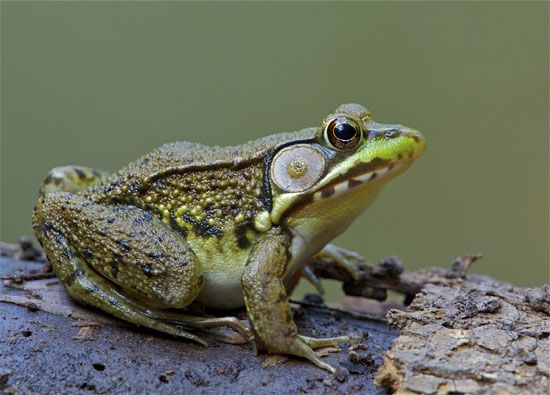
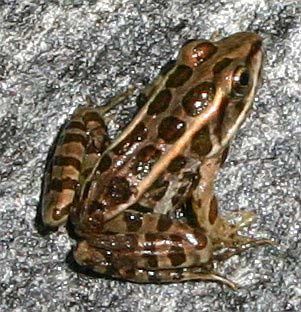
Measuring approximately 5 to 7.5 centimetres (2 to 3 inches) in length, the species is distinguished from other spotted frogs by the shape of its markings. While most spotted frogs have round spots, the pickerel frog features two columns of squarish or rectangular dark spots along its golden or brownish back. These columns are bordered by white or yellow ridges that run the length of its body.12
When the frog leaps, it reveals a characteristic orange or yellow coloration on the inner surfaces of its hind legs. This species also possesses skin secretions that serve as a defense mechanism; these secretions are toxic to other frogs and help protect the pickerel frog from predators such as snakes.12
How do pickerel frogs use their skin secretions to defend themselves?
The pickerel frog (Rana palustris) utilizes specialized skin secretions as a primary chemical defense mechanism. These secretions are known to be toxic to other frogs and serve specifically to protect the pickerel frog from snakes, which are common predators of many amphibians.1
While the specific biochemical makeup of the pickerel frog’s toxins is not detailed, frog skin secretions generally contain complex nitrogenous compounds that can act as irritants, neurotoxins, or vasoconstrictors. These substances are produced by poison glands located within the skin. Although these secretions are effective against certain predators and can irritate human mucous membranes, they are not harmful in the way folklore suggests—they do not cause warts.3
What are the main differences between pickerel frogs and leopard frogs?
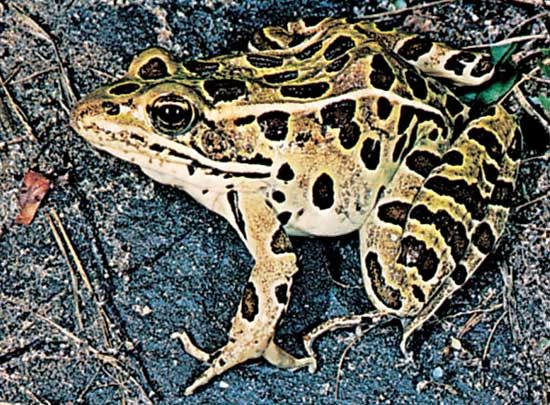
While the pickerel frog and the leopard frog are often confused due to their similar appearance and habitats, they can be distinguished by several key physical characteristics:
- Spot Shape: The most reliable way to tell them apart is by the shape of their dorsal markings. Pickerel frogs have squarish or rectangular spots arranged in two distinct columns along their backs. In contrast, leopard frogs typically feature ellipsoidal or circular spots.1562
- Underside Coloration: When viewed from below, the pickerel frog displays a distinct orange or yellow coloration on the inner surfaces of its hind legs.16
- Dorsal Ridges: The pickerel frog’s back features two columns of spots bordered by white or yellow ridge lines that run the length of its body.16
- Defense Mechanisms: The pickerel frog possesses toxic skin secretions that serve as a defense against predators like snakes. While leopard frogs are also semiaquatic and share similar marshy habitats, they do not possess this specific toxic defense.162
What other types of frogs are native to North America?
North America is home to a diverse array of frog species, ranging from those adapted to extreme cold to those specialized for life in trees or burrows. Notable examples include:
- Wood Frog (Lithobates sylvaticus): Remarkable for its ability to survive freezing temperatures by producing a natural “antifreeze” of glucose in its body fluids.7
- Spring Peeper (Pseudacris crucifer): A small, elusive frog known for its distinct “peep” call in early spring and the dark, X-shaped marking on its back.7
- Mink Frog (Lithobates septentrionalis): Named for the odor of its skin secretions, which resembles that of a mink or a rotten onion.7
- Columbia Spotted Frog (Rana luteiventris): A highly aquatic species found in western North America, recognized by its irregularly shaped spots and reddish or bronze-colored underbelly.7
- Pacific Tree Frog (Pseudacris regilla): A versatile climber equipped with sticky toe pads, capable of changing its color based on environmental conditions.7
- Tailed Frogs (Ascaphidae): Found in northwestern North America, these unique frogs are adapted to life in streams.2
These species represent only a fraction of the continent’s amphibian diversity, which also includes various leopard frogs and tree frogs.
Sources
- pickerel frog — Encyclopædia Britannica
- 7 Awesome Frog Species of Canada and the United States — Encyclopædia Britannica
- frog and toad - Skin toxins — Encyclopædia Britannica
- frog and toad - Coloration — Encyclopædia Britannica
- leopard frog — Encyclopædia Britannica
- pickerel frog — Merriam-Webster
- tree frog — Encyclopædia Britannica
- frog and toad - Annotated classification — Encyclopædia Britannica
- frog and toad - Distribution and abundance — Encyclopædia Britannica
- frog and toad - Size range and diversity of structure — Encyclopædia Britannica
Published on · 3 min read