Pickerel
The term "pickerel" most commonly refers to several species of North American freshwater fish in the family Esocidae. These fish are distinguished from the…
What is pickerel?
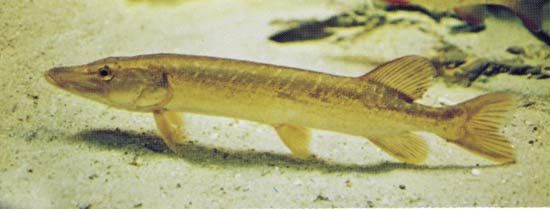
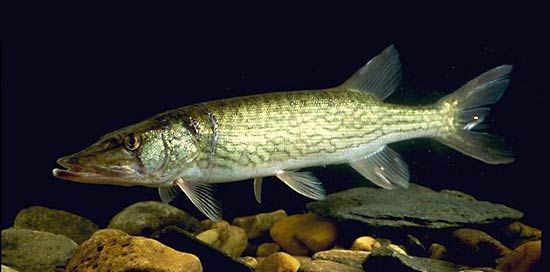
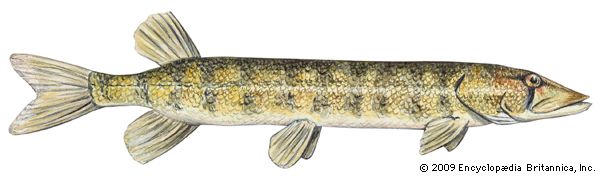
The term “pickerel” most commonly refers to several species of North American freshwater fish in the family Esocidae. These fish are distinguished from the related northern pike and muskellunge by their smaller size, fully scaled cheeks and gill covers, and characteristic banded or chainlike markings. Notable species include the chain pickerel and the grass pickerel and the grass pickerel.12
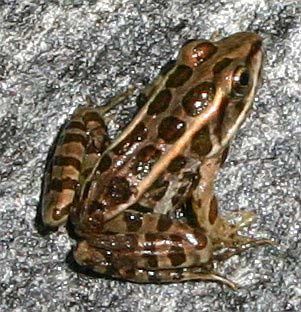
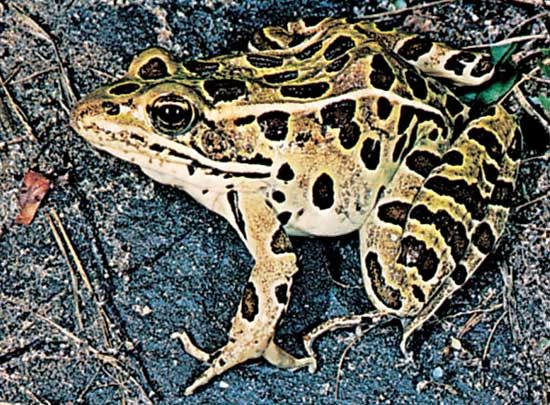
It is important to note that the term is sometimes used colloquially for other species. For instance, the “yellow pickerel” is a common name for the walleye, which is actually a member of the perch family rather than a true pike. Additionally, the name is applied to the pickerel frog, a dark-spotted amphibian found in eastern North America that produces toxic skin secretions.324
How do pickerel differ from northern pike and muskellunge?
While pickerel, northern pike, and muskellunge all belong to the family Esocidae and share similar predatory habits, they can be distinguished by specific physical characteristics and size.167
Key Differences
- Size: Pickerel are significantly smaller than their relatives. For example, the chain pickerel typically reaches about 0.6 meters (2 feet) and 1.4 to 1.8 kilograms, whereas the northern pike can grow up to 1.4 meters (4.5 feet) and weigh as much as 21 kilograms.16
- Scales: A primary diagnostic feature is the scaling on the head. Pickerel have completely scaled cheeks and gill covers. In contrast, the northern pike lacks scales on the lower parts of its gill covers.16
- Markings: Pickerel are characterized by distinct banded or chainlike markings on their bodies. The northern pike is typically identified by pale, bean-shaped spots.16
All three fish are solitary hunters that use a “sit-and-wait” strategy, lurking in weeds to lunge at prey, which includes small fish, insects, and occasionally larger animals like waterfowl.6
What makes the pickerel frog toxic to other animals?
The pickerel frog (Lithobates palustris) possesses specialized skin secretions that serve as a potent chemical defense mechanism. These secretions are highly effective at protecting the frog from predators such as snakes, and they are also reported to be toxic to other frogs.2
While the specific chemical composition of these secretions is a primary deterrent, the frog’s physical appearance—characterized by squarish, dark spots arranged in two columns—also aids in its survival by providing natural camouflage within its habitat of meadows, cool streams, and bogs.28
Why is the walleye sometimes called a yellow pickerel?
The term “yellow pickerel” is a common regional misnomer for the walleye, a freshwater fish belonging to the perch family. The confusion arises because both the walleye and the true pickerel (a member of the pike family) are predatory fish found in similar North American freshwater environments, leading to the interchangeable use of names in certain local dialects.3
Despite the shared name, the walleye is biologically distinct from the pickerel. The walleye is known for its large, light-reflecting eyes—an adaptation for hunting in low-light conditions—and its olive-gold coloration, which likely inspired the “yellow” descriptor.3
Sources
- pickerel — Encyclopædia Britannica
- pickerel frog — Encyclopædia Britannica
- yellow pickerel — Merriam-Webster
- redfin pickerel — Merriam-Webster
- green pike — Merriam-Webster
- pike — Encyclopædia Britannica
- Esocidae — Merriam-Webster
- 7 Awesome Frog Species of Canada and the United States — Encyclopædia Britannica
Published on · 2 min read