Leopard Frog
Leopard frogs are a group of North American frogs belonging to the family Ranidae. They are characterized by a relatively slender body, long legs, and a…
What are the key physical characteristics of leopard frogs?
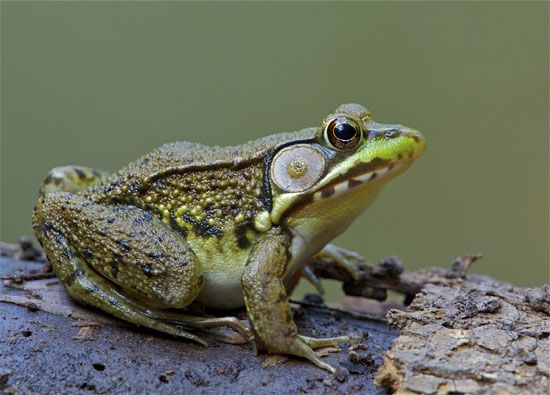
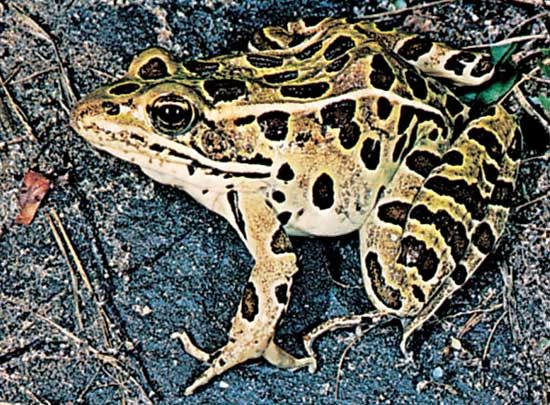
Leopard frogs are a group of North American frogs belonging to the family Ranidae. They are characterized by a relatively slender body, long legs, and a pointed snout.1
Key physical features include:
- Size: They typically measure between 6 and 10 cm (2 to 4 inches) in head-body length.1
- Coloration: Their skin is generally bright green or brown.2
- Markings: A defining characteristic is the pattern of dark, ellipsoidal to circular spots on their backs, which are often white-margined. The specific size, shape, and color of these spots vary among the different species within the Pantherana clade.12
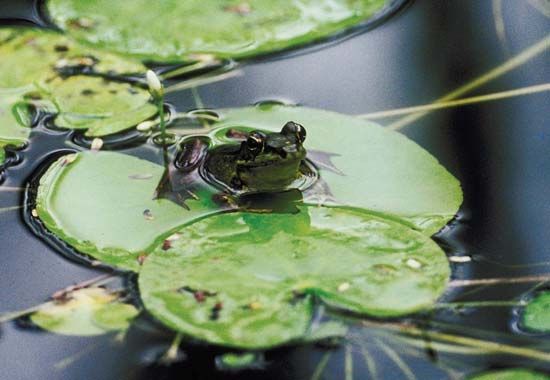
These amphibians are semiaquatic and are primarily found in marshy environments.1
Where are leopard frogs typically found in the wild?
Leopard frogs are found throughout North America, ranging from northern Canada southward into Mexico. Their distribution covers most of the continent, with the notable exception of the coastal band extending from California to British Columbia.1
These amphibians are semiaquatic and are typically associated with marshy habitats. While they are widespread, specific species within the Pantherana clade have more localized ranges, such as the Rio Grande leopard frog, the Plains leopard frog, and the Atlantic Coast leopard frog.1
How do leopard frogs differ from other frog species?
Leopard frogs, which belong to the Ranidae family, are distinguished from other frog species by a combination of specific morphological and behavioral traits. While many frogs exhibit diverse body shapes—ranging from the warty, glandular skin of toads to the transparent skin of glass frogs—leopard frogs are consistently recognized by their slender bodies, long legs, and pointed snouts.41
Key differences include:
- Distinctive Markings: Unlike many other species that may be uniformly colored or possess different patterns, leopard frogs are defined by a pattern of dark, ellipsoidal to circular spots on their backs, often with white margins.15
- Comparison to Similar Species: They are frequently confused with the pickerel frog. However, the pickerel frog is unique for having square or rectangular markings arranged in two columns, as well as a distinct orange coloration on the underside of its legs, which leopard frogs lack.2
- Ecological Niche: As semiaquatic animals, they are primarily associated with marshy habitats, whereas other families have evolved specialized adaptations for life in trees, such as adhesive toe disks, or for burrowing, such as specialized skull shapes.41
What kind of habitats do leopard frogs prefer?
Leopard frogs are semiaquatic animals that are generally associated with marshy habitats. Because they are frequently found in wet, grassy areas, they are sometimes referred to as “meadow frogs”.12
In the wild, these frogs typically inhabit areas close to ponds or lakes. During the winter months, they generally overwinter at the bottom of these bodies of water.2
Sources
- leopard frog — Encyclopædia Britannica
- leopard frog — Merriam-Webster
- Leptodactylidae — Encyclopædia Britannica
- frog and toad - Size range and diversity of structure — Encyclopædia Britannica
- Ranidae — Encyclopædia Britannica
- 7 Awesome Frog Species of Canada and the United States — Encyclopædia Britannica
Published on · 2 min read