Pilot Fish
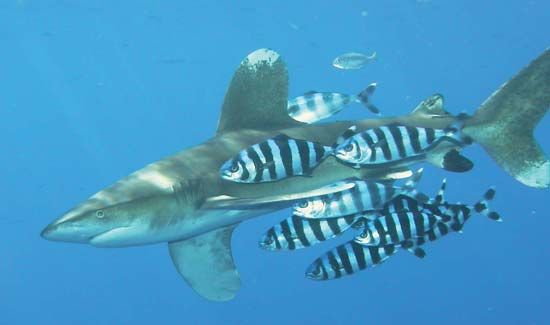
The pilot fish (Naucrates ductor) is a marine fish belonging to the family Carangidae. Found throughout warm and tropical open seas, this species is…
What is pilot fish?
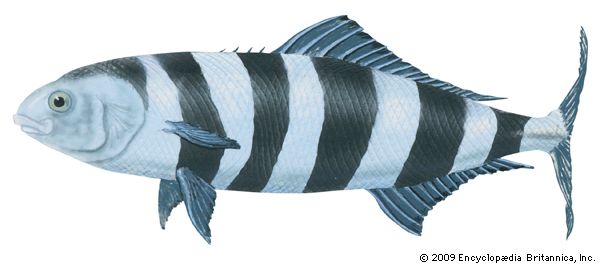
The pilot fish (Naucrates ductor) is a marine fish belonging to the family Carangidae. Found throughout warm and tropical open seas, this species is characterized by an elongated body, a forked tail, and distinctive vertical dark bands against a bluish background.12
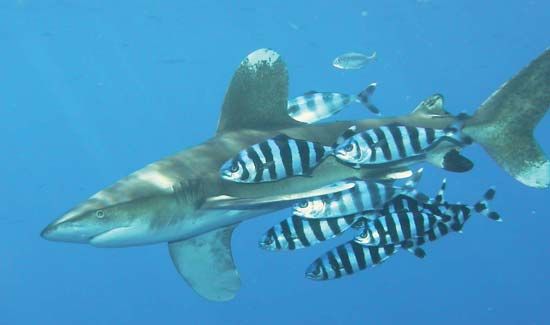
While it was historically believed that these fish guided larger marine animals to food, they are now known to follow sharks and ships primarily to consume parasites and leftover food scraps. This behavior is a classic example of commensalism, a biological relationship where the pilot fish benefits from the association by obtaining food without harming or significantly benefiting the host.13
How does commensalism differ from mutualism in nature?
The primary difference between commensalism and mutualism lies in how the participating species are affected by their interaction.
- Commensalism: This is a relationship between two species where one organism (the commensal) benefits by obtaining food, shelter, support, or locomotion, while the other organism (the host) is neither harmed nor helped. The host remains essentially unchanged by the interaction. Common examples include remoras attaching to sharks to feed on leftovers and various bivalves that live in the burrows of other marine invertebrates for protection.24
- Mutualism: In contrast, mutualism is a relationship in which both species derive a benefit. These associations are often vital to the survival or ecological success of the participants. Examples include mycorrhizal fungi that help plants absorb nutrients, and the endosymbiotic relationships that led to the evolution of mitochondria and chloroplasts within eukaryotic cells.256
While commensalism is a one-sided benefit, mutualism is a cooperative exchange that often shapes the structure of biological communities.25
What are remoras and how do they compare to pilot fish?
Remoras are marine fishes belonging to the family Echeneidae, distinguished by a specialized, flat oval sucking disk on the top of their heads. This structure, derived from their dorsal fin, allows them to physically adhere to sharks, other large marine animals, and even ships for transport.82
While both remoras and pilot fish are often associated with sharks and feed on their meal leftovers, they differ significantly in their methods of interaction:
- Attachment: Remoras use their unique suction disk to remain directly attached to their host, whereas pilot fish swim alongside or near their host without physical attachment.82
- Morphology: Remoras have evolved specialized physical adaptations for adhesion, while pilot fish possess a more standard fish anatomy characterized by vertical dark bands.82
- Ecological Role: Both species exhibit commensalism, benefiting from the host without harming it. Additionally, some remoras act as cleaners by consuming external parasites from their hosts.82
Due to their similar habits, the term “shark pilot” is sometimes colloquially used to refer to both remoras and pilot fish.9
Why do sharks generally not eat pilot fish?
The provided search results do not contain information explaining why sharks generally do not eat pilot fish. While the articles confirm that pilot fish are known to follow sharks to feed on parasites and food scraps, they do not address the specific behavioral or biological reasons behind the shark’s tolerance of these companions.
Sources
- pilot fish — Encyclopædia Britannica
- commensalism — Encyclopædia Britannica
- pilot fish — Merriam-Webster
- community ecology - The pervasiveness of mutualism — Encyclopædia Britannica
- Endosymbiosis — Encyclopædia Britannica
- bivalve - Associations — Encyclopædia Britannica
- commensal — Merriam-Webster
- remora — Encyclopædia Britannica
- shark pilot — Merriam-Webster
Published on · 2 min read