Pin Oak
The pin oak (Quercus palustris) is widely valued as an ornamental tree in landscaping due to its distinctive aesthetic features. Its broad, pyramidal crown…
What are the typical uses of pin oak trees in landscaping and urban forestry?
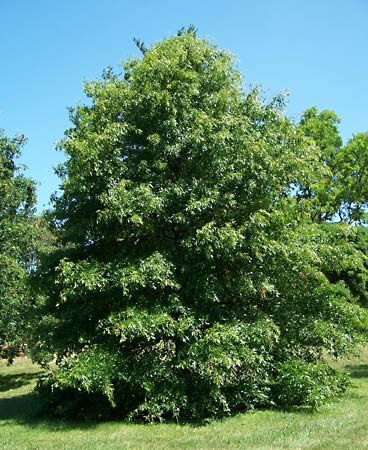
The pin oak (Quercus palustris) is widely valued as an ornamental tree in landscaping due to its distinctive aesthetic features. Its broad, pyramidal crown and unique drooping lower branches make it a popular choice for large landscapes and parks where its form can be fully appreciated.12
In urban and suburban settings, the pin oak is frequently utilized for its rapid growth and its striking seasonal transformation, as its glossy, deeply lobed leaves turn a vibrant scarlet in the autumn. Because the species is naturally found in bottomlands and moist soils, it is particularly well-suited for landscaping areas that experience periodic wetness or poor drainage, where other trees might struggle to thrive. While it serves as a significant ornamental specimen, it is also recognized as a member of the red oak group, which are historically significant as timber trees.12
What is the scientific name of the pin oak tree, and to which family does it belong?
The scientific name for the pin oak is Quercus palustris. It belongs to the family Fagaceae.3
How does the pin oak’s leaf structure differ from other oak species?
The pin oak (Quercus palustris) is a member of the red oak group, which distinguishes its leaf structure from that of the white oak group.14
Key characteristics of the pin oak’s leaf structure include:
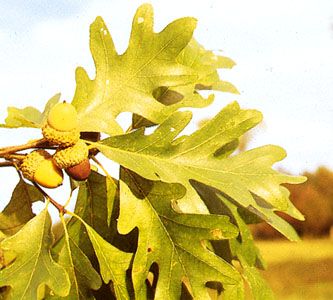
- Bristle-tips: As a red oak, the pin oak features leaves that are bristle-tipped, a trait shared by all members of the Erythrobalanus subgenus but absent in white oaks, which have smooth, non-bristle-tipped margins.45
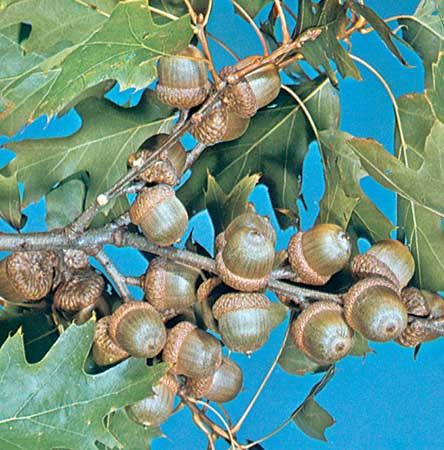
- Lobe Pattern: The leaves are elliptical and glossy green, typically measuring about 13 cm (5 inches) in length, and possess five to seven deeply cut lobes.1
- Comparison to other species: While other red oaks also have bristle-tipped leaves, their specific shapes and sizes vary significantly. For example, the northern red oak has larger, oblong leaves (20 cm or longer) with 7 to 11 lobes, while the blackjack oak features leaves with a wide, three-lobed apex.5
How does the pin oak tree get its name, and what are its other common names?
The common name “pin oak” is derived from the tree’s characteristic spurlike, slender branchlets that protrude from the trunk and larger limbs, resembling pins.1
While “pin oak” is the primary name for Quercus palustris, it is also referred to by several other common names due to its habitat and regional usage:
- Swamp Spanish oak: A specific common name used for Quercus palustris.6
- Swamp oak: A general term applied to various American oaks, including the pin oak, that thrive in wet or bottomland soils.7
Additionally, the name “pin oak” is sometimes applied to the northern pin oak (Quercus ellipsoidalis), also known as the jack oak, which similarly features pinlike branchlets but typically grows in drier upland environments.1
Sources
- pin oak — Encyclopædia Britannica
- pin oak — Merriam-Webster
- Fagales - Characteristic morphological features — Encyclopædia Britannica
- oak — Encyclopædia Britannica
- red oak — Encyclopædia Britannica
- swamp Spanish oak — Merriam-Webster
- swamp oak — Merriam-Webster
Published on · 2 min read