White Oak
The white oak (Quercus alba), also known as "stave oak," holds significant historical and industrial importance in North America. Renowned for its hard…
What is the historical significance of white oak trees in North American culture and industry?
The white oak (Quercus alba), also known as “stave oak,” holds significant historical and industrial importance in North America. Renowned for its hard, strong, and durable wood, it has been a cornerstone of the lumber trade since at least the early 17th century.12
In early American history, white oak was vital to the shipbuilding industry. Its exceptional toughness famously contributed to the resilience of the USS Constitution, which earned the nickname “Old Ironsides” during the War of 1812 because its hull—constructed from white oak and live oak—could withstand enemy cannon fire. Beyond naval architecture, the tree’s natural growth patterns provided essential structural braces for early vessels.3
Industrially, white oak has been utilized for railroad ties, fence posts, fuel wood, and veneer. Today, it remains a primary material for high-quality furniture, flooring, and crates. Its ecological role is equally significant, as gray squirrels play a critical part in the propagation of the species by burying its acorns.31
How long do white oak trees typically live, and how large can they grow?
The white oak (Quercus alba) is a significant timber tree that typically reaches heights of 18 to 45 meters (60 to 150 feet). While the provided search results detail the impressive stature of these trees, they do not specify a typical lifespan for the Quercus alba species.4
It is important to note that while some related species, such as the southern live oak, have been studied for their longevity—with the oldest specimens ranging from 200 to 300 years—this data does not apply to the white oak.1
How can you identify a white oak tree by its leaves, bark, and overall shape?
To identify a white oak (Quercus alba), you can examine its distinct physical characteristics:
Leaves
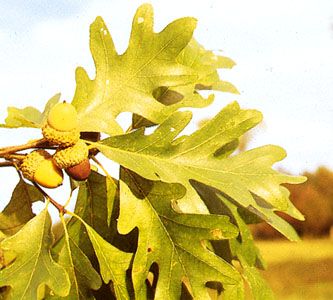
The leaves are glossy and bright green, measuring approximately 23 cm (9 inches) in length. They are narrow toward the base and are divided almost to the midrib into seven or nine lobes. Unlike red or black oaks, the leaves of the white oak are smooth and lack bristle tips. In the autumn, they typically turn a deep wine-red color.15
Bark
The bark of the white oak is pale-gray in color. It is characterized by a shallowly fissured and scaly texture.1
Overall Shape
The white oak is a large, significant timber tree that typically grows to a height of 18 to 45 meters (60 to 150 feet). While the species is part of a broader group of white oaks, the Quercus alba specifically is known for its stature and role in the eastern United States forests.15
What are some common uses for white oak wood in construction and industry?
White oak is a highly valued resource in the lumber trade, prized for its durability and versatility. Because of its structural integrity and resistance to decay, it serves several critical roles in construction and industry:
- Stave Production: Quercus alba is famously known as “stave oak” because its wood is the primary material used to manufacture staves for barrels and casks. The wood’s cellular structure, which contains tyloses that plug the pores, makes it effectively watertight and ideal for aging spirits, wine, and other liquids.1
- General Timber: Timber from all members of the white oak group is marketed as “white oak” and is widely utilized in construction for its strength and longevity.1
- Industrial Applications: Beyond barrel making, the wood is frequently used in high-quality furniture, flooring, and cabinetry due to its attractive grain and hardness. Its resistance to environmental wear also makes it suitable for various outdoor and heavy-duty industrial applications.1
Sources
- white oak — Encyclopædia Britannica
- 11 Questions About Useful Plants Answered - Which tree was used in the early American shipbuilding industry? — Encyclopædia Britannica
- white oak — Merriam-Webster
- live oak — Encyclopædia Britannica
- oak — Encyclopædia Britannica
- bur oak — Encyclopædia Britannica
Published on · 3 min read