Plaice
The plaice (Pleuronectes platessa) is a commercially significant European flatfish belonging to the family Pleuronectidae. Like other members of its family…
What is plaice?
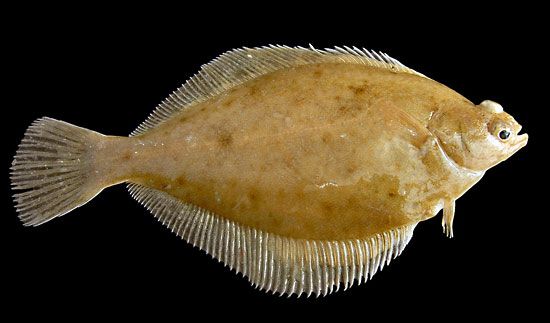
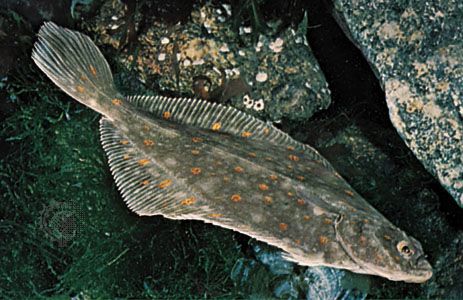
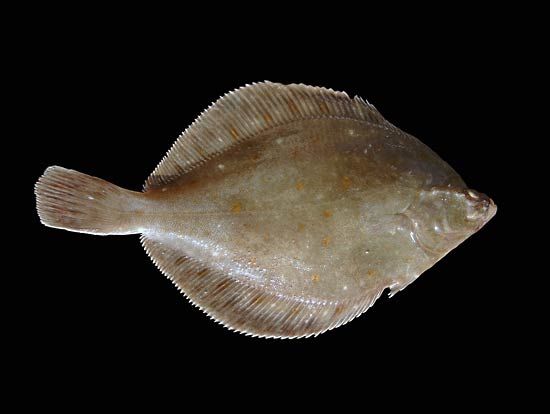
The plaice (Pleuronectes platessa) is a commercially significant European flatfish belonging to the family Pleuronectidae. Like other members of its family, the plaice is characterized by having both eyes positioned on the right side of its head.1
Physically, the fish is known for its striking appearance, featuring red or orange spots set against a brown background, and it can reach a maximum length of approximately 90 centimeters (36 inches). It is widely recognized as a food fish.12
Additionally, the term is used for the American plaice (Hippoglossoides platessoides), another North Atlantic flatfish found in both Europe—where it is known as the rough dab—and North America. This species is typically reddish or brownish in color and grows to about 60 centimeters in length.1
How do flatfish develop with both eyes on one side?
Flatfish, which belong to the order Pleuronectiformes, are unique among vertebrates because they are asymmetrical as adults. While they begin life as bilaterally symmetrical larvae with one eye on each side of the head, they undergo a dramatic transformation known as metamorphosis before settling into their adult benthic (bottom-dwelling) existence.34
During this process, one eye migrates to the other side of the head. This movement occurs either over the middorsal ridge or through the head itself, facilitated by a depression between the supraorbital bars and the dorsal fin. As the eye shifts, the skull undergoes significant osteological changes, including the reabsorption of the dorsal edge of the supraorbital bar and the twisting (torsion) of the frontals, ethmoid, and mouthparts.35
Once the migration is complete, the supraorbital bars ossify to form the interorbital bone, and the fish settles on the seafloor with its ocular (eyed) side facing upward. This side is typically pigmented to allow for camouflage, while the blind side remains unpigmented.65
What are some other common types of flatfish?
Beyond the plaice, there are approximately 680 species of flatfish within the order Pleuronectiformes. These fish are categorized into several families, with common types including:
- Halibut: These are among the largest and most economically valuable flatfish. The Atlantic halibut is the largest species, while the Pacific halibut is also widely recognized. Other species include the Greenland halibut and the California halibut.74
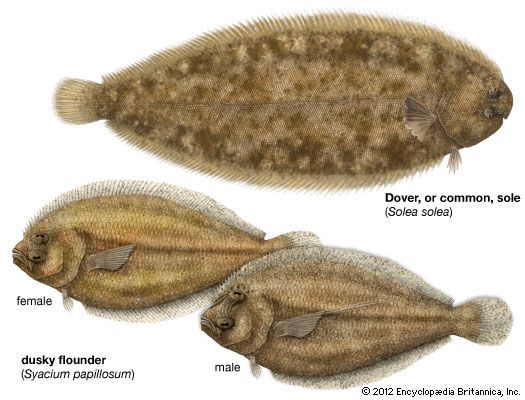
- Flounder: This group includes numerous species across several families. Notable examples include the European flounder, the starry flounder, the winter flounder, the summer flounder, the peacock flounder, and the dusky flounder.8
- Sole: Strictly referring to the family Soleidae, these include the commercially significant Dover sole, found in the eastern Atlantic and Mediterranean.9
- Turbot: A well-known flatfish often associated with the brill, which is a large commercial species found in European waters.1083
Most of these species are found on the continental shelf, where they live as bottom-dwellers.711
How does camouflage help flatfish survive in the ocean?
Camouflage is a vital survival strategy for flatfish, allowing these bottom-dwelling predators to avoid detection by both prey and larger threats. Because they inhabit the seafloor, often resting on sand or mud, their ability to blend into their environment is essential for their protection and hunting success.1213
Flatfish utilize several methods to achieve this concealment:
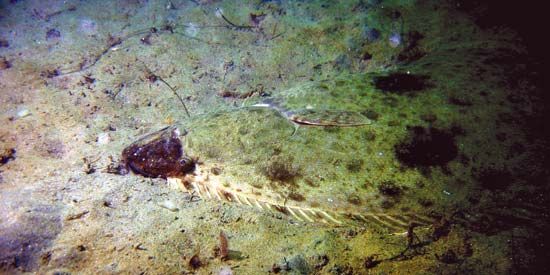
- Background Matching: Many flatfish possess a remarkable ability to change their coloration to match the pattern and shade of the surface upon which they are resting. This allows them to effectively disappear against the seafloor.1413
- Physical Positioning: When resting on the bottom, flatfish typically cover themselves with sand or mud, leaving only their eyes exposed. Because these eyes can be moved independently, the fish can monitor its surroundings while remaining largely hidden.12
- Pigmentation: The ocular (upper) side of a flatfish is pigmented to provide camouflage, while the blind (lower) side is typically white. This coloration is a key adaptation for life on the substrate.13
By remaining motionless and camouflaged, flatfish can wait for prey—such as crustaceans or small fish—to venture close before launching a sudden, successful attack.12
Sources
- plaice — Encyclopædia Britannica
- plaice — Merriam-Webster
- Did you know? — Merriam-Webster
- pleuronectiform — Encyclopædia Britannica
- pleuronectiform - Form and function — Encyclopædia Britannica
- pleuronectiform - Reproduction — Encyclopædia Britannica
- pleuronectiform - General features — Encyclopædia Britannica
- halibut — Encyclopædia Britannica
- flounder — Encyclopædia Britannica
- sole — Encyclopædia Britannica
- brill — Merriam-Webster
- coloration - Background matching — Encyclopædia Britannica
- coloration - Short-term changes — Encyclopædia Britannica
- pleuronectiform - Feeding behaviour — Encyclopædia Britannica
- coloration - Physiological control — Encyclopædia Britannica
- Integument - Fishes — Encyclopædia Britannica
- coloration - Disruptive coloration — Encyclopædia Britannica
- fish - Locomotion — Encyclopædia Britannica
Published on · 3 min read