Plane Tree
Plane trees, which belong to the genus Platanus, are native to temperate regions across North America, eastern Europe, and Asia.
Where are plane trees commonly found and what types of environments do they thrive in?
Plane trees, which belong to the genus Platanus, are native to temperate regions across North America, eastern Europe, and Asia.12
These trees are known for their rapid growth and ability to provide quick shade. While they are found in various natural settings, they are also frequently utilized in urban environments. Specifically, the London plane is widely planted in cities because of its notable resistance to air pollution and various diseases that often affect other tree species.13
Whether in a wild or urban setting, these trees are easily recognized by their picturesque, scaling bark that flakes away to reveal inner layers of white, gray, green, and yellow.1
What is a plane tree and what are its distinguishing features?
A plane tree is any of the 10 species belonging to the genus Platanus, which is the sole genus within the family Platanaceae. These large, fast-growing trees are native to North America, eastern Europe, and Asia.1
Distinguishing features of plane trees include:
- Bark: They are noted for their picturesque, scaling bark that flakes away to reveal inner layers of white, gray, green, and yellow.1
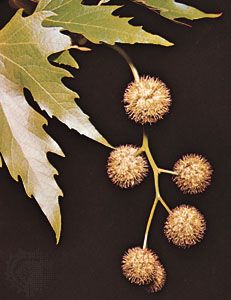
- Leaves: They feature large, deciduous leaves that are typically palmately lobed.1
- Flowers and Seeds: The trees are monoecious, bearing flowers of both sexes in separate clusters on the same tree. Their seeds are produced in globose heads.1
- Growth Habit: They are known for rapid growth and providing dense shade, with some species, such as the American plane tree, reaching heights exceeding 50 meters.1
It is important to note that the sycamore maple is a distinct species and should not be confused with the true plane tree.1
What are the unique characteristics of plane tree bark and why does it peel?
Plane trees (Platanus) are widely recognized for their picturesque, patchy bark, which serves as a primary identifying feature of the genus. This bark is characterized by its scaling appearance, where the outer layers flake away to reveal vibrant inner layers in shades of white, gray, green, and yellow.45
The peeling process is a natural result of how the tree grows and manages its protective outer covering:
- Growth Constraints: As a tree increases in diameter, its outer bark—which consists of dead, non-living tissue—cannot expand to accommodate the growing girth of the trunk.41
- Exfoliation: Because the dead outer cells are rigid and cannot stretch, they eventually crack and slough off to allow the tree to expand.41
- Protective Function: This shedding is a continuous process that helps the tree maintain its protective barrier. The cork cambium produces new layers of tissue, and as the tree grows, the older, outer layers are pushed outward, crushed, and shed.41
This unique pattern of exfoliation is a common trait among woody plants, but it is particularly dramatic and aesthetically distinct in plane trees.45
How long do plane trees typically live and how large can they grow?
Plane trees are known for their rapid growth and impressive size, though their longevity is not explicitly detailed in the provided information. Regarding their physical dimensions, they can reach significant heights and girths:
- American plane tree (P. occidentalis): This is the tallest species, sometimes reaching heights of more than 50 meters (160 feet).1
- Oriental plane (P. orientalis): This species reaches up to 30 meters (100 feet) in height and is noted for its massive trunks, with some measuring nearly 10 meters in circumference (about 10 feet in diameter).1
- California sycamore (P. racemosa): This tree typically grows to about 25 meters (80 feet) tall.1
- London plane (P. acerifolia): As a hybrid, this tree is generally shorter and more squat than the American plane tree.1
While these trees are recognized for their ability to provide quick shade due to their fast growth rates, the provided search results do not contain specific data regarding their typical lifespan.1
Sources
- plane tree — Encyclopædia Britannica
- London plane — Merriam-Webster
- platanus — Merriam-Webster
- Tree - Tree bark — Encyclopædia Britannica
- Angiosperm - Dermal tissue — Encyclopædia Britannica
Published on · 3 min read