Sabiaceae
The term Sabiaceae refers to a family of plants within the order Proteales. While some older classifications may associate the family with the order…
What is Sabiaceae?
The term Sabiaceae refers to a family of plants within the order Proteales. While some older classifications may associate the family with the order Sapindales, modern botanical consensus identifies it as part of the Proteales.12
This family comprises 4 genera and approximately 120 species of evergreen trees or lianas native to tropical regions of America and Southeast Asia. Key characteristics include:
- Morphology: The leaves or leaflets feature distinct looping venation, and the plants produce small flowers with stamens positioned opposite the petals or sepals.1
- Genera: The family includes Sabia, Kingsboroghia, and Ophiocaryon (notably O. paradoxum, known as the snake nut). The genus Meliosma is the largest, containing about 80 species known for anthers that open explosively.1
- Fruit: The plants typically produce fleshy, flattened, and curved fruits.1
What are lianas and how do they grow?
A liana is any long-stemmed, woody vine that remains rooted in the soil while climbing or twining around other plants for support. These plants are a prominent feature of tropical forest ecosystems, where they represent a significant structural component.34
Growth and Adaptation
Lianas have evolved to avoid the high energy costs associated with developing a self-supporting trunk. Instead, they exploit the trunks and limbs of tropical trees to reach the well-lit portions of the forest canopy. Their growth strategies include:35
- Climbing Mechanisms: Many lianas utilize specialized devices that resemble grapnel-like hooks to ascend toward the canopy.5
- Structural Exploitation: As they grow, their stems often loop through hundreds of meters of forest. They are capable of sending new shoots into different tree crowns as their original supporting trees die and decay.5
- Physical Dimensions: These plants can reach impressive sizes, growing up to 60 cm (about 24 inches) in diameter and 100 meters (about 330 feet) in length.3
Because they rely on other plants for support, lianas are often described as structural parasites. Their presence is frequently used as an indicator of mature, older forest stands.3
How do explosive anthers help plants reproduce?
Explosive anthers are a specialized botanical adaptation that facilitates pollination by forcefully discharging pollen onto visiting animals. This mechanism ensures that pollen is effectively transferred to a pollinator, which then carries it to another flower to complete the reproductive cycle.
A notable example of this process is found in the genus Axinaea, which utilizes a mechanism known as “puff pollination.” These flowers feature unique, juicy organs attached to their stamens that resemble fruit. When a bird attempts to grasp these structures with its beak, the action triggers the anther to release a blast of pollen directly onto the bird’s face. The flower and anther function similarly to a bellows or a turkey baster, using the physical force of the bird’s interaction to propel the pollen. It is believed that this process either coats the bird in pollen for transport to other flowers or helps disperse the pollen into the air for wind-assisted movement.
What are some other plant families in the order Proteales?
The order Proteales consists of four distinct families of eudicotyledonous flowering plants. While Proteaceae is the largest and most well-known family in the order, the other three families are:
- Sabiaceae: This family comprises four genera and approximately 120 species of evergreen trees or lianas native to tropical America and Southeast Asia.
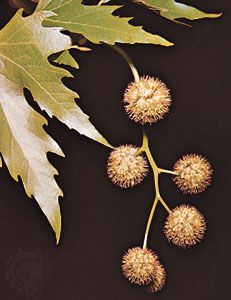
- Platanaceae: This family contains a single genus, Platanus, which includes plane trees, sycamores, and buttonwood. These are deciduous trees native to the Northern Hemisphere.
- Nelumbonaceae: This is an aquatic family consisting of only one genus, the lotus (Nelumbo), which includes two north temperate species: the sacred lotus and the American lotus.
The grouping of these disparate families into a single order was a significant finding of molecular studies, though some nonmolecular data also support their relationship.9
Sources
- Sabiaceae — Encyclopædia Britannica
- Sabiaceae — Merriam-Webster
- Liana — Encyclopædia Britannica
- Tropical rainforest - General structure of the rainforest — Encyclopædia Britannica
- liana — Merriam-Webster
- reptile - Clinging and climbing — Encyclopædia Britannica
- Angiosperm - Pollination — Encyclopædia Britannica
- Botanical Sex: 9 Alluring Adaptations — Encyclopædia Britannica
- Proteales — Encyclopædia Britannica
- Proteaceae — Merriam-Webster
Published on · 3 min read