Plateosaurus
Plateosaurus was a significant dinosaur from the Late Triassic Period, notable for being one of the earliest dinosaurs to reach a relatively large size. It…
What were the physical characteristics and size of the Plateosaurus?
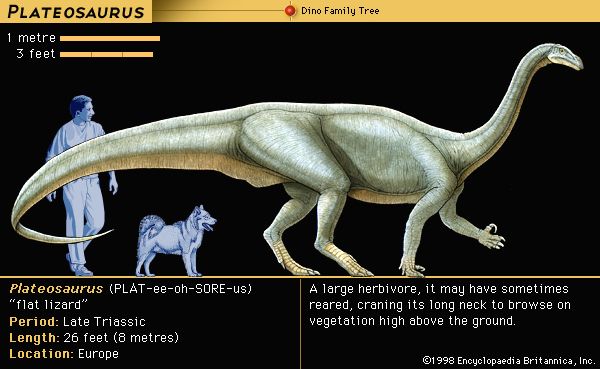
Plateosaurus was a significant dinosaur from the Late Triassic Period, notable for being one of the earliest dinosaurs to reach a relatively large size. It grew to approximately 8 meters (26 feet) in length and possessed a stocky, massive build with thick bones.1
Its physical characteristics included:
- Skull and Neck: It featured a small skull positioned on a long, flexible neck.1
- Dentition: The skull contained flat teeth that were serrated on both the front and back edges, adapted for its role as a large herbivore.1
- Locomotion: While it possessed two very strong hind legs and could rise up, its forelimbs were also well-developed and strong, suggesting it may have moved on both two or four legs depending on its needs.1
As a member of the prosauropods, Plateosaurus is considered a key representative of the group that may have been ancestral to the later, massive sauropod dinosaurs.1
How does Plateosaurus fit into the evolutionary history of dinosaurs?
Plateosaurus occupies a pivotal position in the evolutionary history of dinosaurs as a member of the prosauropods, a group of saurischian dinosaurs within the Sauropodomorpha lineage.13
Living during the Late Triassic Period, Plateosaurus represents one of the earliest instances of dinosaurs achieving a relatively large body size. Because they appear in the fossil record before the emergence of the massive, “true” sauropods in the Early Jurassic Period, many paleontologists have long viewed prosauropods as the direct ancestors of these later giants. This transition is supported by their shared anatomical traits, such as small heads, long necks, and a general trend toward increasing size.143
However, this evolutionary relationship remains a subject of scientific discussion. While the ancestral hypothesis is widely accepted, some researchers suggest that prosauropods and sauropods may have been distinct groups that shared a common ancestor earlier in the Triassic. Regardless of the specific lineage, Plateosaurus remains a crucial example of the early diversification of herbivorous dinosaurs.143
What is the Plateosaurus and in which geological period did it live?
Plateosaurus is a genus of dinosaurs belonging to the group known as prosauropods, which were among the earliest dinosaurs to reach a relatively large size. These herbivores grew to approximately 8 meters (26 feet) in length and possessed a stocky build, with a small skull atop a long, flexible neck.1
They lived during the Late Triassic Period, which spanned from about 229 million to 200 million years ago. Extensive fossil evidence for Plateosaurus has been discovered in Europe, and related species have been found in South Africa, North America, and China. Because they appeared before the emergence of the massive sauropod dinosaurs of the Jurassic Period, many scientists consider them to be potential ancestors to those later giants.1
What impact did the discovery of Plateosaurus have on our understanding of dinosaur evolution?
The discovery of Plateosaurus significantly advanced our understanding of dinosaur evolution by providing a critical link in the development of large-bodied herbivores. As one of the earliest dinosaurs to reach a substantial size—growing up to 8 meters (26 feet)—it demonstrated that the trend toward gigantism began as early as the Late Triassic Period.16
Plateosaurus serves as a primary representative of the prosauropods, a group whose anatomical features, such as long necks and small heads, mirror those of the massive sauropods that dominated the Jurassic Period. The observation that prosauropods disappeared just as true sauropods emerged has led many paleontologists to conclude that sauropods evolved directly from these earlier forms. While some researchers debate whether they represent a direct lineage or separate groups, Plateosaurus remains essential for mapping the transition from small, bipedal ancestors to the colossal dinosaurs of the later Mesozoic Era.1
Sources
- Plateosaurus — Encyclopædia Britannica
- Plateosaurus — Merriam-Webster
- dinosaur - Prosauropoda — Encyclopædia Britannica
- saurischian — Encyclopædia Britannica
- A Journey Through Time Since the Precambrian - Triassic Period: 252.2 million to 201.3 million years ago — Encyclopædia Britannica
- Triassic Period - The first dinosaurs — Encyclopædia Britannica
Published on · 3 min read