Po River
The Po River is the "prince of Italian rivers" and serves as a vital artery for the nation's agriculture and economy. Its drainage basin forms Italy’s widest…
What role does the Po River play in Italy’s agriculture and economy?
The Po River is the “prince of Italian rivers” and serves as a vital artery for the nation’s agriculture and economy. Its drainage basin forms Italy’s widest and most fertile plain, which is central to the country’s agricultural output.12
Agricultural Significance
The Po plain is a powerhouse for crop production, benefiting from fertile soil and irrigation. It is a primary region for:23
- Rice: Italy is a major exporter of rice, with the majority grown on the Po plain.4
- Cereals: The northern lowlands, including the Po valley, are the primary areas for soft wheat production, as well as corn (maize).4
- Productivity: Due to favorable terrain and advanced mechanization, agricultural yields in the north are significantly higher than those in the south.4
Economic and Transport Role
The Po valley serves as a critical economic hub, with cities like Milan positioned at the nexus of its traffic routes. While Italy relies heavily on maritime trade, the Po is the country’s only navigable internal waterway, allowing for transport from its mouth to Pavia.352
How has the Po River’s course changed over time due to natural and human factors?
The course of the Po River has been significantly shaped by both natural geological processes and centuries of human intervention.
Natural Factors
The river’s path is defined by its heavy sediment load, which continuously alters the landscape. As the Po flows toward the Adriatic Sea, it deposits vast amounts of silt, causing its delta to extend by approximately 200 acres annually. This sedimentation has historically pushed the coastline outward, leaving once-prominent ancient ports, such as Ravenna, miles inland from the sea. Additionally, the river naturally forms meanders and oxbow lakes throughout its middle and lower courses.3
Human Factors
Human efforts to regulate the Po date back to pre-Roman times, with extensive work undertaken by the Romans to protect riparian lands. These efforts include:
- Flood Control: To manage the river’s frequent and devastating floods, engineers have constructed dikes and levees to constrain the water and protect inhabited areas.36
- Land Reclamation: Over the past three centuries, large-scale projects have reclaimed thousands of acres of marshy land, such as the Valli di Comacchio, for agricultural use.3
- Channel Management: Hydraulic engineering has been essential in diverting silt and managing the river’s complex delta, which consists of multiple mouths.3
Despite these efforts, the river remains a dynamic force, and the ongoing struggle to balance human development with the river’s natural hydrology continues to challenge engineers.3
How has the Po River influenced the history and culture of the regions it flows through?
The Po River has been a foundational element of Italian history and culture, serving as a cradle for human settlement and a central axis for regional development.
Early Settlement and Hydraulic History
Human presence in the Po valley dates back to the Paleolithic and Neolithic periods, when inhabitants built dwellings on piles along the river’s swampy banks. The river’s influence on human organization was profound; the necessity of managing its frequent, torrential floods and sediment load led to the development of early “hydraulic civilizations.” By pre-Roman times, communities had begun engineering works to protect riparian lands. The Romans further formalized this by establishing rectangular land divisions, many of which remain visible today, reflecting a long-standing cultural commitment to reclaiming and organizing the landscape for agriculture.3
Linguistic and Cultural Legacy
The river’s cultural significance is embedded in its very names. The Ligurian term Bodincus (meaning “bottomless”) and the Celtic/Venetic name Padus highlight the river’s ancient identity. These names persist in local geography, such as the town of Bodincomagus and the city of Padua.3
Regional Identity and Connectivity
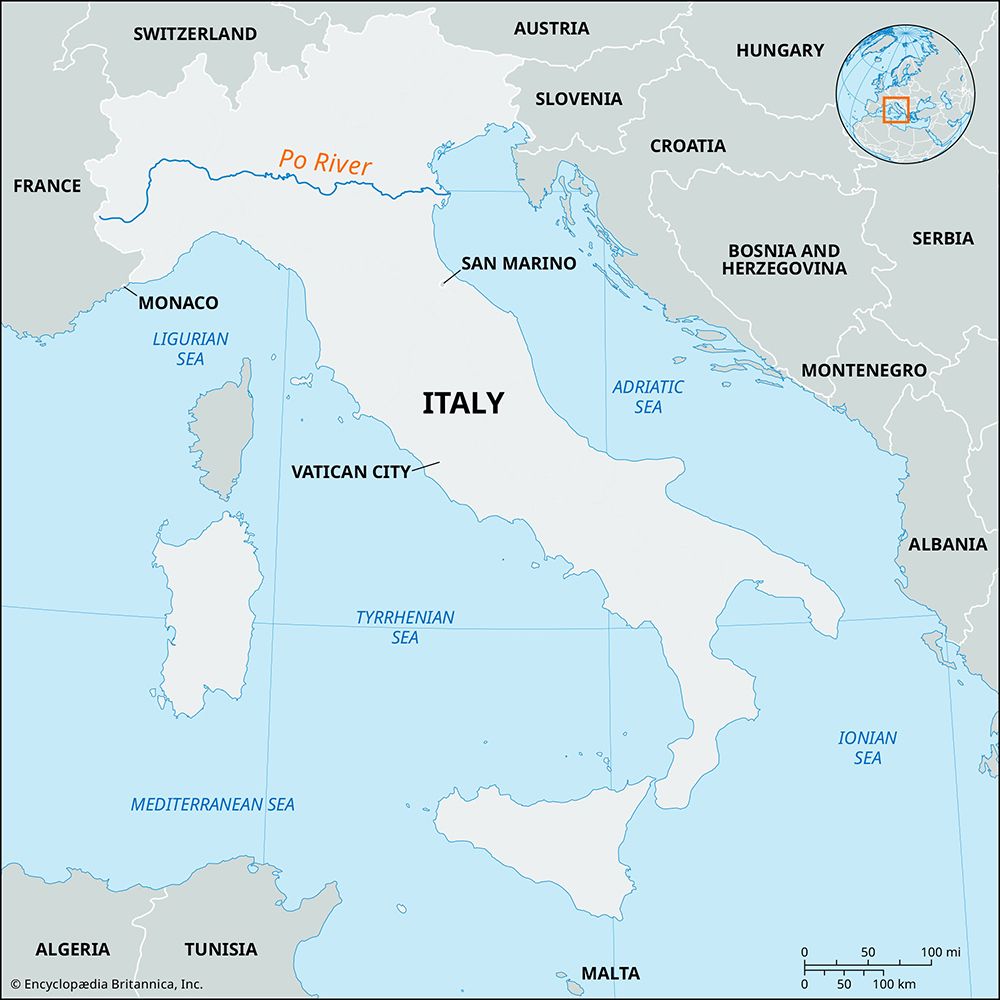
The Po serves as a natural boundary between the regions of Lombardy, Emilia-Romagna, and Veneto. Its valley is the core of Piedmont, a region whose history is deeply tied to the river’s fertile plains and the strategic mountain passes that connected Italy to the rest of Europe. Throughout the Middle Ages, the river became a vital artery for trade and communication, with the control of crossing points leading to the rise of significant bridge towns and strongholds.39
What flood control measures have been implemented along the Po River?
To manage the frequent and often devastating floods of the Po River, various hydraulic engineering measures have been implemented over centuries:
- Dikes and Levees: The construction of dikes to constrain the river’s flow and protect surrounding lands dates back to pre-Roman times. These systems were significantly expanded under the Romans and were further maintained and restored during the Middle Ages, with the current protective framework largely established by the end of the 15th century.3
- Canalization: The Venetian Republic historically utilized canals to divert silt, helping to manage the river’s heavy sediment load and reduce the risk of channel blockage.3
- Land Reclamation: Extensive projects have been undertaken to drain marshy areas, such as the Valli di Comacchio. These efforts, including the 1953 Italian Land Reform project, focused on soil improvement and the reclamation of the polesine (delta area) to stabilize the landscape and support agriculture.3
Despite these long-standing efforts, the river’s high discharge variability continues to pose significant challenges to flood management.3
Sources
- Italy - Rivers — Encyclopædia Britannica
- Italy - Water transport — Encyclopædia Britannica
- Po River — Encyclopædia Britannica
- Milan - Economy — Encyclopædia Britannica
- Italy - Field crops — Encyclopædia Britannica
- levee — Encyclopædia Britannica
- Adige River — Encyclopædia Britannica
- Mississippi River - Flood control — Encyclopædia Britannica
- Piedmont — Encyclopædia Britannica
- river - Significance in early human settlements — Encyclopædia Britannica
Published on · 4 min read