Pollock
Pollock refers to several species of fish belonging to the cod family, Gadidae.
What is pollock?
Pollock refers to several species of fish belonging to the cod family, Gadidae.12
The North Atlantic pollock (Pollachius virens), also known as saithe or coalfish in Europe, is an elongated, deep-green, schooling fish that can grow to approximately 1.1 meters (3.5 feet) and 16 kg (35 pounds). It is a carnivorous species valued for both commercial food production and sport fishing.1
Additionally, the Alaska pollock, or walleye pollock (Gadus chalcogrammus), is a significant commercial species found in the North Pacific, particularly in the Bering Sea. These bottom-dwelling fish typically reach lengths of up to 91 cm (36 inches). A separate, related species, Pollachius pollachius, is found inshore in European waters but holds no commercial value.321
How does the Alaska pollock differ from the Atlantic pollock?
The Alaska pollock and the North Atlantic pollock are distinct species within the cod family, Gadidae, differing primarily in their scientific classification, geographic range, and physical size.
Scientific Classification and Range
- North Atlantic pollock (Pollachius virens): Found in the North Atlantic, this species is also known as saithe or coalfish in Europe. It is a schooling, carnivorous fish that inhabits these northern waters.1
- Alaska pollock (Gadus chalcogrammus): Also known as the walleye pollock, this species is native to the North Pacific. Its range extends from the Sea of Japan (East Sea) to the California coast, with the highest concentrations found in the Bering Sea.2
Physical Characteristics
The two species differ significantly in their maximum growth potential:
- North Atlantic pollock: This is a larger, more robust fish, reaching lengths of approximately 1.1 meters (3.5 feet) and weights of up to 16 kg (35 pounds).1
- Alaska pollock: This species is smaller, typically reaching a maximum length of about 91 cm (36 inches) and a weight of approximately 3.9 kg (8.6 pounds).2
What are some other common fish species in the cod family?
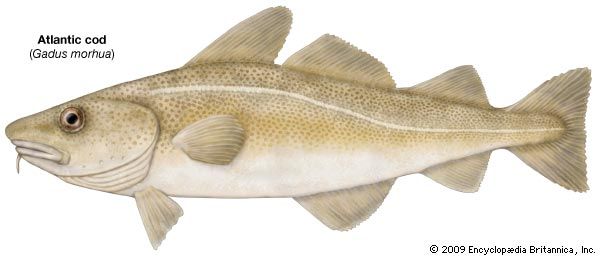
The family Gadidae includes several economically important marine fish species beyond the well-known cod. Common members of this family include:
- Haddock (Melanogrammus aeglefinus): A valuable North Atlantic food fish that resembles cod but is distinguished by a dark lateral line and a dark shoulder spot.2
- Whiting (Merlangius merlangus): A common European marine fish often found in the North Sea, characterized by its silvery color and a black blotch near the pectoral fins.4
- Hake (genus Merluccius and Urophycis): Large, swift, carnivorous fish found in the Atlantic, eastern Pacific, and near New Zealand. While sometimes classified in their own family (Merlucciidae), they are traditionally associated with the cod family.5
- Pacific Cod (Gadus macrocephalus): A species very similar to the Atlantic cod, found in the North Pacific and known in Japan as tara.6
- Greenland Cod (Gadus ogac): A species found in cold northern waters, such as Baffin Bay and the Gulf of Saint Lawrence, which is genetically very similar to the Pacific cod.6
Why is the Alaska pollock considered so important for the fishing industry?
The Alaska pollock (Gadus chalcogrammus) is a cornerstone of the commercial fishing industry, particularly within the United States. Its economic significance is driven by its massive abundance in the Bering Sea and its versatility in food production.102
A primary driver of its importance is the use of its flesh in the production of surimi, a processed fish product that serves as a base for various seafood analogs. Beyond surimi, the species is widely utilized in the form of minced fish flesh, which is processed into a variety of consumer goods, including fish sticks, nuggets, and formed patties for sandwiches and main dishes.11
Because Alaska pollock is harvested in significant quantities by commercial fleets, it remains a vital export commodity for the state of Alaska, supporting major processing hubs in cities like Unalaska. The industry is carefully managed through international cooperation and regulatory frameworks, such as the exclusive economic zone and U.S.-Russian agreements, to ensure the sustainability of these high-volume fisheries.10
Sources
- pollock — Encyclopædia Britannica
- cod — Encyclopædia Britannica
- pollock — Merriam-Webster
- whiting — Encyclopædia Britannica
- haddock — Encyclopædia Britannica
- hake — Encyclopædia Britannica
- Gadus — Encyclopædia Britannica
- gadid — Merriam-Webster
- gadid — Merriam-Webster
- Alaska - Agriculture, forestry, and fishing — Encyclopædia Britannica
- fish processing - Minced fish flesh — Encyclopædia Britannica
Published on · 3 min read