Polyp
Polyps, which are members of the phylum Cnidaria, reproduce through both sexual and asexual methods.
How do polyps reproduce and what are the different methods they use?
Polyps, which are members of the phylum Cnidaria, reproduce through both sexual and asexual methods.12
Asexual Reproduction
Asexual reproduction allows polyps to create genetically identical individuals, often leading to the formation of a colony. Common methods include:13
- Budding: Small portions of the parent’s tissue grow into new, independent individuals or remain attached to form a colony.123
- Fission: A parent polyp divides lengthwise or crosswise into two smaller individuals.1
- Strobilation: In some species, such as scyphozoans, a polyp undergoes transverse division at its oral end to produce multiple free-swimming immature medusae called ephyrae.1
Sexual Reproduction
Sexual reproduction typically involves the production of gametes. While many species shed eggs and sperm into the water for external fertilization, others utilize internal fertilization. The resulting planula larva eventually settles on a surface to develop into a new polyp. Some species exhibit hermaphroditism and may even practice self-fertilization.123
What is the basic structure of a polyp in zoology?
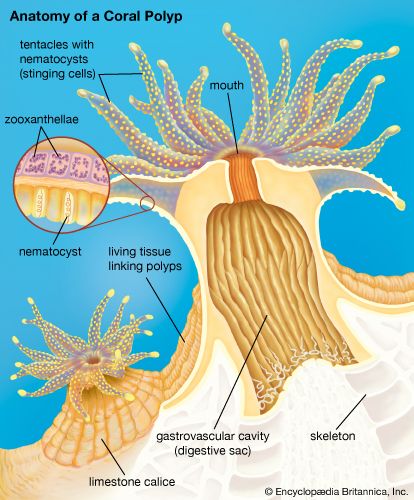
In zoology, a polyp is one of the two primary body forms of the phylum Cnidaria. It is characterized by a hollow, cylindrical body that is typically sessile, meaning it is attached to a solid surface at its base.45
The basic structural features include:
- Body Layers: The body wall is composed of two distinct cell layers: an outer ectoderm and an inner endoderm.45
- Oral End: The free, upper end features a mouth surrounded by extensible tentacles. These tentacles are equipped with specialized stinging structures called nematocysts, which are used to capture prey.45
- Internal Anatomy: The body contains a saclike cavity known as the coelenteron, which serves as the digestive space. In many hydrozoan polyps, the mouth is located at the end of a tubelike structure called a manubrium, while anthozoan polyps possess an internal pharynx, or stomodaeum, that connects the mouth to the coelenteron.5
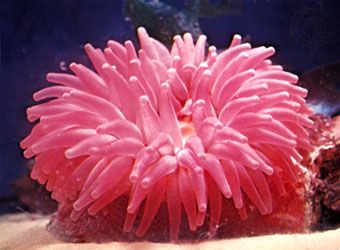
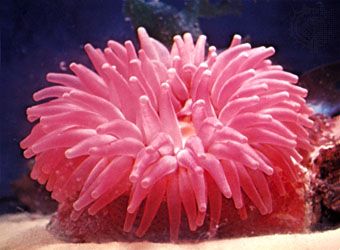
Polyps may exist as solitary individuals, such as sea anemones, or as part of a colony, such as corals.45
What is the difference between solitary polyps and colonial polyps?
The primary difference between solitary and colonial polyps lies in their physical connection and social organization.
Solitary Polyps
Solitary polyps exist as independent individuals. A well-known example is the sea anemone, which functions as a single, self-contained organism. While they may reproduce asexually to create clones that eventually separate, they do not remain physically linked to their parent or siblings.471
Colonial Polyps
Colonial polyps remain physically attached to one another, often embedded in a common mass of tissue or held together by a shared skeleton, such as the calcium carbonate structures found in coral.431
Key characteristics of colonial polyps include:
- Shared Resources: In many colonies, polyps share a common coelenteron (digestive cavity), allowing food captured by one member to be distributed throughout the colony.1
- Polymorphism: Members of a colony are often polymorphic, meaning they vary in form and function. For example, some polyps may be specialized for feeding (gastrozooids), while others are specialized for defense (dactylozooids) or reproduction (gonozooids).1
- Growth: Colonies grow through the constant addition of new buds, creating complex, integrated structures that can reach significant sizes.17
How do polyps contribute to the formation of coral reefs?
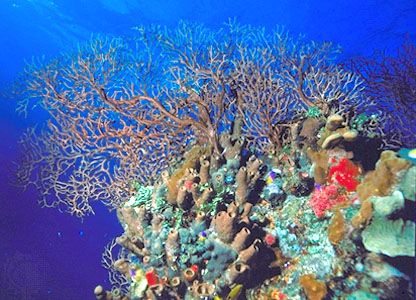
Coral polyps are the primary architects of coral reefs, functioning as the essential structural framework for these complex ecosystems. Most reef-building corals are colonial organisms that reproduce by dividing into daughter polyps, eventually forming large colonies held together by a continuous, rigid calcium carbonate skeleton.7
Their contribution to reef formation involves several key processes:
- Skeletal Construction: Polyps extract calcium and carbonate from seawater to build their limestone skeletons. Over time, these accumulate to create the massive, solid structures that define a reef.79
- Symbiotic Efficiency: The formation of these skeletons is significantly accelerated by zooxanthellae, symbiotic dinoflagellate algae living within the coral tissues. These algae aid in the rapid removal of metabolic carbon dioxide and enhance the speed at which the coral deposits calcium carbonate.10
- Structural Integration: As polyps grow side by side and over one another, they create a stable foundation. Other organisms, such as calcareous algae, mollusks, and protozoans, further contribute by filling gaps and cementing the reef structure together.7
Sources
- cnidarian - Reproduction and life cycles — Encyclopædia Britannica
- Reproductive behaviour - Coelenterates — Encyclopædia Britannica
- coral — Encyclopædia Britannica
- polyp — Encyclopædia Britannica
- cnidarian - Size range and diversity of structure — Encyclopædia Britannica
- cnidarian - Ecology and habitats — Encyclopædia Britannica
- coral reef - Corals and other reef-building organisms — Encyclopædia Britannica
- moss animal - Colonies — Encyclopædia Britannica
- coral reef - Winds , currents, temperature, and salinity — Encyclopædia Britannica
- coral reef - Biological factors — Encyclopædia Britannica
Published on · 4 min read