Planula
A planula is a free-swimming or crawling larval form common to many species within the phylum Cnidaria, such as jellyfish, corals, and sea anemones.
What is planula?
A planula is a free-swimming or crawling larval form common to many species within the phylum Cnidaria, such as jellyfish, corals, and sea anemones.1
The planula typically features a cylindrical or egg-shaped body covered in cilia, which are tiny, hairlike projections used for locomotion. During the cnidarian life cycle, these larvae are produced by the polyp form in anthozoans and by the medusa form in most other cnidarians.1
Developmentally, a planula arises from a ciliated ball of cells that elongates and develops a forward-directed tuft of cilia, which may possess sensory capabilities. After a period of motility, the larva attaches to a solid surface by its forward end and develops tentacles around its posterior end, eventually transforming into a polyp. While many planulae are planktonic, some species exhibit different developmental strategies, such as brooding their offspring until they are more advanced.2
How do cnidarians differ from other marine invertebrates?
Cnidarians are distinguished from other marine invertebrates primarily by their unique biological structures and relatively simple, radially symmetrical body plans.
Defining Characteristics
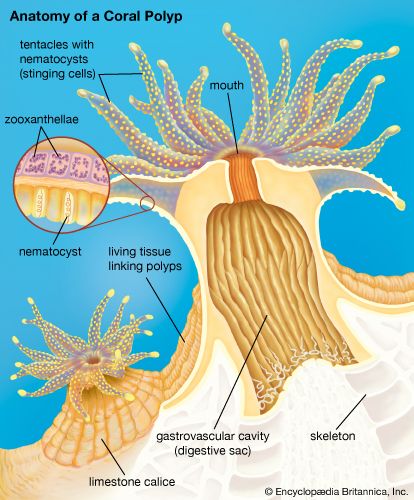
- Nematocysts: The most definitive feature of the phylum Cnidaria is the production of microscopic, intracellular stinging capsules called nematocysts (or cnidae). These complex structures are used for defense and capturing prey, and they are not found in any other animal group.34
- Body Organization: Cnidarians are organized around a central body cavity known as the coelenteron, which serves as a primitive gut. Their bodies exhibit radial symmetry, meaning their parts are arranged symmetrically around this central axis.35
- Nervous System: Unlike more complex invertebrates that possess centralized brains, cnidarians utilize a nerve net—a diffuse, meshlike system of neurons distributed throughout the body. While they lack ganglia or a brain, this system allows for coordinated movement and behavioral responses to stimuli.65
- Integument: Their outer layer, or epidermis, is highly functional, containing specialized cells for sensation, secretion, and protection. Some species further differentiate by secreting calcareous skeletons, which form the structural foundation of coral reefs.7
While some organisms like ctenophores (comb jellies) may appear superficially similar due to their gelatinous bodies, they are distinct from cnidarians; any cnidae found in ctenophores are typically acquired through predation rather than internal production.8
What is the difference between a polyp and a medusa?
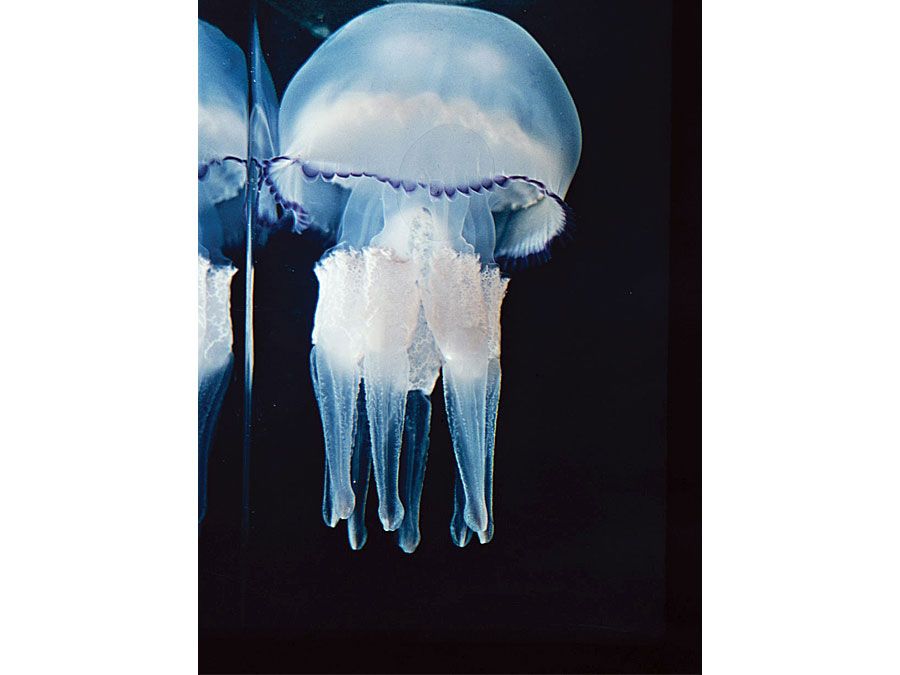
Cnidarians exhibit two primary body forms, the polyp and the medusa, which often represent different stages in a single life cycle.9
Key Differences
Feature
Polyp
Medusa
Body Shape
Cylindrical, stalked
Bell- or umbrella-shaped
Orientation
Mouth and tentacles face upward
Mouth and tentacles hang downward
Lifestyle
Generally sessile (attached to a substrate)
Free-swimming (planktonic)
Role
Often the juvenile or asexual form
Typically the adult or sexual form
Structural and Functional Distinctions
- Movement: Polyps are typically attached to a firm surface, though they may form large, stationary colonies. In contrast, medusae move through the water via rhythmic muscular contractions of their bell.92
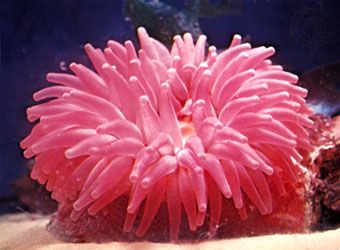
- Anatomy: The medusa features a central, tubelike manubrium that connects the mouth to the internal body cavity. While many hydrozoan polyps also possess a manubrium, anthozoan polyps (such as sea anemones) utilize an internal pharynx called a stomodaeum to connect the mouth to the coelenteron.92
- Life Cycle: In many species, medusae reproduce sexually to produce larvae that develop into polyps, while polyps reproduce asexually to generate new medusae. Notably, Anthozoa (such as corals and anemones) exist exclusively as polyps and lack a medusa stage entirely.910
How do corals build reefs using their life cycle?
Reef-building corals, primarily the stony corals, construct massive reefs through a process of colonial growth and the secretion of calcium carbonate skeletons.1112
The Process of Reef Construction
- Colonial Growth: Unlike solitary anemones, reef-building corals are colonial. An initial polyp reproduces asexually, creating daughter polyps that remain attached to one another. Over time, these colonies grow into massive structures, with polyps often packed so tightly that they share common walls.1113
- Skeletal Secretion: Each polyp secretes a rigid, cup-shaped calcareous skeleton around itself. As these colonies expand, they build a continuous, solid limestone matrix. In massive corals, this skeleton is deposited at a rate of about one centimeter per year, while branching species can grow significantly faster.1113
- Symbiotic Assistance: The speed of skeletal formation is greatly enhanced by zooxanthellae, single-celled algae living within the coral tissues. Through photosynthesis, these algae remove metabolic waste products and accelerate the precipitation of calcium carbonate.1412
- Reef Accumulation: As corals grow, other organisms—including calcareous algae, mollusks, and echinoderms—contribute to the reef by filling gaps with skeletal fragments, which are then bound together by encrusting algae.11
Sources
- planula — Encyclopædia Britannica
- cnidarian - Reproduction and life cycles — Encyclopædia Britannica
- cnidarian — Encyclopædia Britannica
- cnidarian - Nervous system and organs of sensation — Encyclopædia Britannica
- Integument - Cnidarians — Encyclopædia Britannica
- nervous system - Diffuse nervous systems — Encyclopædia Britannica
- cnidarian - Critical appraisal — Encyclopædia Britannica
- cnidarian - Defense and aggression: nematocysts — Encyclopædia Britannica
- cnidarian - Size range and diversity of structure — Encyclopædia Britannica
- medusa — Encyclopædia Britannica
- coral reef - Corals and other reef-building organisms — Encyclopædia Britannica
- cnidarian - Support mechanisms and skeletons — Encyclopædia Britannica
- coral reef - Biological factors — Encyclopædia Britannica
- Marine ecosystem - Benthos — Encyclopædia Britannica
Published on · 4 min read