Predaceous Diving Beetle
Predaceous diving beetles (family Dytiscidae) exhibit a significant range in size across their more than 4,000 known species. These aquatic insects vary in…
How large can predaceous diving beetles grow, and how does their size vary among species?
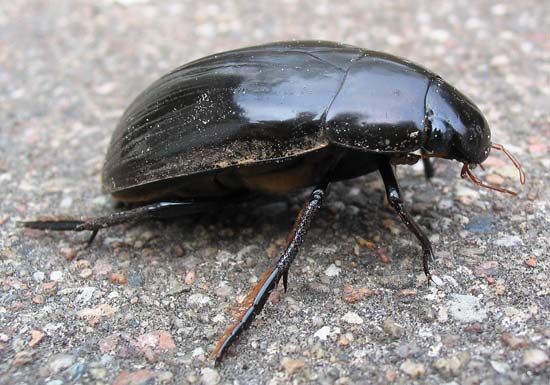
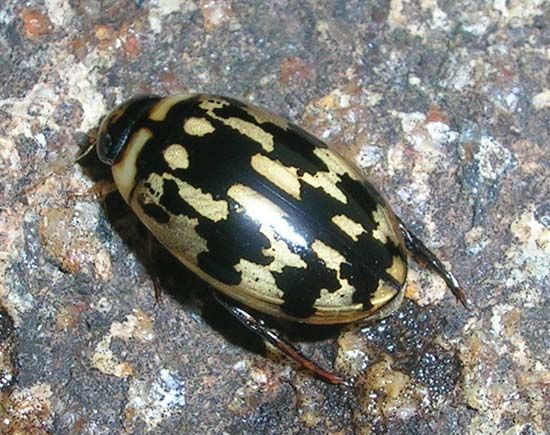
Predaceous diving beetles (family Dytiscidae) exhibit a significant range in size across their more than 4,000 known species. These aquatic insects vary in length from as small as 1.5 mm (0.06 inches) to more than 35 mm (1.4 inches).1
The size of these beetles is largely determined by their specific genus and species. While many are quite small, members of the prominent genera Dytiscus and Cybister are among the largest, consistently reaching lengths exceeding 35 mm. These larger varieties are notable for being harvested and consumed as food in parts of the Orient. In contrast, the family includes a wide diversity of forms, such as the specialized, eyeless genus Siettitra, which inhabits deep wells.1
How do predaceous diving beetles breathe underwater?
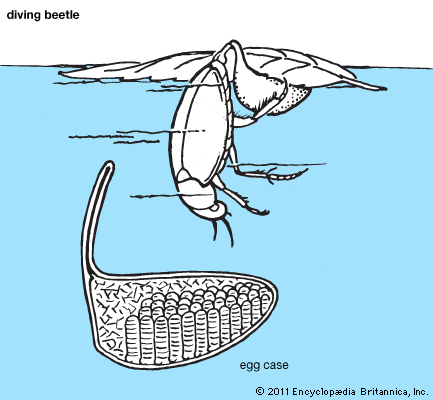
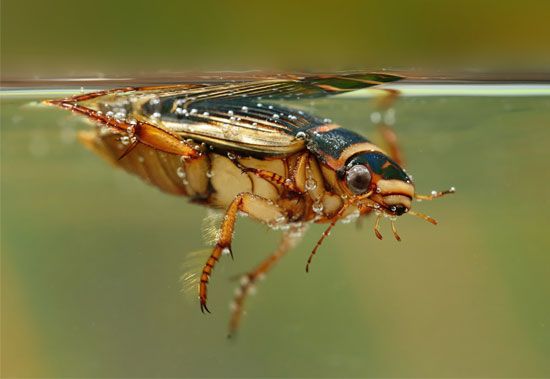
Predaceous diving beetles (family Dytiscidae) utilize a specialized tracheal system to breathe while submerged. Their spiracles—the openings used for gas exchange—are located on the abdomen beneath the tips of their wing covers, or elytra.
When at the water’s surface, the beetle rests with its head down and raises the tips of its elytra to intake air through these spiracles. Before diving, it traps a supply of air under its wings to serve as an oxygen reservoir while underwater. This bubble functions like a gill: as the beetle consumes oxygen from the bubble, the partial pressure of oxygen within it drops, causing dissolved oxygen from the surrounding water to diffuse into the bubble. Simultaneously, carbon dioxide produced by the beetle diffuses out into the water.13
Because nitrogen eventually diffuses out of the bubble, causing it to shrink, the beetle must periodically return to the surface to replenish its air supply. In contrast, the larvae of some species possess filamentous abdominal appendages that function as gills, allowing them to remain submerged without surfacing to breathe.31
How do predaceous diving beetles reproduce and what is their life cycle like?
Predaceous diving beetles (family Dytiscidae) undergo complete metamorphosis, a life cycle consisting of four distinct stages: egg, larva, pupa, and adult.14
Reproduction
Reproduction in these beetles is typically bisexual. Males are equipped with specialized sucker-like cups on their first pair of legs, which allow them to securely grip the smooth surface of the female during mating. The male uses a hardened, tubelike structure called an aedeagus to transfer sperm to the female, where it is stored in a specialized sac (spermatheca) until needed for fertilization. Females deposit their eggs either directly in the water or on aquatic vegetation.14
Life Cycle
- Larva: Upon hatching, the larvae—often called “water tigers”—are long, slender, and highly predatory. They possess sickle-shaped jaws with internal canals used to inject digestive juices into prey and suck out the liquefied tissues. As they grow, they undergo several molts, shedding their skin (cuticle) as it becomes too small.14
- Pupa: Once mature, the larvae leave the water to pupate in moist ground. During this inactive, nonfeeding stage, the insect undergoes a dramatic transformation, breaking down larval tissues and developing adult structures.154
- Adult: The adult emerges from the pupal skin with fully formed wings and a hardened outer skeleton. Adults are well-adapted to aquatic life, featuring long, fringed hind legs for swimming and a streamlined body shape.1
How do predaceous diving beetles defend themselves against predators?
Predaceous diving beetles (family Dytiscidae) utilize chemical defenses to protect themselves from potential predators. Like many other beetles, they produce foul-smelling or distasteful secretions from specialized glands on their bodies. These defensive compounds serve as effective repellents, often acting as a deterrent by creating an unpleasant odor or taste that discourages attackers.18
While the provided search results do not detail the specific chemical composition of the secretions for the Dytiscidae family, they note that many beetles employ such chemical defenses to enhance their survival against predators. These strong odors are often associated with toxic substances, which can help predators learn to avoid them, thereby reinforcing the protective effect of the secretions.18
Sources
- predaceous diving beetle — Encyclopædia Britannica
- diving beetle — Merriam-Webster
- Respiratory system - Trachea — Encyclopædia Britannica
- Metamorphosis — Encyclopædia Britannica
- Coleoptera - General features — Encyclopædia Britannica
- Coleoptera - Larvae — Encyclopædia Britannica
- heteropteran - Eggs — Encyclopædia Britannica
- Chemoreception - Defensive odors — Encyclopædia Britannica
- Coleoptera - Protection — Encyclopædia Britannica
Published on · 3 min read