Quetzal
A quetzal refers to any of five colorful bird species within the genus Pharomachrus, part of the trogon family (Trogonidae). These birds are native to the…
What is Quetzal?
A quetzal refers to any of five colorful bird species within the genus Pharomachrus, part of the trogon family (Trogonidae). These birds are native to the neotropics, ranging from southern Mexico to Bolivia.1
The five species include:
- White-tipped quetzal (P. fulgidus)
- Crested quetzal (P. antisianus)
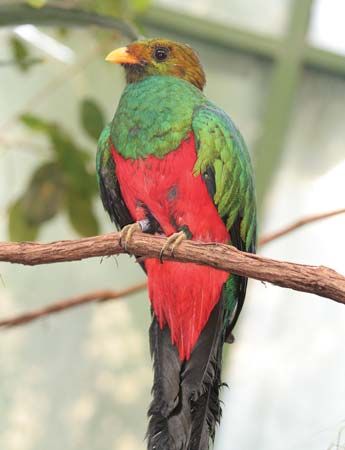
- Golden-headed quetzal (P. auriceps)
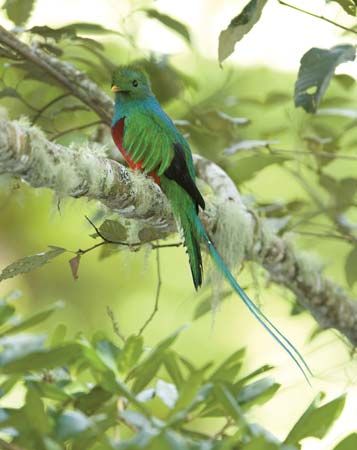
- Resplendent quetzal (P. mocinno)
- Pavonine quetzal (P. pavoninus)
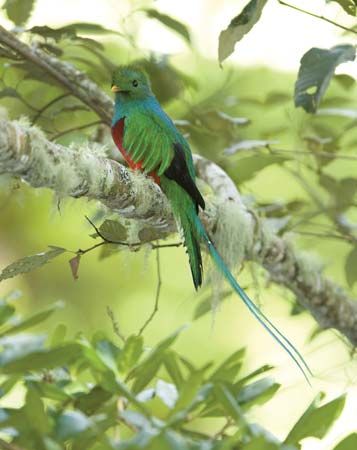
The resplendent quetzal held sacred status among the ancient Mayas and Aztecs. Today, it serves as the national emblem of Guatemala, which also named its national currency unit, the quetzal (GTQ), after the bird. Known for their striking plumage, adult quetzals typically measure 33 to 40 cm in length, though males of certain species possess elongated tail feathers that can extend up to 90 cm.12
Why was the resplendent quetzal considered sacred by the Maya and Aztecs?
The resplendent quetzal was considered sacred by the ancient Maya and Aztec civilizations primarily due to its striking appearance and its deep symbolic connection to their religious pantheon.
The bird’s significance is most notably reflected in the name of the major deity Quetzalcóatl, the “Feathered Serpent.” The name itself is derived from the Nahuatl words quetzalli, meaning the “tail feather of the quetzal bird,” and coatl, meaning “snake.” By incorporating the quetzal’s brilliant, elongated plumes into the imagery of this powerful god—who was associated with the wind, learning, and the planet Venus—the cultures elevated the bird to a divine status.13
The resplendent quetzal’s physical beauty, characterized by its iridescent gold-green head and breast, blue back, and the male’s dramatic tail feathers that can reach up to 90 cm in length, likely contributed to its veneration as a creature of unique spiritual importance.1
What other animals were significant in ancient Mesoamerican cultures?
In addition to the quetzal, several other animals held profound religious and symbolic significance in ancient Mesoamerican cultures, often serving as manifestations of the divine or as essential components of their ritual calendars.
Significant Animals in Mesoamerican Belief
- Hummingbird: Among the Aztecs, the hummingbird was inextricably linked to Huitzilopochtli, the god of sun and war. His name is derived from the Nahuatl word for hummingbird, and he was often depicted in this form. The Aztecs believed that warriors who died in battle were reincarnated as hummingbirds, which served as a symbol of the “resuscitated warrior of the south.”4
- Eagle: The eagle was a powerful symbol of the sun and military prowess. It served as the nagual (animal disguise) for Huitzilopochtli. The image of an eagle devouring a snake while perched on a rock was a foundational vision for the founding of the Aztec capital, Tenochtitlán. Additionally, sacrificial hearts were offered to the sun as the “eagle who rises,” and elite warriors were known as the “eagle’s people.”4
- Snake (Serpent): Serpents were central to Mesoamerican iconography. Beyond the Feathered Serpent (Quetzalcóatl), snakes were associated with various deities, including the “turquoise snake” weapon of Huitzilopochtli and a prominent snake god worshiped by the Maya at Yaxchilán.45
- Jaguar and Rabbit: These animals were so culturally vital that they were used as signs in the Tonalpohualli, the 260-day ritual calendar. A person’s birth date—and thus their destiny—was determined by these signs; for instance, those born under the “One-Jaguar” series were destined for the sacrificial stone, while those born on “Two-Rabbit” were associated with drunkenness.6
- Frog: In Maya culture, frogs (uo) were considered companions to the rain gods (Chac). Their croaking was believed to announce the arrival of the rains, which were essential for agricultural survival.5
How does the quetzal bird’s habitat affect its survival today?
The survival of the resplendent quetzal is closely tied to the health of its specialized habitat, specifically the cloud forest. These birds rely on these high-altitude, humid environments to thrive, making them particularly vulnerable to habitat loss and environmental changes.
Because quetzals are hole nesters—often utilizing natural cavities in trees or digging into soft, decaying wood—the preservation of mature forest ecosystems is essential for their reproductive success. The fragmentation of these forests directly threatens their ability to find suitable nesting sites and food sources. Recognizing this fragility, conservation efforts have been established, such as the Biotopo del Quetzal in Guatemala, which serves as a protected sanctuary dedicated to the preservation of the species and its unique mountain habitat.112
Protecting these sensitive ecosystems is a moral imperative, as the loss of such specialized environments risks the extinction of a species that holds deep cultural and ecological significance.
Sources
- Quetzal — Encyclopædia Britannica
- Guatemala: Country Facts — Encyclopædia Britannica
- Quetzalcóatl — Encyclopædia Britannica
- Huitzilopochtli — Encyclopædia Britannica
- religious symbolism and iconography - Theriomorphic, or zoomorphic, motifs — Encyclopædia Britannica
- Latin American art - Mesoamerica — Encyclopædia Britannica
- Pre-Columbian civilizations - The gods — Encyclopædia Britannica
- Pre-Columbian civilizations - Aztec ritual calendar — Encyclopædia Britannica
- serpents — Merriam-Webster
- dog - Role in human societies — Encyclopædia Britannica
- feathered serpent — Merriam-Webster
- Cobán: Top Questions — Encyclopædia Britannica
- Trogon — Encyclopædia Britannica
Published on · 3 min read