Rarotonga
The economy of Rarotonga, the largest island in the Cook Islands, is heavily reliant on the service sector, with tourism serving as its largest single…
How does Rarotonga’s economy rely on tourism, and what are the main attractions?
The economy of Rarotonga, the largest island in the Cook Islands, is heavily reliant on the service sector, with tourism serving as its largest single contributor. International visitors, primarily arriving via Rarotonga Airport, come from countries including New Zealand, Australia, the United States, Canada, and Europe.12
While the provided search results do not explicitly list specific “tourist attractions,” they highlight several sites of cultural and historical significance on the island:
- Cultural Landmarks: The island features ancient marae (temple platforms) and the Ara Metua, an ancient inland pathway.13
- Avarua: The capital town serves as a commercial center, housing the Sir Geoffrey Henry National Culture Centre, the National Museum, and the National Library.3
- Historical Sites: Visitors can view the wreck of the SS Maitai, which ran aground on a reef in 1916, and artifacts such as the islands’ first printing press at the Cook Islands Museum3.
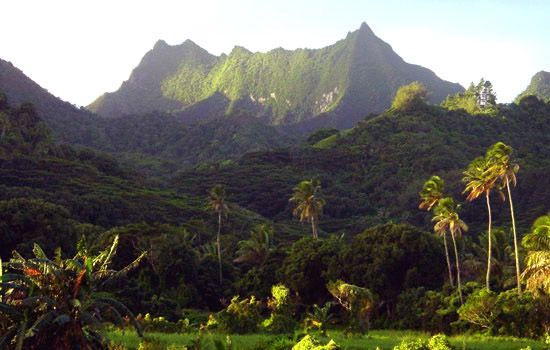
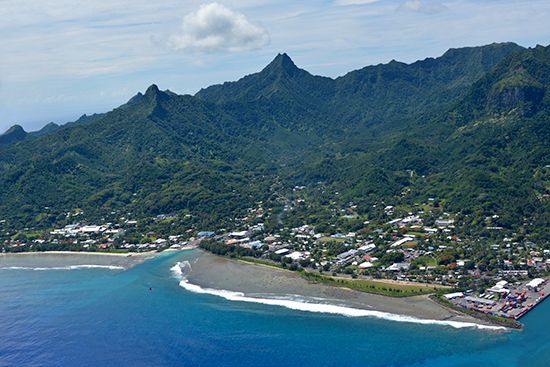
- Natural Geography: The island is defined by its volcanic, rugged interior, including Te Manga, and is fringed by a coral reef.1
What is the history of Rarotonga’s settlement and its role in Polynesian navigation?
Rarotonga, the largest island in the southern Cook Islands, was first inhabited by Polynesian people around 800 CE. The island bears significant archaeological evidence of this long period of habitation, including marae (temple platforms) and the Ara Metua, an ancient inland pathway that circles the island.
The settlement of Rarotonga is part of the broader history of Polynesian navigation, a culture defined by a mastery of the ocean environment. Polynesians were exceptional mariners who navigated vast distances across the Pacific Ocean using systematic observations of stars, winds, currents, and landforms. Their languages and oral traditions reflect this deep knowledge, containing precise terminology for navigation and direction. These voyagers traveled in large, double-hulled canoes, often carrying plants and animals to establish new settlements.
This navigational expertise allowed for frequent interaction between island groups, facilitating the exchange of goods and cultural practices. Historical accounts often describe these migrations and the subsequent development of island cultures, underscoring the profound connection between Polynesian social organization, religion, and the maritime environment.
How does the traditional Polynesian system of land ownership work on Rarotonga?
In traditional Polynesian societies, land ownership was complex and deeply tied to social organization. While individuals held personal property like tools and clothing, land was often vested in extended families or descent groups to be used for the common good. In some regions, this system faced pressure as social structures evolved, sometimes leading to the consolidation of land under powerful chiefs.9
On Rarotonga, the management of land remains a significant cultural matter. Today, the House of Ariki (a council of hereditary high chiefs) serves an advisory role to the government specifically regarding traditional customs and land tenure.10
The physical landscape of Rarotonga influences how this land is utilized. The island features a rugged, mountainous interior and a coastal ring of fertile volcanic soil, which has historically supported farming. While many Cook Islanders live in villages, it is common on Rarotonga for residents to live directly on their farms.711
What is the geographical location and size of Rarotonga?
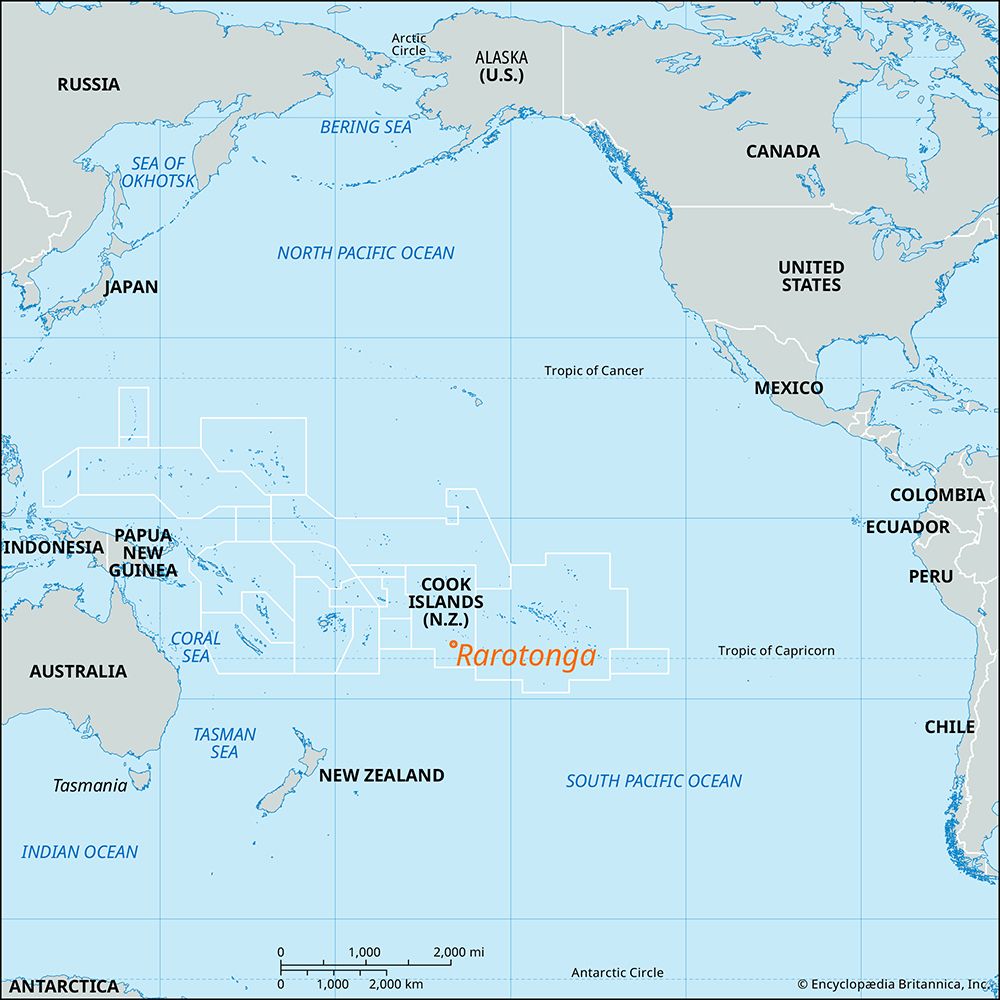
Rarotonga is the largest island in the southern group of the Cook Islands, situated in the South Pacific Ocean approximately 2,100 miles (3,400 km) northeast of New Zealand.1
The island covers an area of 25.9 square miles (67.1 square km). It is volcanic in origin, characterized by a rugged interior that rises to an elevation of 2,139 feet (652 metres) at Te Manga.1 This mountainous core is surrounded by a plain—an ancient raised fringing coral reef covered with sediment—and the entire island is fringed by a living coral reef.1
Sources
- Rarotonga — Encyclopædia Britannica
- Cook Islands - Services, finance, and taxation — Encyclopædia Britannica
- Avarua — Encyclopædia Britannica
- Easter Island - Economy — Encyclopædia Britannica
- Cook Islands - History of the Cook Islands — Encyclopædia Britannica
- history of New Zealand - Discovery of New Zealand — Encyclopædia Britannica
- Cook Islands - Settlement patterns — Encyclopædia Britannica
- Polynesian culture - Traditional Polynesia — Encyclopædia Britannica
- Cook Islands - Soils — Encyclopædia Britannica
- Polynesian culture - Property and exchange — Encyclopædia Britannica
- Cook Islands - Constitutional framework — Encyclopædia Britannica
Published on · 3 min read